

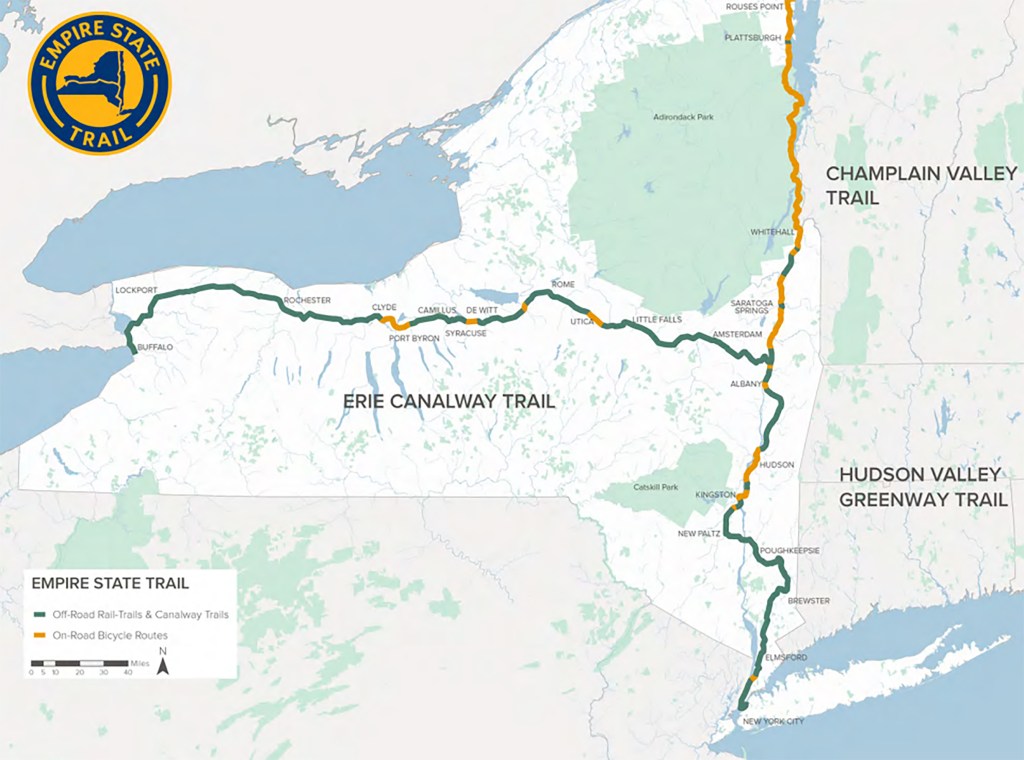
Last month, Parks & Trails New York released a landmark report on the economic impact of the Empire State Trail. Its findings should permanently change how New York City and New York State think about greenways, trails, and public investment
For too long, greenways have been treated as pleasant amenities. They were seen as nice places to bike, walk, or exercise, but separate from the “real” economy. The new data makes clear that era is over
The Empire State Trail is a 750-mile network connecting New York City to Canada and Albany to Buffalo. It generates $1.87 billion in annual economic output, supports nearly 9,700 jobs, produces more than $206 million in state and local tax revenue, and attracts nearly 10 million visits each year. Every public dollar invested returns more than five dollars in economic activity. These are infrastructure numbers, not recreation numbers
In many ways, New York City showed the way. Under former Mayor Mike Bloomberg, the city began investing aggressively in waterfronts, parks, greenways, cycling infrastructure, and public space. Those investments reflected a simple but powerful insight: people increasingly choose where to live, work, and invest based on quality of life. Talent flows toward places where people actually want to be
As president and CEO of the New York City Economic Development Corp., I saw firsthand how transformative that philosophy could be. Projects such as the Hudson River Greenway, Brooklyn Waterfront Greenway, Harlem River Greenway, and Jamaica Bay Greenway were never merely recreational amenities. They were long-term investments in mobility, public health, tourism, resilience, and economic growth
When planned well, greenways coexist and complement pedestrians, cars, and trucks. All New Yorkers see this along Hudson River Park, where one of the nation’s busiest multi-use greenways coexists with a major urban roadway and thriving waterfront destinations
More than 20 years ago, the greenway around the Brooklyn Navy Yard became wildly popular, integrating pedestrians, bicycles and trucks around the perimeter of one of the country’s most successful industrial parks. Well-designed greenways strengthen mobility for everyone while supporting vibrant local economies
Today, Mayor Mamdani is signaling that New York intends to continue that tradition. His recent commitment to move forward with the Queensway, complete the long-awaited Harlem River Greenway, and ensure that it is safe and accessible for the communities it serves is exactly the kind of ambitious investment this report supports
Together, these projects will bring safe, connected trail infrastructure to hundreds of thousands of New Yorkers while strengthening neighborhoods, reconnecting communities to their waterfronts, expanding mobility options, and creating new economic opportunities for surrounding businesses
Gov. Hochul also deserves credit for building on the success of the Empire State Trail and recognizing the economic value of connected trail and greenway networks. Her administration has invested in closing critical gaps, improving connectivity, and expanding access to outdoor recreation across the state
Through the Environmental Bond Act and other initiatives, New York has committed substantial funding to transformative projects such as the Adirondack Rail Trail and other regionally significant greenway investments. Those efforts reflect an understanding that trails and greenways are not simply recreational amenities. They are investments in economic development, quality of life, and community connectivity
The Empire State Trail provides powerful evidence that this strategy works. For many New Yorkers, the trail is not some distant upstate attraction. It begins right here in the city. The New York City portion runs from Van Cortlandt Park in the Bronx down Manhattan’s West Side along the Manhattan Waterfront Greenway to Battery Park. Every day, New Yorkers use that corridor to commute, exercise, access parks and waterfronts, and move through the city without a car
The numbers are extraordinary. Just 17 miles of the Hudson River Greenway from the Bronx to the Battery account for more than 3.4 million annual visits and generate more than $687 million in economic output each year, making it one of the most successful urban greenways anywhere in America
Anyone who has spent time on the Greenway understands why. It connects neighborhoods to the waterfront, residents to jobs, visitors to local businesses, and millions of New Yorkers to public space that improves daily life
That connection between quality of life and economic competitiveness has only grown stronger. Employers compete for talent, cities compete for residents, and workers increasingly choose communities that offer access to parks, waterfronts, outdoor recreation, and alternatives to car-dependent travel
The report also highlights an important lesson for the future: connectivity matters. Off-road greenways generate four times the economic impact of on-road segments. The safer and more seamless the network becomes, the greater its value
That finding points toward a clear agenda. First, New York City and New York State should fully fund and complete the Queensway while also completing the Harlem River Greenway and ensuring that every segment is safe, welcoming, and fully accessible to the neighborhoods it is intended to serve. The economic evidence is overwhelming, and the potential benefits for Queens, the Bronx, Upper Manhattan, and the city as a whole are enormous
Second, the city should accelerate efforts to close the remaining gaps in the five-borough greenway network. We have seen what happens when corridors are connected, and we should finish the job
Third, New York State should begin planning the next great chapter of the Empire State Trail: a Long Island Greenway extending the network from Queens to Montauk. The Empire State Trail should not end in Manhattan
A continuous Long Island Greenway would connect millions of residents to downtowns, parks, beaches, waterfronts, transit hubs, and local businesses. It would expand tourism, strengthen local economies, improve mobility, and create one of the great recreational and transportation corridors in the United States
These are infrastructure investments, not recreation projects. They support local businesses, improve public health, increase property values, attract visitors, strengthen neighborhoods, and help communities compete for talent and investment
New York helped pioneer that vision. The Empire State Trail has now proven it works. The next step is to build on that success from Van Cortlandt Park to Battery Park, from Queens to Montauk, and across New York State
Kimball is the former president and CEO of the New York City Economic Development Corp
