


After working more than six years under the radar, the startup Hemispheric announced Wednesday that it has raised $52 million in three rounds as it builds an artificial intelligence model that deciphers the activity of the brain
Hemispheric is led by CEO Hagai Lalazar, a brain researcher and serial developer, and Chief Technology Officer Gidi Littwin, an AI researcher and a founder of RealFace, an AI software company bought by Apple in 2017. Littwin is a co-holder of a patent for the key component used by Apple’s Face ID facial recognition system
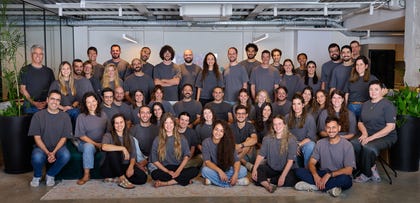
Littwin and Lalazar met seven years ago when Littwin was about to leave the U.S. tech giant. Hemispheric now employs 112 people in brain science, artificial intelligence, software engineering, electronics and medical systems
“The brain is the most important organ in the body and the one that causes the most morbidity, but the only way to diagnose the brain’s health is to ask you how you’re feeling, with no technological solution that can decipher the brain’s signals through noninvasive sensors,” Lalazar says
His and Littwin’s biggest problem was the paucity of data for feeding such an AI model, so Hemispheric set up labs in Israel, the United States and the Philippines starting in 2019
There, volunteers have their brain activity recorded for 15 minutes, after they don a light helmet to take an electroencephalogram, an EEG, the brain’s version of an electrocardiogram. Hemispheric now has more than 250,000 hours of EEG data from over 100,000 participants
“The brain speaks in a very complicated electrical language, and though large language models practice on all the information on the internet, there was no database of brain activity for a model to practice on,” Littwin says. “In the labs we set up, we obtained data from over 1,000 people a week.”
The company’s model, called Descartes, took 6 billion parameters into account in training its model. According to Hemispheric, the results can help diagnose ailments such as depression, post-traumatic stress disorder, Parkinson’s disease and early signs of cognitive deterioration
“It’s something that six and a half years ago I wasn’t sure was even possible,” Lalazar says
Currently, such situations can only be diagnosed through questionnaires or a doctor’s subjective assessment of a patient’s behavior
Hemispheric is already selling its knowhow to drug companies, which use it in their own research. After receiving regulatory approval, Hemispheric hopes its AI model will become a tool in doctors’ clinics, so patients can take a five- to 10-minute EEG and receive a report on their brain’s electrical activity
“The EEG is a tool that’s been around for 100 years, but it’s almost unusable. It produces a collection of waves that are very hard to understand … there are very big differences in this electrical activity from person to person,” Littwin says. “No two brains are the same. AI translates this complexity into a language we can work with.”
Investors behind Hemispheric include Henko Partners, OneMind/Awareness Capital, Arkin Capital, the Artofin Venture Capital Fund, L Catterton and Protocol Labs
