

Taxpayer group warns New York’s AI data center moratorium could cost jobs and investment
byTAYLOR FISHMAN | The National News Desk
Thu, July 16, 2026 at 10:03 AM
 4VIEW ALL PHOTOS
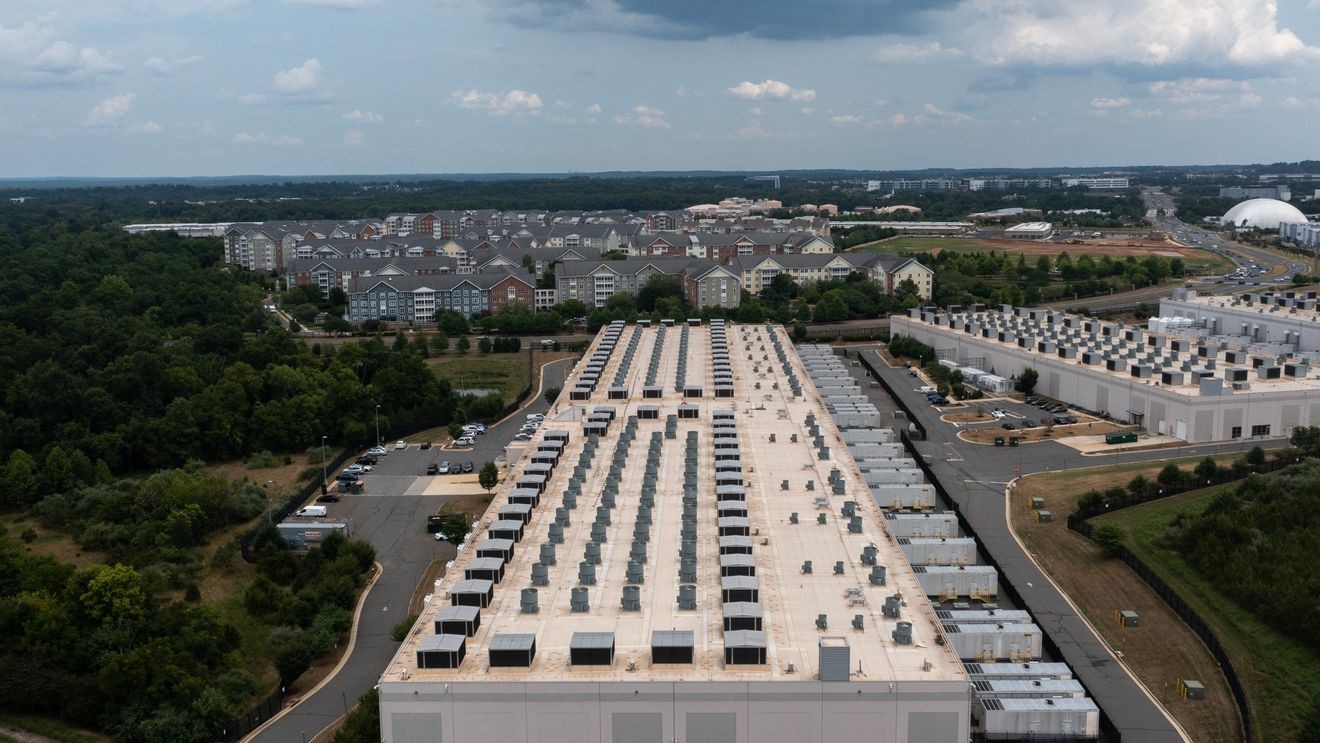
FILE – In an aerial view, the IAD71 Amazon Web Services data center is shown on July 17, 2024, in Ashburn, Virginia. (Photo by Nathan Howard/Getty Images)
New York has become the first state to impose a moratorium on new hyperscale artificial intelligence data center projects, a move supporters say is necessary to protect the electric grid and consumers, but critics argue could send billions of dollars in investment elsewhere
Speaking with The National News Desk, Brandon Arnold, executive vice president of the National Taxpayers Union, said he believes the state’s decision could have significant economic consequences
“I think the critics of this moratorium certainly have the better argument,” Arnold said
New York officials have said the temporary pause will allow the state to develop policies addressing electricity demand, environmental concerns, and infrastructure needs before approving additional large-scale AI facilities
Arnold argued that banning data centers because they require large amounts of electricity sets a troubling precedent
“You wouldn’t ban new automobile factories because they use a lot of electricity,” he said. “You wouldn’t implement a statewide ban on new farms because they use a lot of water.”
He described the moratorium as “foolish, knee-jerk, reactionary politics” that overlooks the broader economic and technological implications
“These new data centers are going to be built somewhere,” Arnold said. “Do we want them built here in the United States, or do we want them built in China?”
Arnold said the competition to build AI infrastructure is closely tied to America’s ability to remain competitive in emerging technologies such as artificial intelligence and quantum computing
One of the primary concerns surrounding data centers is their substantial demand for electricity, leading some residents to worry that additional facilities could drive up utility bills
Arnold acknowledged that data centers require significant amounts of power but argued that electricity prices are influenced by a range of factors beyond AI infrastructure
“They place additional demand on the grid,” he said. “One of the reasons we need to upgrade our electrical infrastructure is to make it more accommodating for data centers and other power-thirsty technologies.”
According to Arnold, research conducted by the National Taxpayers Union compared electricity prices in the ten states with the largest concentration of data centers to prices elsewhere in the country
“We looked at the ten states with the most data centers,” he said. “Guess what? Prices are about the same.”
While he believes infrastructure upgrades are necessary, Arnold said concerns that data centers alone will dramatically increase electricity prices are overstated
“I think they’re overblown,” he said
Arnold also pointed to Northern Virginia as an example of the economic impact large-scale data center development can have on local communities
Loudoun County, Virginia, widely regarded as one of the world’s largest concentrations of data centers, generates substantial tax revenue from the industry
“They are generating $1.3 billion annually in property tax revenue due to just the data centers that have been built,” Arnold said
He said those revenues help fund schools, public safety, infrastructure improvements, and in some cases reduce pressure on local tax rates
In addition to long-term tax revenue, Arnold said construction of a single hyperscale data center can create approximately 1,000 construction jobs before transitioning to permanent operational positions
Still, Arnold acknowledged that local communities should ensure companies contribute to the infrastructure necessary to support new developments
“What should local leaders be requiring?” he said. “Common-sense solutions.”
He noted that many companies already invest in on-site power generation and other improvements designed to reduce strain on the public electric grid
“Many data centers are doing that,” Arnold said. “They’re building on-site generation for power that alley grid.”
Rather than discouraging development, Arnold urged communities to negotiate agreements that protect taxpayers while allowing projects to move forward
“Welcome them to your community,” he said. “Don’t put up these ‘not wanted’ signs.”
He argued that attracting AI infrastructure could strengthen both local economies and America’s broader technological competitiveness
“Engage in some sort of common-sense solution that’s going to benefit taxpayers,” Arnold said, “and certainly benefit this country as we seek to get a leg up over China on AI and quantum technology.”
