

‘Not up for grabs’: Albanese establishes AI office and vows to protect Australian creatives from copyright ‘theft’
PM lays out plan for datacentre development and rejects prospect tech companies will be given free use of Australian data
Follow our Australia news live blog for latest updates
Get our breaking news email, free app or daily news podcast
Anthony Albanese has promised “the strongest possible protection” for Australian creatives against misuse of their work by artificial intelligence models, warning it would be “theft” if writers, artists and musicians didn’t have control of their work or receive payment for its use
Amid growing community concern about large energy-intensive datacentres, the federal government will also set strict new rules for the facilities, including where they can be built, that they shouldn’t compete for land with housing, their power and water use, and that they don’t increase electricity prices for consumers
AI may be the toughest challenge Anthony Albanese faces this term. Guardrails are urgently needed | Peter Lewis
Read more
In a major speech on AI, the prime minister announced the establishment of an office of AI and rejected the prospect of large companies like OpenAI and Anthropic being given free use of Australian data – a development warmly welcomed by creatives including the Australian Recording Industry Association (Aria) – but questions remain about how the government will modernise copyright laws and regulate datacentres
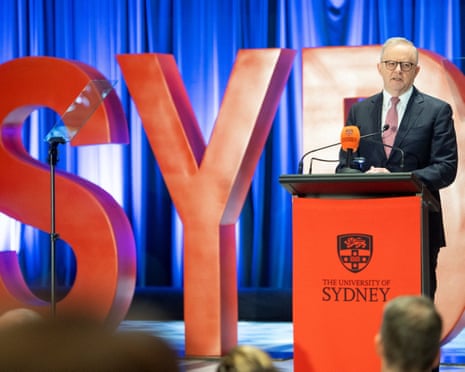
“Let me make this crystal clear: not everything produced in Australia is up for grabs,” Albanese said on Wednesday
“Australian writers, musicians, artists and journalists must retain ownership and control of their work. Our laws will spell that out, plain as day.”
Sign up for the Breaking News Australia email
Labor has long ruled out giving a text and data mining exemption allowing AI firms to train their large language models on Australian content without compensation to creators, but there has been lobbying from big tech and an industry proposal for special copyright exemptions
Cabinet discussions on copyright reforms are continuing, with a diversity of views among senior ministers, but Albanese’s speech was the strongest assurance yet that journalists, musicians, artists and writers would be protected in the age of AI
“No company should use Australian books, music, art or news to build or train AI without the artist’s control. That includes the artist’s control of the price and value of their work,” Albanese said
Annabelle Herd, CEO of Aria, was relieved to hear Albanese’s guarantees. She said groups like hers were keen to sign licensing deals with AI companies to ensure artists were fairly compensated for the use of their work
“We don’t know exactly what most of these AI companies want, they haven’t made a public case about what the problem is, but there isn’t one,” she told Guardian Australia
“[Albanese’s speech] should be a very strong message to the AI companies, they should pick up the phone and start licensing … we are very good and efficient at licensing at scale
“We’d like get on with it, not be stuck in this ongoing no man’s land.”
Jeff Bleich, Anthropic’s general counsel, said the company “respect[s] the process articulated by the prime minister today for establishing Australia’s AI framework and take seriously Anthropic’s responsibility to meet the terms set out by the Australian government for AI developers”
Ahead of meetings with senior cabinet ministers earlier this year, Anthropic cited Australia’s policy uncertainty as a major impediment to new investments in the country
Microsoft Australia’s president, Jane Livesey, said users would embrace the technology if “people trust that AI is safe and well-governed”
skip past newsletter promotion
after newsletter promotion
Comparing AI to the rise of social media, Albanese said governments should have placed tougher rules on tech companies when online harms first became known. The government would legislate a set of binding standards for AI companies and datacentres, building on existing expectations around energy usage, he said
That framework is intended to help fast-track decisions around major investments and construction, as well as set nationally consistent mandatory rules for how and where such centres can be built
The Business Council of Australia’s CEO, Bran Black, welcomed the speech but warned against regulation going “too far” or being “too prescriptive” in case it stifled business
“We don’t want to see ourselves get out of step with international counterparts, and that as a consequence, we would lose investment,” he said after the speech
The changes will not be legislated until early next year. Some experts have criticised the government for not moving faster to regulate a rapidly growing sector – former industry minister Ed Husic, speaking on ABC radio before Albanese’s speech, claimed the Australian government had delivered “a faster response to dangerous strawberries as opposed to the dangers of high-risk AI”
“We can’t have two terms of parliament pass without having some concrete mandated guardrails.”
A critical point of tension in government deliberations has been balancing the potential economic benefits of AI companies with rising voter concerns about suburban datacentres and a low level of community trust in the new technology. Labor MPs including Sam Rae, Dan Repacholi and Alice Jordan-Baird have conceded there are concerns in their electorates about local datacentre development
Albanese said the national standards would set rules for the location and energy use of datacentres, declaring: “We have more than enough room for new datacentres, without them competing with new housing
“We will create a legal obligation for the next generation of large-scale datacentres to underwrite new power supply. To pay their full share of grid connection, so no costs are passed on to homes or businesses. And to put at least as much energy into our grid as they take out of it.”
Datacentres would also be required to generate renewable energy , minimise water use and maximise energy efficiency
Belinda Dennett, the CEO of Data Centres Australia, said she was pleased to hear Albanese back the economic benefits for more AI investment. She was also unfazed by the new standards, saying datacentres were already pursuing renewables and sustainability
Explore more on these topicsShare
Reuse this content
