

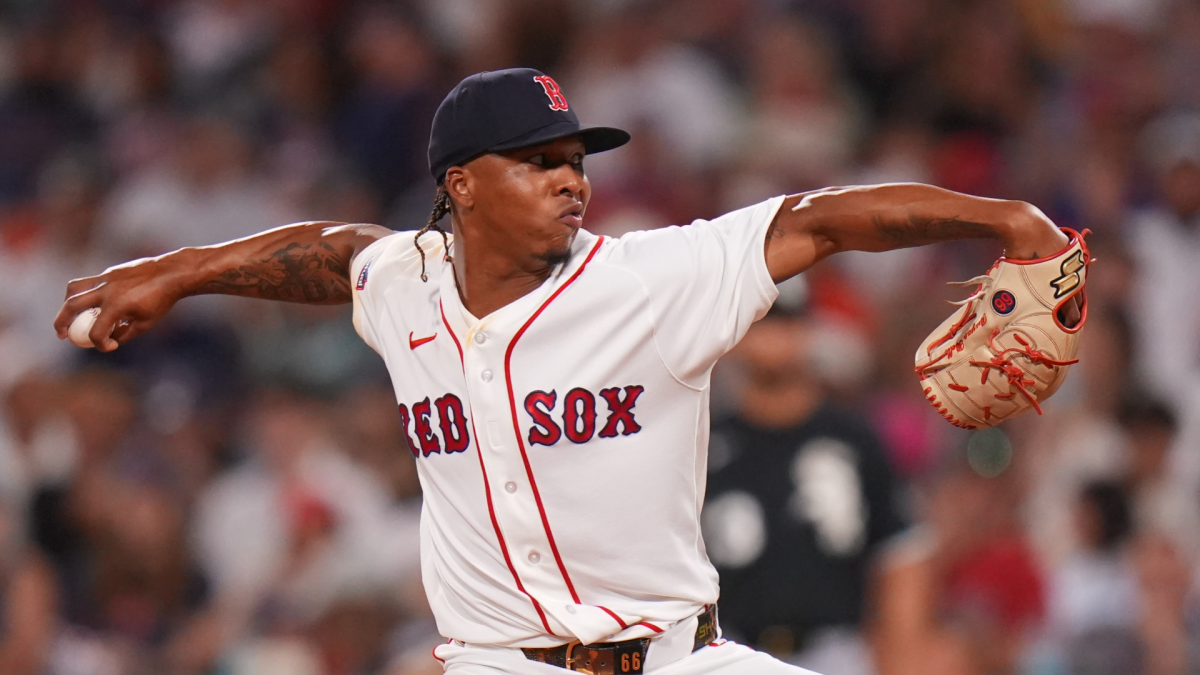
The trade deadline has come and gone and dozens of players are still getting used to new uniforms. Now that all the midsummer pomp and circumstance (draft, All-Star Game, trade deadline, etc.) is in the rearview mirror, it’s time to focus on the actual baseball being played on the field. We’re in the dog days of August now. Soon, the postseason and award races will really heat up
Here now are three things going on across the league that are worth keeping an eye on the rest of the season

Brayan Bello thriving in new role
Brayan BelloBOS • RP • #66
ERA4.69
WHIP1.40
IP88.1
BB28
K67
View Profile
Much like the Red Sox as a team, it has been a tale of two seasons for right-hander Brayan Bello. The 27-year-old opened the season as Boston’s No. 5 starter, pitched terribly, then got demoted to Triple-A in June. He came back up just before the All-Star break and has been working as a bulk reliever since, and he’s been terrific. On Monday night, he allowed one run in 4 ⅓ innings
“It’s been great,” interim manager Chad Tracy said about Bello after Monday’s game . “I think obviously it was well documented how the beginning of the year went for him. The frustrations and that he believes he’s a starter. We still think that. But he’s in a really good place as far as accepting the role and knowing that he’s not only accepting the role, but he’s going out there and helping us win in that role, and that’s a good place for him to be.”
Bello’s splits are drastic. As a starter, he has a 10.35 ERA with hideous under-the-hood numbers (7.34 FIP and 8.44 expected ERA) in 35 ⅔ innings. That’s 35 ⅔ innings in eight starts, or 4.5 innings per start. As a reliever, Bello has pitched to a 0.85 ERA in 52 ⅔ innings in 11 games (4.8 innings per game). The under-the-hood numbers are way better as well (2.19 ERA and 3.33 xERA)
There is not one single reason Bello has been more effective as a bulk reliever than as a traditional starter. He’s replaced a few cutters and curveballs with changeups and sweepers, though not in a significant way that suggests wholesale approach changes. He’s added less than 1 mph to his sinker (his primary fastball). His locations (middle-middle rate, edge rate, etc.) are unchanged
I don’t want to call it good luck, but there are some things going Bello’s way as a reliever that weren’t going his way as a starter. Things that aren’t 100% in Bello’s control that nonetheless affect his performance. Some numbers:
Batting average on ground balls | .163 | .241 | |
Home runs per fly ball | 23.3% | 3.2% | 11.7% |
Strand rate | 50.0% | 84.6% | 72.4% |
In a full season, even the worst pitchers in baseball won’t allow a .319 average on ground balls or nearly a quarter of their fly balls to leave the yard or half their baserunners to score, yet Bello did that as a starter. At the same time, the best pitchers won’t hold hitters to a .163 average on grounders or a 3.2% HR/FB rate. Those numbers are unsustainably low (the 84.6% strand rate isn’t)
Part of Bello’s success is not being asked to go through the lineup a third time in his bulk reliever role. In 11 relief appearances, he’s faced 29 batters a third time. In eight starts, he faced 41 batters a third time, and those 41 batters hammered him (.429/.463/.686). The bulk relief role has put Bello in a better position to succeed. He’s getting more favorable matchups, which absolutely helps
Confidence and comfort are real things that could (and may) be impacting Bello’s performance. There haven’t been major changes to his arsenal as a reliever, though, nor is he locating in a way he wasn’t as a starter. He’s gotten some breaks as a reliever that he didn’t get as a starter, specifically his infielders turning ground balls into outs, plus he’s seeing fewer batters. It all helps
Whatever the reason, Bello is thriving in his new role and he’s elevated what was already one of the best and deepest pitching staffs in baseball. The Red Sox owe him $44.5 million from 2027-29, and surely they want him back in their rotation at some point, but right now, Bello fits the team best as this shutdown multi-inning reliever. He’s become quite a weapon for Tracy
“I feel happy and proud to be able to help the team every time they give me the ball,” Bello said , “and I’m able to perform and give my team a chance to win.”

How Noah Cameron turned his season around
Noah CameronKC • SP • #65
ERA4.16
WHIP1.22
IP138.1
BB43
K126
View Profile
A year ago, Royals lefty Noah Cameron stormed to a fourth-place finish in the American League Rookie of the Year voting thanks to a 2.99 ERA in 24 starts and 138 ⅓ innings. There were some under-the-hood indicators that Cameron hadn’t pitched quite as well as his ERA suggested (4.18 ERA and 4.08 expected ERA), though that stuff pointed toward a league-average pitcher, not a bad one
Cameron did not have nearly as much success early on this season. He pitched to a 5.27 ERA in his first 19 starts and allowed at least five runs in seven of those 19 starts. There was some speculation the Royals could demote Cameron to Triple-A for a reset, though injuries left them short on arms, so he remained with the big-league team and kept making his starts
That has proven to be a wise decision, even if the Royals are out of the postseason race. Cameron has been sensational in his last five games. He’s allowed five runs total in those five games (four runs in one game), and three times he completed at least eight innings. Cameron actually leads the AL with three eight-inning starts, and they’ve all come within his last four games
Last time out, Cameron took a perfect game into the sixth inning and a no-hitter into the seventh inning against an admittedly weak Angels lineup. He struck out eight in a one-hit shutout. It was the first one-hitter by a Royal since Zack Greinke in 2009
Cameron has made several changes to turn his season around. First, he’s cut back on his low-90s four-seam fastball, particularly in two-strike counts. He’s replaced those four-seamers with sliders, mostly, but also some sinkers and changeups. Cameron is a six-pitch guy (four-seamer, sinker, cutter, changeup, curveball, slider) and he’s stopped throwing his worst pitch
Stuff+ grades pitches based on their characteristics (velocity, spin, movement, etc.) and, similar to OPS+ and ERA+, it is indexed to 100. So 100 is average, and the higher the number, the better the pitch quality. Here are Cameron’s Stuff+ grades and usage rates:
Four-seamer | 89 | 27.7% | 17.6% |
Sinker | 92 | 4.0% | 4.5% |
Cutter | 90 | 20.2% | 20.7% |
Changeup | 103 | 21.0% | 21.7% |
Curveball | 107 | 17.3% | 16.9% |
Slider | 103 | 9.8% | 18.6% |
The four-seam fastball doesn’t grade out well analytically, plus hitters hit it hard. It sounds easy and obvious, but you’d be surprised how many pitchers resist the “throw your worst pitch less” idea, especially when it’s their fastball. Cameron, to his credit, bought into the adjustment and is on a major hot streak right now. He’s an AL Pitcher of the Month candidate for August
In addition to throwing fewer fastballs, Cameron took control of his outings five games ago and started calling his own pitchesy might not allow a pitcher to call his own game if it “was a different guy who didn’t do his homework like Noah does,” but Cameron is prepared, so the Royals have let him take the reins
“It feels like I’m playing a video game now more than ever because I’m literally clicking buttons and calling the pitch. Kind of feels like MLB The Show,” Cameron told MLB.com. “… The style isn’t changing. It really is just more mindset for me. I think it’s just when I call a pitch now, it’s just more quality. When I call it, I already have good thoughts and confidence in my head of the pitch.”
Not much has gone right this season for the Royals, who have the AL’s second-worst run differential and are headed for a lottery draft pick. Cameron won’t pitch this well forever, but getting his season back on the rails is a win for the team in 2027 and beyond. He again looks like a keeper and rotation mainstay. As recently as a month ago, that was in question.
Where has the offense gone in August?
It has been a weird season for offense. The baseball itself seems to have changed, and instead of offense peaking during the hot summer months, it has taken a step back in August. Power and slugging percentage in particular have slipped. Fly balls are not leaving the park this month as often as they did in June and July, and even in previous Augusts
Here are the home run per fly ball numbers going into Tuesday, with 2025 for comparison:
April | 10.9% | 11.0% |
May | 11.2% | 10.8% |
June | 11.7% | 12.9% |
July | 12.2% | 12.4% |
August | 12.8% | 11.4% |
September | 12.4% | ??? |
The individual rates fluctuate each year, but 2025 followed the usual pattern for offense. It’s down in April, then it picks up in May and June, then it’s at its highest in July and August before cooling down a bit in September. This season, offense, particularly power production, peaked in June and has dipped in August. The August home run rate is closer to April’s than July’s. That is … odd
It could just be that 2026 is an outlier season for offense, and we’ll look back in a few years and say, “Huh, what was that about?” It definitely is not great when offense trends down, though. The MLB batting average sits in the .240s, there are lots of strikeouts and walks, and there are too many quiet games that fail to entertain. The more offense, the better the product, and it’s down in August
