

The Economic Club of New York, a nonprofit that serves as one of the city’s highest-profile discussion forums and has hosted American presidents and foreign heads of state as well as countless business leaders, was founded in 1907. Chicago, Detroit and Boston formed their own versions in the 1920s and 1930s, and Washington, D.C. welcomed one in the 1980s.
But until recently Dallas — a city with a long history of business prominence that’s also increasingly at the forefront of the 21st-century American economy — never had its own.
“We so needed this,” said Michael Levy, the CEO of Crow Holdings and board chair of the new Economic Club of Dallas. “This city is so primed for this conversation about growth in commerce and welcoming all sorts of people in.”
Article continues below this ad
Dallas’ new club, which came together last year after an effort led by Levy and three others, now counts dozens of North Texas’ biggest business and economic names as founding members and has welcomed speakers including U.S. Treasury Secretary Scott Bessent and Reza Pahlavi, the exiled former crown prince of Iran.
In June, the club named Luisa del Rosal, an SMU faculty member whose professional background ranges from public policy and politics to small business ownership, as its new executive director as it embarks on an ambitious growth push. “She’s the one who had the best ideas and the best energy,” said Levy.
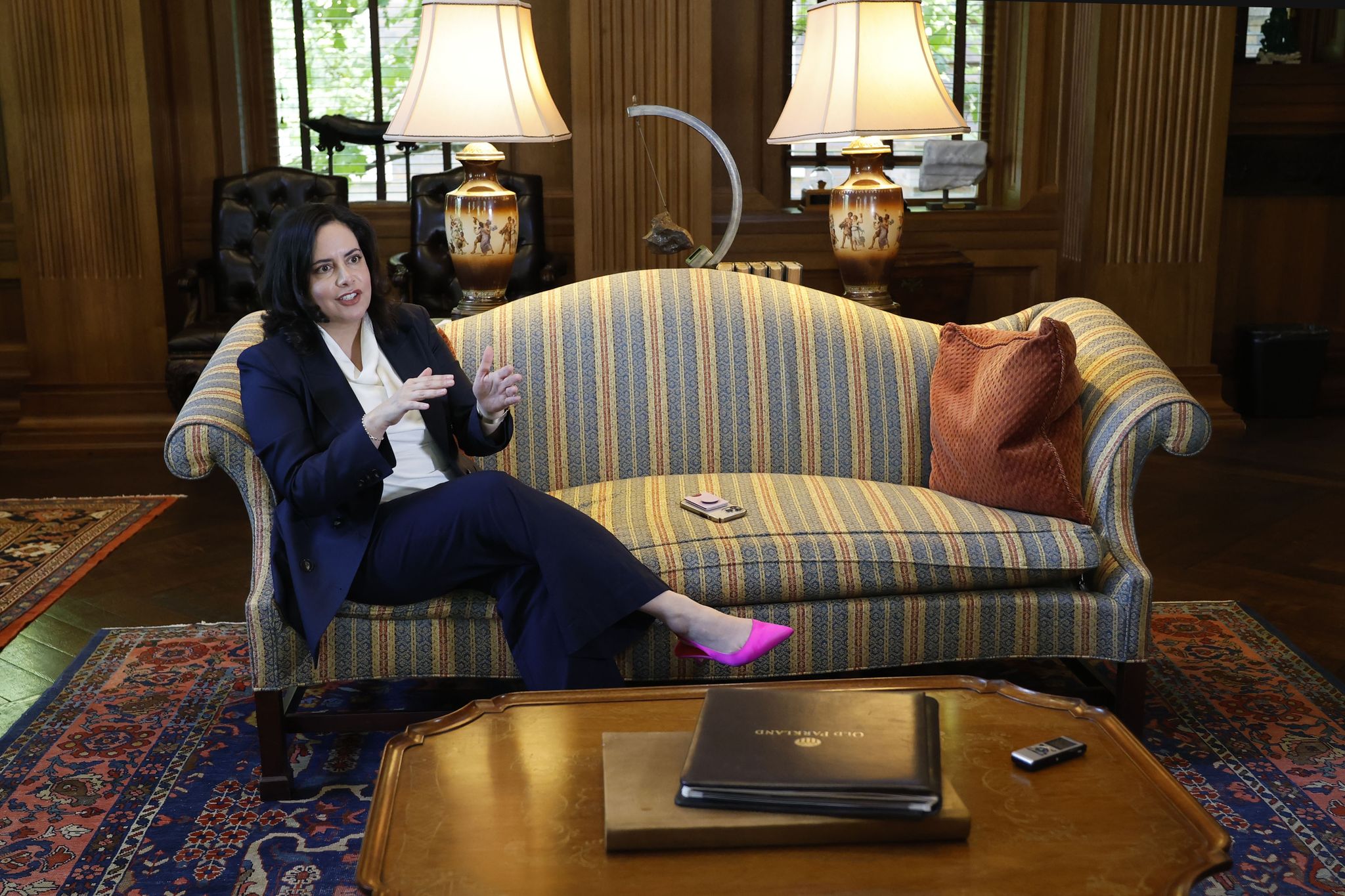
The Dallas Morning News recently sat down with del Rosal for a wide-ranging conversation inside Old Parkland, the historic Dallas business campus that serves as the club’s home. This interview has been edited for length and clarity.
I think a lot of people aren’t all that familiar with The Economic Club of Dallas. Can you introduce the organization a little bit? What does the group do?
People think about, ‘Oh, there’s a lot of places to network’ — that’s not it. [The Economic Club] is a place where we convene conversations, so leaders can think and learn. I tell people all the time: This is really about putting the “club” back in club. We are having invitation-only members that want to come into our forums. But the interesting thing is the most interesting person that might be in that conversation might not be the speaker, but the person sitting next to you. It’s all about being in this marketplace of ideas — all ideas are welcome to the table, for our leaders to come learn about something different that might impact their business, society, etc..
Article continues below this ad
Ok, so you’re in the top seat now. What are some of the things that are on your mind?
One, I want people to know about us, right? So people understand what our purpose is. I want to make sure we are bringing those meaningful conversations to Dallas and the region in a way that also platforms our region. Sometimes I say — even though Dallas, people don’t think about it as a major place, they should. We’re a place where, you know, completely ordinary people with nothing but concrete do extraordinary things. So hosting the type of conversations that put Dallas on the map, that remind people why Dallas is a powerhouse, that again tells the story of us being the fastest growing region in the nation, in the world. That’s impressive, and Dallas is at the center of it
What do you think about the downtown Dallas situation? AT&T’s moving out, Comerica. The Mavs, the Stars, you know, the whole thing.
I think there’s opportunity for growth at the end. To me, most important is: We have to do what’s best for the city, for the business community and for its citizens. I don’t really have an opinion because I think it’ll play out in the best way if we all stay engaged in the conversation. But that’s the type of meaningful conversation — like, ‘What do downtowns mean today? What do we understand by ‘cities’? How do we understand regions? Those are the types of things that I might not answer, but I am sure there’s several speakers out there, or business leaders, that can come talk to us about that.
It’s a theme that The Economic Club of Dallas would address.
Article continues below this ad
Yeah it could be, absolutely. But we’re thinking larger than that. I think that downtown is going to figure it out because Dallas always figures it out. We have several members that have moved here from other states specifically because they love the energy and the possibilities of Dallas. They don’t talk about the issues of downtown. They don’t talk about the Mavs. They talk about, ‘This is a place where I can get business done, and that’s why I want to be here.’ So to me, I’m like, ‘Whatever happens downtown is going to be ok, because as long as we’re a place where people want to do business, we’ll figure it out together.’
Do you have any thoughts on how to keep that [bigger growth story] going, or what the region needs to keep this momentum going?
What we’re doing. These salons that we will have, these leaders ultimately will go back with what they learned and hopefully grow their area, get involved civically, figure out big problems together. That’s what we need to be doing. As long as we’re talking to each other and not in silos — I think that happens sometimes in other places and cities. We don’t believe in that. All ideas will be at the table for discussion, for growth, for knowledge. We’re not going to be advocating for anything. It’s really a forum where leaders come to learn and think, and I think that’s super powerful. Where else do you do that?
What do you think are the biggest challenges facing North Texas, in terms of economic prosperity?
I think as we grow we have to do it thoughtfully. So infrastructure. How are we growing? If you’ve driven up in Denton and Collin County, sometimes the roads cannot manage the population explosion. I think data centers and just data, AI — we have to understand how it kind of moves and belongs in our region, so that we create adequate opportunities for business but also that makes sense for the communities that are here. So to me it always comes back to infrastructure. I think everything else can be left to the market. Same with education: How are our schools competing? How are we making sure our schools are the best in the region?
Article continues below this ad
Exactly. It comes down to that — a lot of people move here and can’t believe the affordability. How do we maintain that affordability while giving great services? And I give a lot of kudos to our state leadership for keeping that eye on the ball. And I think as cities we need to continue to see that.
I wanted to get into your own background a little bit. From what I gather, you grew up in a conservative Catholic family in Mexico. How much do you think that sort of shaped you as a professional or as a business leader, economic leader?
I always say Mexico gave me roots, but the U.S. gave me wings. I have the foundation of hard work — my dad always said, if you work hard and, you know, you always continue to be a person of high moral character, which is where my faith comes from, you can do anything. So I always grew up with a sense of, ‘I can do anything,’ I was just in a place where that was not true, right? In Mexico that’s not true. I come here, and I have nothing but opportunity
You have a very good immigrant story, right? Like a textbook immigrant story in a way.
Article continues below this ad
Yeah totally. I still believe it’s the land of opportunity, but I make that opportunity. So to your question: I do think it’s a mix. I think the opportunities were there, but I was willing to seize it, and I was willing to do the things that got me there, get an education, work really hard, speak the language, right? I was willing to work really hard
Before coming back here, I was chief of staff for a member of Congress, then I came home, and my husband and I invested in a franchise — parking lot line striping. Literally watching paint dry. And the first job we had, the guys didn’t show up, the crew didn’t show up. So I told my husband, ‘Ok, we’re taking the day off from work, and you and I are going to learn how to paint a parking lot.’ And so I can tell you very proudly that I can push a line striper. It took us three days to paint a bank, which is absurd. I did a great handicap spot. So to your point, I do think this is a land of opportunity, but I was willing to do whatever it took to take those opportunities.
You’ve also run for office a few times, right?
Two times. I couldn’t quite run up the score.
What I’m interested in there — from campaigning at least, what did you take from that experience? Like how does that impact you moving forward in the broader business world or in terms of economic leadership?
Article continues below this ad
It’s a great question. My favorite part of campaigning, actually, is how many people you meet and the different perspectives. You see some of the assumptions we might make, in beautiful boardrooms like this, about what people might think or want or understand about economics or their daily life or quality of life. So it shaped me to always be open to hearing a different perspective, because there’s value in learning what somebody else thinks, and to always question your assumptions.
And then my favorite part was also to kind of represent a different type of candidate. So I would get sometimes, on Facebook or Instagram, messages where somebody would say, ‘Hey I heard you speak,’ or, ‘I saw your ad.’ I had an ad during my state House race [that talked] about, ‘women in Texas could do anything.’ And I cannot tell you how many women I had contacting me saying, ‘Thank you, because I think we can.’
On that note: Obviously you’re a woman, you’re Latina, you’re a Millennial. How big of a deal is that? Just [being] in North Texas, being in the business world.
I think it is. I will tell you, a lot of times when I’m in rooms, I will be either the only woman, the only Hispanic, the only immigrant. I think it’s a big deal. I think it’s part of who I am. I never let it be everything that I am, though. At the end I’m just Luisa, who has very specific views of the world and is willing to learn. But I do think it means something, and I think it speaks very loudly about the vision of our board. I think they picked me because they thought, ‘She’s got an interesting background and knows how to convene conversations.’ I think it means more for the people that can see themselves in me — like, I hope somebody sees the profile and reads it, somebody that might look and sound like me, or they can identify with a part of my story and say, ‘Well I can do that too.’
I know I’ve asked about [your priorities], but thinking ahead to next year, a couple years, what are you most excited about seeing?
I mean, folks ask me, ‘Why did you decide to leave the comfines of academia and start another startup? One, I have startup energy, as you can hear from my entrepreneur journey through line striping. But I was like, ‘This is a group of leaders who want to learn, and want to be meaningfully engaged. That’s the Dallas energy. Those are the leaders who are here saying, ‘How do we do better? How does our region stay at the top of the conversation?’ Folks that come here, the leaders that come here, will learn from our people as well. They get to see what titans of industry are here in Dallas, and I love that because they’ll take that message [back] to whatever corners of the world and say, ‘Have you heard what’s going on in Dallas?’
