

Japan eyes nonartificial intelligence
Quite aware that it lags in creating AI models, Japan instead aims to gain advantage by speeding up AI’s use in its mighty factories. That requires elevated types of human intelligence
|Kim Kyung-Hoon/Reuters
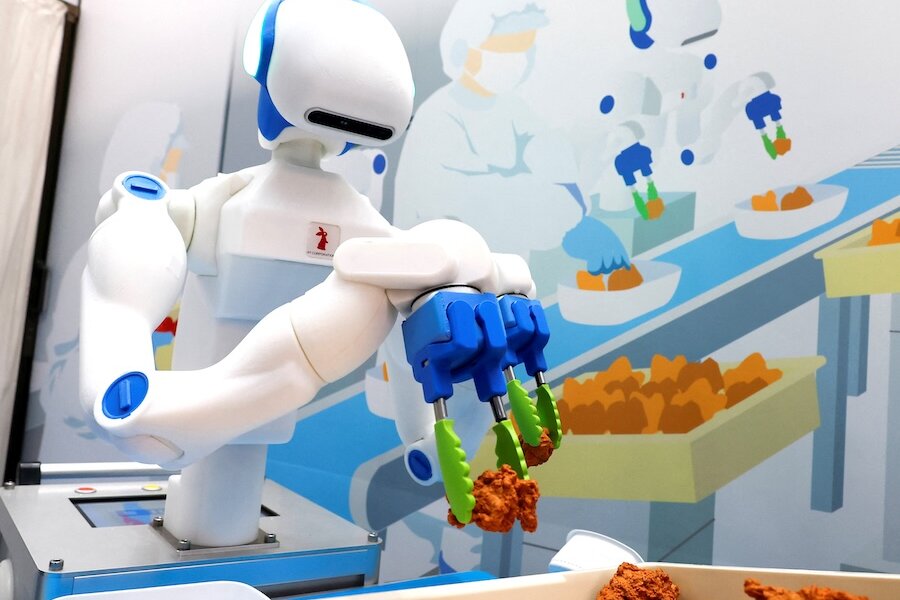
A food-picking robot performs at a food technology expo in Tokyo, Japan, June 2.
Loading
- By
In trying to hatch their own artificial intelligence, many countries are playing catch-up to the two world giants: the United States and China. In recent months, however, Japan has taken a different course. It admits it cannot create the most advanced AI models. Yet it might be the first nation to put AI at the center of a new economic strategy
In late July, Prime Minister Takaichi Sanae’s Cabinet approved a plan to inject $2.3 trillion in public and private investment toward strengthening key industries by 2040, starting with AI and the computer chips that run it. The plan goes beyond merely automating current work, improving efficiencies, cutting costs, or boosting the economy
It would also enhance human creativity and innovation by focusing on applying AI to real-world problems – starting on the factory floor of Japan’s existing world-class manufacturing industries
The plan even sets a high goal of building about 10 million AI robots by 2040. And it promises that Japan would become “the world’s most-friendly country for developing and utilizing AI.”
Experts say the worldwide focus in AI has shifted away from the race to develop more powerful models and toward defining AI’s value in lifting human capabilities to once-unimagined levels
“Organisations must ask not only how AI replaces tasks, but also how future professionals will acquire the judgement, intuition and contextual understanding that cannot be downloaded from a model or generated through a prompt,” wrote two Indian scholars, Anu Singh Lather and Tarun Agarwal, in the Asia Times
Japan’s plan has so far received lukewarm reception. Currently, only about 8.4% of Japanese workers use AI on the job, compared with 50% in the U.S. And, according to a Reuters survey, more than 4 in 5 Japanese firms have yet to fully deploy AI. Deep cultural reasons, such as collective aversion to the reputational risk for companies that suffer an AI failure, have prevented rapid use
Japan firms have also sought profits in hardware more than software. Recognizing this, the government made an agreement to invite 500 highly skilled Indian AI professionals to Japan by 2030 to help in applying the technology. (In the past year, India has overtaken Japan as the world’s fourth-largest economy.)
Japan’s hope is to master the nonlanguage aspects of AI, using it to improve the tactile and spatial capabilities of physical machines. This might help expand humanity’s concepts of intelligence beyond data and words
“AI leadership depends not only on technology and investment,” wrote Maha Matsumura in Al Jazeera, “but also on developing researchers, innovators and the next generation of scientific talent.”
You’ve read of free articles.
Subscribe to continue.
Thank you for contacting The Christian Science Monitor.
