

Federal changes chopping funds that feed area kids
Published 6:00 am Sunday, July 19, 2026
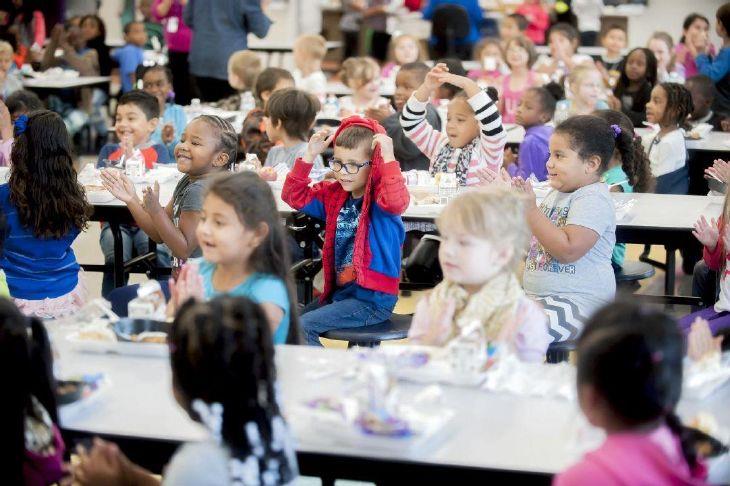
Dishman-McGinnis Elementary School students sing happy birthday Wednesday, September 13, 2017, during a birthday celebration for cafeteria worker Mary Cox Anthony at the school. (Bac Totrong/photo@bgdailynews.com)
Cuts to SNAP, school food programs impacting thousands in region
Targeted by Trump administration initiatives, key funds feeding local children have faced ongoing reductions and cancellations, with the potential for deeper losses — across food stamps, school district meals, farm-to-table foods for students and food assistance for low-income people
In Warren County, 1,232 fewer children received food stamps last month compared to before the One Big Beautiful Bill Act’s biggest changes to the Supplemental Nutrition Assistance Program (SNAP) took effect Nov. 1, according to Kentucky Cabinet for Health and Family Services data from October to June
This reduction took place across all eight southcentral Kentucky counties — 2,098 fewer children across Allen, Barren, Butler, Edmonson, Hart, Logan, Warren and Simpson counties. Statewide, it’s 23,795 fewer children — a reduction of 9.7% — among 42,777 fewer participating households, according to the data
This is slated to cascade into funding losses for public schools’ meal programs because National School Lunch Program reimbursements for breakfast and lunch hinge on participation in low-income assistance programs such as SNAP
School districts have up to four years before incurring the full brunt of these losses, according to the Kentucky Department of Education. However, if the trend doesn’t reverse by then, losses would ensue: For example, Bowling Green Independent School District estimates, ballpark, eventually losing more than $100,000 annually in expenses for feeding students
Child nutrition advocates, including the School Nutrition Association, have warned that the losses also threaten districts’ ability to afford the federal Community Eligibility Provision (CEP) — which enables school districts to offer free breakfasts and lunches to all students
Meanwhile, children and their families are going without food support from three programs because the USDA had suspended what’s known as Commodity Credit Corporation (CCC) funding in March 2025
One was Local Food for Schools (LFS), a farm-to-student assistance program launched in late 2022 as part of COVID relief that was, later, slated for renewal. The USDA then canceled LFS, and some resulting partnerships between local school districts and farms ended due to no longer being financially feasible
The other two suspended funding pots that had helped the regional food bank, Feeding America Kentucky’s Heartland (FAKH), support food pantries — small, volunteer-run groups that school family reries additional proteins thanks to a COVID relief initiative passed alongside LFS called the Local Food Purchase Assistance program (LFPA), which was slated for renewed funding — but the USDA had then canceled it with LFS
And, Warren pantries last fall described seeing less food from FAKH — which further Daily News reporting revealed was due to a $500 million USDA funding suspension in March 2025 of CCC funds within The Emergency Food Assistance Program (TEFAP), an initiative serving low-income individuals
The USDA criticized mentioning the cancellations — which remain in effect
“To reference a fraction of that spending repurposed more than 16 months ago is disingenuous and a slap in the face to the taxpayers funding nearly $385 million per day across 16 charitable nutrition assistance programs housed at the Department,” a USDA spokesperson told the Daily News
The USDA did not respond by press time where that funding was “repurposed” to
However, in December, it had announced $12 billion in CCC funds for farmers. This was framed as addressing Biden-era policy impacts, but it came as tariffs late last year hiked costs for farmers
The changes come as one in six — and one in five children — experience food insecurity in Warren County Kentucky’s average meal cost rose 16% in Kentucky — and about 21% in Warren County — from 2019 to 2023, according to the most recent localized data from the nonprofit Feeding America
“At a time when grocery prices are increasing and Kentucky is less affordable, Kentuckians are losing access to their vital food assistance — and that includes children,” summed up Jessica Klein, the nonprofit Kentucky Economic Policy’s senior policy associate specializing in food assistance and public health, asked about the changes
Localizing kids’ SNAP losses
The average county across the Daily News coverage area has 10.3% fewer children receiving SNAP — with Edmonson County facing the highest percentage loss of 15.8%, followed by Warren at 13.5%, according to the October to June state data
Allen has 84 fewer SNAP-participating kids, the smallest local percentage drop at 7.2%; Barren’s number fell by 265, or 10.2%; Butler’s fell 92, 9.3%; Edmonson’s fell 105; Hart’s fell 95, 9.2%; Logan’s fell 143, 9.8%; and Simpson’s fell 82 kids, 7.5%
Enacted last July by Congressional Republicans, the OBBBA had implemented numerous, staggered changes to SNAP qualifications that make the October-to-June comparison valuable. The most impactful was a Nov. 1 work requirement expansion for so-called able-bodied adults without dependents, according to the nonprofit Kentucky Economic Policy: Notably, to receive SNAP for more than three months in three years, those adults must file paperwork to prove they meet a requirement of working or volunteering at least 80 hours a month.
OBBBA’s supporters have argued that the changes would incentivize work and reduce any waste, fraud or abuse; the USDA similarly told the Daily News that OBBBA holds states accountable for issuing benefits accurately. National analysts opposing the provisions, as well as Klein, have contended that people whose income qualifies for food stamps will fall through the cracks due to administrative red tape to reduce a minute amount of fraud
In the latest data available, less than 1% of SNAP participants were disqualified for fraud in fiscal year 2023, according to the USDA’s SNAP State Activity Report
Policy analysts nationwide, including Feeding Kentucky’s John Cain, have described the changes as the principal driver of the SNAP participation decline. The USDA stated that SNAP participation constantly changes due to factors such as employment moves, program disinterest and other household changes, as multiple states have seen declines before OBBBA — and that the number of SNAP participants “is not representative of any one policy.”
USDA data show that SNAP participation has dropped across all states from the OBBBA’s enactment to March — down more than 4 million people, or 10%, according to an analysis by the nonprofit Center on Budget and Policy Priorities. The last decline as steep in as short a period, besides temporary spikes after natural disasters, occurred almost three decades ago when Congress enacted deep cuts in 1996, according to the center
School meal funding
BGISD is on track to eventually lose somewhere in the ballpark of $116,500 annually because it, like all our area’s school districts, participates in CEP — where a district offers free-of-charge breakfasts and lunches for all students, partially reimbursed by the USDA
Under CEP, the USDA issues the maximum “free” reimbursement rate (above $4 for lunch) or the minimum “free” rate (under $0.50 for lunch) — where the rate depends on a critical variable known as the Identified Student Percentage (ISP). Notably, the ISP comprises the fraction of a student body who are either directly certified for a federal assistance program such as SNAP or Medicaid, or identify as homeless, foster, runaway, migrant or part of a HeadStart program
This ISP — times a CEP multiplier of 1.6 — becomes the percentage of school breakfasts and lunches reimbursed at the maximum rate, while the remainder is reimbursed at the minimum rate, confirmed Cain, director of Feeding Kentucky’s children’s food advocacy campaign KY Kids Eat. Households cannot submit a USDA paper application or state Household Income Form to enhance the ISP, KDE confirmed
So, when SNAP losses reduce ISPs, the CEP-participating school district covers their meals while receiving a drastically reduced USDA reimbursement rate. Districts have several years to incur the loss because students who lose SNAP mid-school year remain in the ISP until the following school year, and districts have up to four years to update their CEP reimbursement percentage
However, if a decreased ISP doesn’t improve by then, that would translate to less federal reimbursement for meals, Cain said
So, at BGISD, the ISP in April 2025 was 58.55% — meaning 93.7% of BGISD’s breakfast and lunch reimbursements came at higher rates, while the remaining 6.3% were reimbursed at the lower rate, BGISD Director of Child Nutrition Dalla Emerson said
This April, the ISP fell to 55.95%, meaning 89.52% of meals would be reimbursed at the greater rate — a 4.16 percentage point decrease — while the remaining 10.5% would get reimbursed at the minimum rate
Given BGISD distributes about 350,000 breakfasts and 500,000 lunches annually, the ISP decline would provide the minimum reimbursement rate for 14,560 breakfasts and 20,800 lunches
Plugging in the USDA’s rate difference of $4.16 apiece for lunch, and a minimum $2.06 apiece for breakfast, that totals a minimum estimated loss of about $116,500 for the number of meals, Emerson confirmed
Unless the trend reverses, this would translate to losses in areas like cafeteria staff and equipment replacements, Emerson said. Changing students’ food directly such as by cutting school meal options would be a last resort, she added
“When we stop making sure that our families have what they need, it’s a domino effect for everything else in our community,” Emerson said. “It adds undue stress to families already struggling, and desperation causes bad decisions.”
Some districts — such as Hardin County and elsewhere nationwide — have recently terminated CEP at some schools due to financial infeasibility, meaning students not directly or categorically certified for free lunch would begin paying for it
But the Daily News confirmed with all our coverage area’s school districts that for them, at least this upcoming school year, CEP will continue
At Logan County Schools, the ISP has decreased slightly atop an already dropping rate, according to data from LCS Director of Food Service Jaime Fair. These past three years, the ISP fell 3 percentage points for its elementary and middle school group, and 4.8 percentage points for the high school group; this past year, it fell 1.9 percentage points across elementary and middle schools, and 0.7 percentage points for the high school group, Fair stated
Because LCS is starting year three of its four-year CEP rate cycle, it won’t affect the district’s reimbursement rate until the 2027-28 school year, Fair added. LCS monitors expenses, operates a commodity program for discounts and maintains training to keep CEP successful, Fair said
But, she added, “in the future if ISP continues to decrease and reimbursement meal rates don’t see a significant increase, then this will put a heavier burden on the program.”
Farm to schools
The USDA’s suspension of renewed funding for Local Food for Schools last year canceled a program that previously helped school districts purchase local farm foods for K-12 students — including across southcentral Kentucky
The USDA in late 2022 had announced $3.2 million for LFS statewide. The Allen, Barren, Caverna, Butler, Logan, Bowling Green and Warren school districts participated, according to the Kentucky Department of Agriculture
The canceled round of LFS funding had been announced by the Biden-era USDA in late 2024 as one of several programs to share a slated $1.13 billion for local and regional food systems
“Unlike the Biden Administration, which funneled billions (…) into short-term programs with no plan for longevity, USDA is prioritizing stable, proven solutions that deliver lasting impact,” the USDA told numerous news outlets following the cancellation. A Daily News follow-up that mentioned the quote elicited no supplementary information about the statement
In the first LFS funding round, BGISD had received $44,932 — providing food that, due to the cancellation, is now financially un included chicken and beef from local farms, with the latter being used in hamburgers and beef stew
Logan County Schools received $27,768, which covered produce from Jackson’s Orchard and Obenchain Farms, Fair said. LCS plans to continue offering local options where possible, such as strawberries it had just begun to offer, she added
But, Fair added, local comes at a higher cost, “so supplements like LFS funding are important.”
“I’ll quote one of the food service directors and say that this program was a game changer,” added Laurie White, this month the outgoing network coordinator for the Kentucky Farm to School Network, a coalition of partners working on farm-to-school activities
“The current administration says (…) they want schools to be serving less processed foods, more whole fresh foods. But then, they cut the program that was doing exactly that.”
Low-income supports
The USDA’s $500 million CCC suspension for emergency food assistanceies — and the regional food bank FAKH provided updated data
Last fall, sharply reduced FAKH food supplies were observed across Warren County pantries, including the Holy Spirit Conference of St. Vincent de Paul, Feeding America Lampkin Park and First Christian Church’s “community grocery” programs. FAKH at the time stated those reductions likely took place due to the TEFAP loss; the Kentucky Department of Agriculture, which helps manage TEFAP funding distribution, had then affirmed that the drop in TEFAP foods stemmed from the USDA cut
The loss translated to 1.7 million fewer pounds of food that the regional food bank, Feeding America Kentucky’s Heartland, could distribute free of charge to local food pantries this past fiscal year across its 42-county service area — a 36.3% drop from the previous FY, according to the latest FAKH data
To localize that, in Warren County, FAKH provided 316,896 pounds of food through TEFAP, which made up 21% of the roughly 1.5 million pounds FAKH distributed in Warren County in FY 26
After the $500 million suspension, the USDA allocated some funds “to help make up the shortfall,” the KDA told the Daily News last October, adding that TEFAP was continuing normal programming, and it was expecting deliveries throughout early 2026. KDA had added that it anticipated a slow decline in shipments around January if funding wasn’t restored; asked for updates this month, KDA stated, “TEFAP and CSFP continue normal operations and remain stable.”
Separately, FAKH is one of the food banks that had benefited from the LFPA program, which was to share the renewed $1.13 billion funding round with LFS
Kentucky’s Farms to Food Banks program solely covers produce — and for FAKH and local pantries, the LFPA had filled a gap by supplying proteins such as chicken, eggs and sausage, FAKH’s marketing and communications manager Manda Barger said
— In the trimmed print edition, the school funding calculation had an effectively inconsequential mislabel: The 4.16 percentage point decrease labeled “ISP” should have read “maximum reimbursement rate”; however, given it was only a mislabel, the 4.16 figure was used properly, and the calculation in our print edition remains accurate as is
