

- Etsy announced layoffs on Wednesday that will hit about 220 employees.
- CEO Kruti Patel Goyal said in a note that the cuts will position the company for growth.
- The digital marketplace has faced increasing competition from Amazon and Walmart, along with newer e-commerce entrants TikTok Shop and Temu.
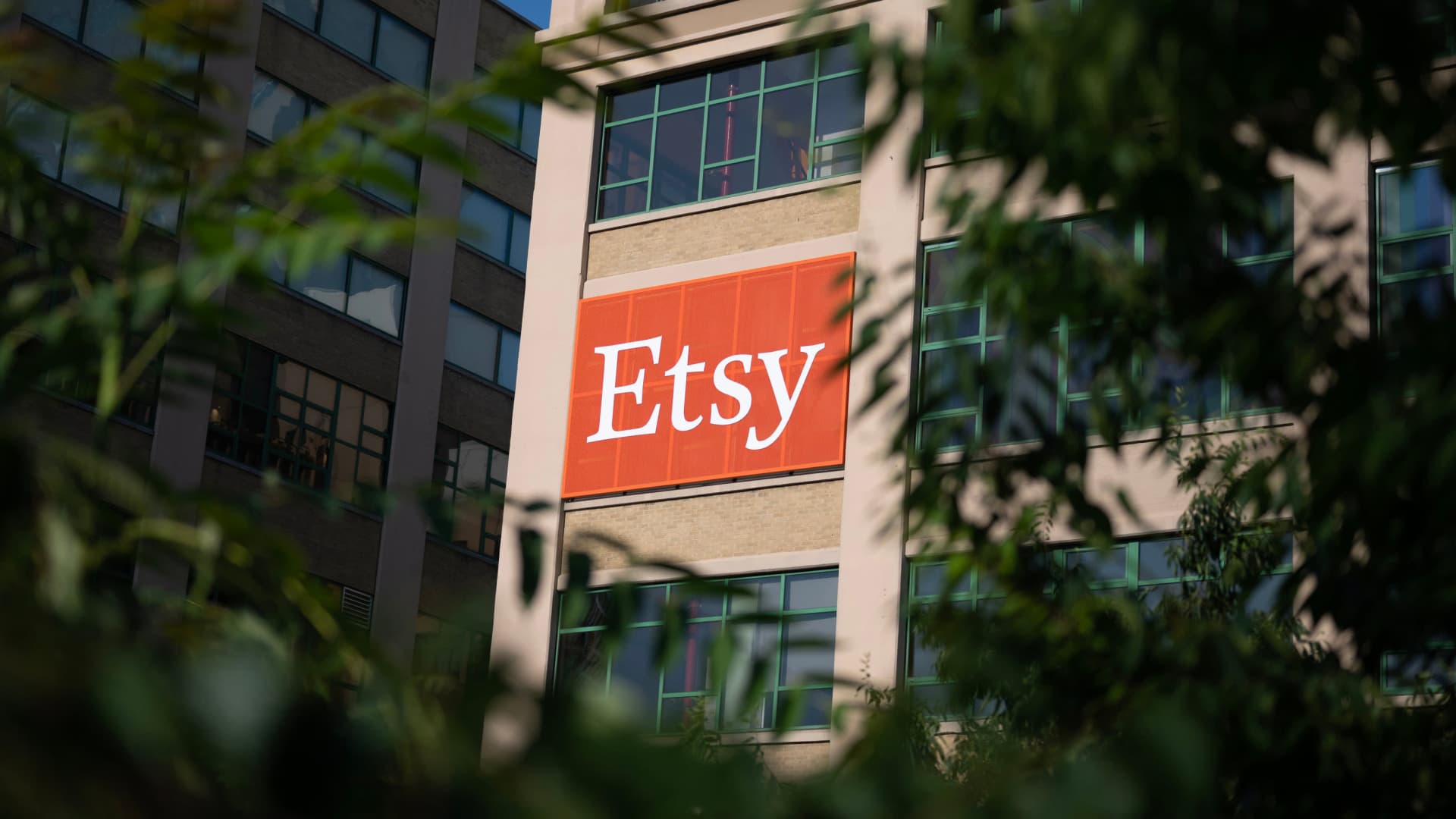
The Etsy Inc. headquarters in the Brooklyn borough of New York, US, on Tuesday, June 25, 2024.
Victor J. Blue | Bloomberg | Getty Images
Etsy said Wednesday it’s laying off about 220 employees, or roughly 12% of its workforce, as the online marketplace looks to simplify its organizational structure and innovate faster in an increasingly competitive e-commerce industry
Etsy CEO Kruti Patel Goyal, who took over the helm at the beginning of this year, told staffers in a memo that the job cuts will position the company for “building the organization we believe Etsy needs for the future.”
Most of the cuts will impact Etsy’s product and engineering teams, the company said
The layoffs, which were announced alongside Etsy’s second-quarter earnings results, aren’t a cost-cutting effort, but are intended to help the company “lean in during a period of strong momentum so that we can move faster and execute with even greater focus,” Etsy wrote in its letter to shareholders
The cuts also weren’t driven by artificial intelligence, an Etsy spokesperson said
“You’ve heard me say that our first priority was to get the business growing again,” Patel Goyal wrote in the staff memo. “Our ultimate goal, though, has always been to take Etsy to the next level of growth so we can fully deliver on our mission and our potential. We are now at the point where we need to make that shift – to build the team, culture, and organization that will make that possible.”
Etsy runs a digital marketplace that’s known for its assortment of handcrafted and artisanal wares. The company’s business boomed during the Covid-19 pandemic, as shoppers flocked to online retailers in droves, but it struggled to keep that momentum going once lockdowns eased and consumers returned to physical stores
The company has also faced growing pressure to compete with rivals like Amazon and Walmart, along with newer e-commerce entrants TikTok Shop and Temu
Under Patel Goyal and her predecessor, Josh Silverman, the company has looked to double down on its reputation as a marketplace for unique products, while weeding out mass-produced, generic items from resellers. In a warning shot to Amazon, the company in June launched a “Shop Other Jeffs” advertising campaign during the retail giant’s Prime Day promotion that featured “non-billionaire makers” named Jeff
It’s also made improvements to search capabilities on its website to show more personalized results to shoppers and help them discover items faster
So far, the changes appear to be bearing fruit. For the second quarter, sales came in at $668.3 million, while analysts surveyed by LSEG expected $649.1 million. Sales on its core marketplace grew 9.3%
The company boosted its full year guidance for gross merchandise sales, or the dollar value of items sold, projecting they’ll grow in the mid-single-digit range, up from low-single-digit growth. For the third quarter, the company expects GMS to be between $2.53 billion and $2.58 billion, beating consensus estimates of $2.49 billion
Etsy has been facing year over year declines in the number of buyers on its platform. The company had 87 million active buyers in the second quarter, down 0.4% from one year ago. But for the second quarter in a row, it added more merchants year over year to the Etsy marketplace, hosting 5.7 million sellers, up 5.9%
Etsy posted a net loss of $46.65 million during the quarter, a loss of 36 cents per share, compared to a year-ago net income of $28.84 million, or 25 cents per share
The net loss included discontinued operations, which included last month‘s completed sale of Depop to eBay for $1.2 billion. The sale came five years after it acquired the secondhand marketplace for $1.6 billion
Etsy has been offloading other brands in its portfolio as part of its effort to focus on the core marketplace business
Diluted net income from continuing operations per share was 98 cents per share, versus 39 cents per share a year ago. FactSet was expecting that metric to come in at 75 cents per share
