

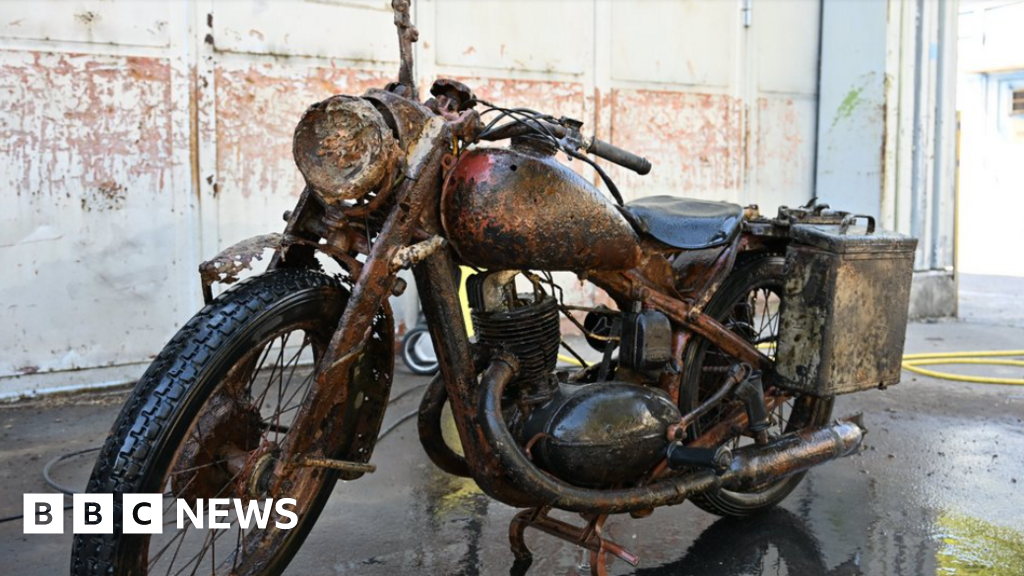
Danube river’s low water levels reveal remains of WWII soldiers and motorcycle
4 hours ago

German War Graves Commission
The bodies of two World War Two German soldiers have been found in Budapest’s Danube river, due to record-low water levels after an intense drought
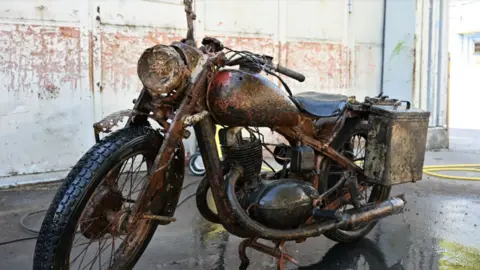
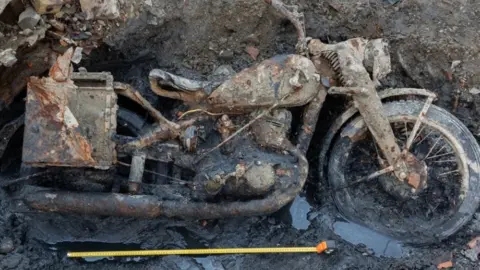
Found alongside their remains were the identification tags of the two soldiers, a largely intact German army Wehrmacht motorcycle, a wedding ring and a Kuban shield – a combat badge of the Wehrmacht, the German War Graves Commission said
The remarkable finds have sparked hope that some families could finally discover the fates of their ancestors, more than 80 years on from the war
“Now begins a puzzle, in which we will try to determine the identity of the two dead,” Arne Schrader, of the German War Graves Commission, told German newspaper Bild
The wreck in the Danube was reportedly discovered on 2 August, when a passersby reported part of the motorcycle protruding from the rocks on the riverbank in downtown Budapest
The team also found anti-tank mines, leading to the temporary closure of the riverbank as a bomb disposal unit was deployed
Some of the items found in the river, notably the identification tags and motorcycle, are remarkably well-preserved due to the mixture of harbour sludge and oil found on the river bed, the German War Graves Commission said
The commission is a German non-profit organisation that searches, recovers and buries the war dead on behalf of the German government
The motorcycle is thought to be a DKW NZ 350-1 model, the organisation said, which was produced specifically for wartime use from 1944
The commission added that of the two tags found, one belonged to a Wehrmacht soldier, and the other to a member of the Waffen-SS, which was declared a criminal organisation responsible for war crimes at the Nuremberg Trials
German War Graves Commission
During the Second World War, German soldiers’ identification tags were split into two on the event of a soldier’s death. One half would be kept with the soldier, while the other would be sent to German army authorities, which tracked German military casualties and would notify relatives of soldiers’ deaths
The German War Graves Commission said the families of these two soldiers would have “waited in vain” for official notification of their deaths
It said it had begun its investigation to find out the identities of the two soldiers, and that anyone who is still missing a relative can search for their names in its database
It would take time, however, to determine who they were, as the commission will need to ascertain whether the identity tags and Kuban shield actually belong to the two soldiers found
“The names of the original wearers can probably be found quickly, but that is only the first step,” the commission said. “Too many pieces of the puzzle need to be gathered, and the outcome is uncertain.”
Bone analysis would be a key way of determining the soldiers’ identities, it added
The news of the soldiers’ discovery has gained much attention in World War Two-related social media groups
“As bad as the low water level is, I am glad that bereaved families can once again be informed about the whereabouts of their relatives, and that the fallen soldiers can be given a dignified burial. Rest in peace,” said one person in a Facebook group where people share information about the fate of their ancestors who fought in WWI and WWII
The soldiers are to be buried at the German war cemetery in Budaörs, just outside the Hungarian capital
Budapest was the site of fierce fighting between the Soviet Red Army and the German Wehrmacht late in the Second World War
Other remnants of World War Two have appeared in the Danube as of recent, including a broken-up hull near Prahovo in Serbia
Danube’s record low levels force shutdown of Hungary’s only nuclear plant
Rhine falls to record low levels as drought strains Europe’s rivers
World War Two
Hungary
Nazi Germany
Budapest
