

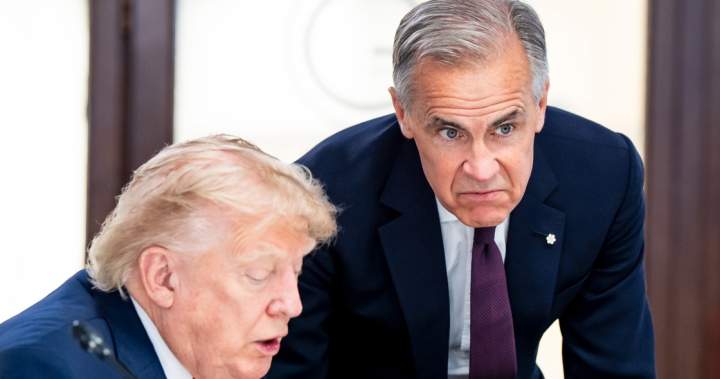
Ottawa “should not be offering any concessions to the United States,” Canada’s largest private sector union Unifor said on Friday as the clock ticks down to a fresh round of tariffs from U.S. President Donald Trump next week

“We shouldn’t be offering any concessions to the United States right now. The reality is the US has imposed tariffs on Canada,” Lana Payne, Unifor’s national president said
Canada has “created leverage” for itself, which it should not give up by offering more concessions to the U.S., Payne said
“We have a lot in this country that the U.S. needs. They rely on energy from Canada. They rely on potash from Canada. They rely on aluminum from Canada,” she added
While Canada has been dealing with Trump’s tariffs for more than a year, including sectoral tariffs on steel, aluminum and automobiles, the vast majority of Canadian goods traded under CUSMA have been exempt from the tariffs
This could change on Aug. 19, when a new set of tariffs could hit Canada
I met with my counterpart, United States Trade Representative Jamieson Greer, this afternoon in Washington, D.C. alongside Canada’s Chief Trade Negotiator. This is our fourth meeting in the last three weeks. Negotiations are ongoing, and we continue to advance Canada’s…
— Dominic LeBlanc (@DLeBlancNB) August 13, 2026
If a deal is not reached by Wednesday, there is “only one path for Canada,” which is to “retaliate and to retaliate hard against these unjustified tariffs,” Payne said
Trump has vowed to hit Canada with new sweeping 50 per cent tariffs on a wide range of goods
Trump’s decision to impose 50 per cent tariffs on Canadian goods was in response to what the U.S. calls “discriminatory” measures
Trump signed three executive orders, each one using a different justification for the new tariff: the provincial and territorial boycotts on American alcohol products, Canada’s retaliatory tariffs on U.S.-made vehicles and auto parts, and quotas on American dairy imports under Canada’s supply management system
In early 2025, several Canadian provinces removed U.S. alcohol from their shelves in response to Trump’s trade war and threats to make Canada the “51st state.”
6:09
Washington This Week: Canada-U.S. trade talks resume amidst tariff threats
U.S. won’t tolerate retaliation: Trump’s trade rep
The Canadian delegation is looking for a “conciliatory approach” in trade talks, but Washington will hit back against any trade action, U.S. Trade Representative Jamieson Greer said on Friday
Canadian officials have been meeting with Greer and trying to hash out a trade deal with Washington before U.S. President Donald Trump’s tariffs hit Canada in less than a week

Get daily National news
Get daily Canada news delivered to your inbox so you’ll never miss the day’s top stories.
By providing your email address, you have read and agree to Global News’ Terms and Conditions and Privacy Policy.
“This is not a trade war. We have domestic supply chains that we are trying to protect and support, that’s what we’re trying to do. It’s not Canada-specific,” Greer told reporters in Iowa Friday
The incoming U.S. tariffs against Canada are in response to “Canadian retaliatory measures,” Greer said
“If a country retaliates against us, we’re obviously not going to tolerate that. We’ll take action. My sense is the Canadians, they want to have a more conciliatory approach, but we’ll see,” he added
Finance Minister François-Philippe Champagne said he is “confident” in the Canadian economy’s ability to weather the trade uncertainty
“The best thing that we can do as Canadians is obviously to support our negotiating team, but at the same time to focus on what we can control,” Champagne said, adding that Ottawa was looking to build new trading relationships while negotiating a trade deal with the United States
“I’m very confident in the Canadian economy. We are very resilient. Canadians are resilient. And we’re going to continue to do the work that needs to be done,” Champagne told reporters in Quebec on Friday
Canada-U.S. Trade Minister Dominic LeBlanc met with U.S. Trade Representative Jamieson Greer in Washington on Thursday afternoon
Canada’s chief negotiator, Janice Charette, was also part of those talks, LeBlanc confirmed on social media after the meeting
The two Canadian officials are “engaging with our U.S. counterparts” and “defending Canadian interests,” Champagne said
4:39
Canada-U.S. trade war: Tariff deadline 1 week away, but have negotiations progressed?
Talks intensify
Thursday’s meeting was the fourth one between LeBlanc and Greer in the last three weeks, LeBlanc posted on social media
“Negotiations are ongoing, and we continue to advance Canada’s interests,” the minister said in a statement
on Thursday that the Trump administration is pushing to keep at least some level of tariffs on vehicles and auto parts compliant with the Canada-U.S.-Mexico Agreement on free trade (CUSMA) under an eventual deal
Thens beyond dropping provincial and territorial boycotts on U.S. alcohol and easing restrictions on dairy imports — two irritants identified by the U.S. as being behind the latest tariff threat
While Canada is willing to walk away from a deal if tariffs are not reduced enough, theeal now, as part of a three-step trade strategy it is attempting to employ
That strategy would start with a deal on sectoral tariffs and avoiding new ones coming into place, followed by new partnerships with the U.S. in areas like trade and defence and, finally, renegotiating CUSMA, according to the
1:56
What’s the potential impact on Canada if U.S. trade talks fall apart?
What’s at stake?
Trump’s sweeping tariffs would affect both countries, a note from the Royal Bank of Canada economists Nathan Janzen and Claire Fan said on Friday
The impact on Canada “will be bigger” than the one on the U.S., “but still manageable,” the note said
“The economy wide impact may be small, but reduced foreign demand for these products would still hurt production and jobs in key manufacturing industries—notably apparel and electrical equipment and appliances manufacturing,” it added
If the CUSMA deal breaks down, it would lead to more than 100,000 job losses in Canada and more than twice that in the United States, a report by the Canadian American Business Council warned earlier this week
In July, Washington said it won’t renew the deal, known as USMCA in the U.S., in its current form. That means the trade deal must be reviewed annually, adding to the volatility and economic uncertainty facing businesses
A lot is riding on the deal being renewed, the report said
“Successful renegotiation of USMCA would create an additional 137,000 American jobs and 98,000 Canadian jobs in 2027 relative to the status quo,” it reads
Dairy Farmers of Canada issued a statement Thursdayas the dairy sector is one of the prime areas in focus during these negotiations, with president David Wiens saying, “our national food sovereignty is not up for negotiation.”
– with files from Global’s Mackenzie Gray, Reggie Cecchini, Sean Boynton and Ariel Rabinovitch
