

- President Donald Trump said the U.S. is not in any talks with Iran and has no plans to start new ones.
- Trump claimed that the Strait of Hormuz is “open and operating,” and that “all water mines have been removed or detonated.”
- Trump once again raised the idea of making the strait a territory of the U.S.
- Oil prices rose for a third straight session as the U.S. and Iran appeared to move further away from any potential deal.
- Air defenses in the United Arab Emirates detected two ballistic missiles launched from Iran toward the UAE, according to that country’s Ministry of Defense. The first missile fell outside the UAE’s territorial waters, and the second missile fell in territorial waters, the defense ministry said.
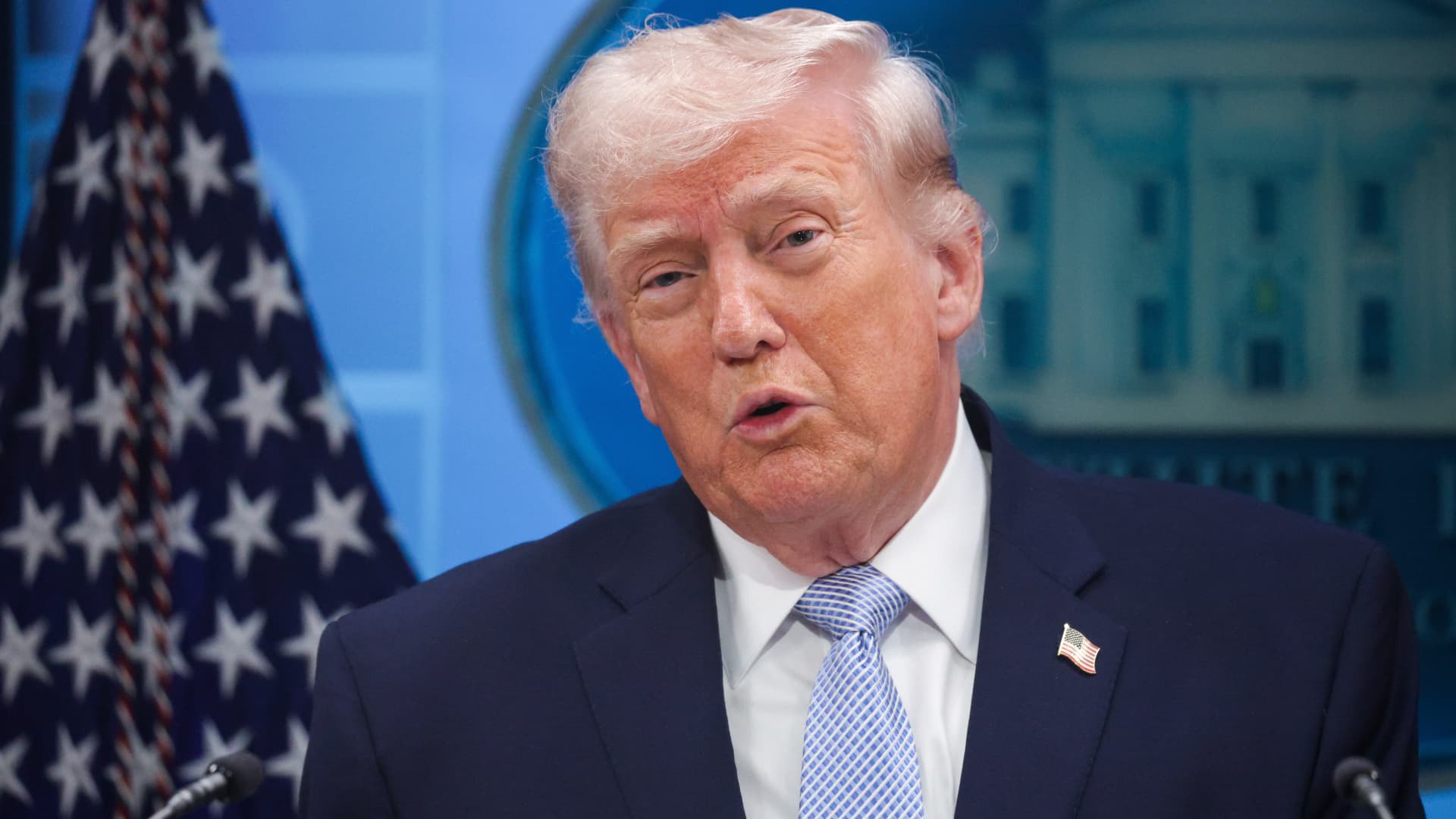
U.S. President Donald Trump speaks during a news conference in James S. Brady Press Briefing Room of the White House on April 06, 2026 in Washington, DC.
Alex Wong | Getty Images News | Getty Images
President Donald Trump on Tuesday said the U.S. is not in any talks with Iran and has no plans to start new ones, though he continued to assert that the Strait of Hormuz is open and cleared of water mines
Trump’s claim on Truth Social abruptly contradicted his prior insistence that Washington and Tehran are in active negotiations, even as Iran has repeatedly stated that no such talks are occurring
Later Tuesday, air defenses in the United Arab Emirates detected two ballistic missiles launched from Iran toward the UAE, according to that country’s Ministry of Defense
The first missile fell outside the UAE’s territorial waters, and the second missile fell within territorial waters, the defense ministry said
Trump, in his Truth Social post on Tuesday morning, said, “There are no talks or conversations going on, or scheduled, with the Islamic Republic of Iran.”
Just over two weeks earlier, Trump claimed Iran was being “duplicitous” by denying that talks were underway
Trump’s post added: “The Naval Blockade remains in full force and effect. The Hormuz Strait is open and operating. All water mines have been removed or detonated.”
Passage through the economically vital strait has been stifled since the war began, in part due to the threat of Iranian mines. The U.S. in April launched a mine-clearing mission in order to establish a safe passage for ships transiting the waterway
U.S. Central Command has not echoed Trump’s claim, and referred CNBC to the White House when asked if it could confirm that the strait has been demined
Traffic through the strait, which saw 20% of the world’s oil trade before the war started nearly six months ago, has winnowed to a trickle and slowed further in recent days, exacerbating global energy concerns
Trump maintains that the U.S., not Iran, is in control of the strait, even though transiting vessels continue to come under attack and few attempt the crossing
Oil prices on Tuesday rose for a third straight session as the U.S. and Iran appeared to move further away from any potential deal
Strait of Hormuz, a new U.S. territory?
Trump’s reversal on the existence of talks with Iran came one day after he ruled out extending a 60-day ceasefire agreement, which expired Monday and had already been effectively abandoned by both sides
Amid the apparent breakdown in diplomacy with Iran, Trump has repeatedly raised the idea of making the strait a territory of the U.S
“It’s a great idea,” Trump said in the Oval Office on Monday when asked about the prospect of taking over the international waterway, which experts have said would violate international law
“I mean, we control it. We control it with the blockade,” Trump said, referring to the ongoing U.S. naval blockade of Iranian ports
In another Truth Social post earlier Tuesday, Trump shared an image declaring the strait a “New U.S. Territory.”
@realDoanldTrump | Truth Social
It was not immediately clear to what extent the post was an actual expression of U.S. foreign policy. The White House did not immediately respond to CNBC’s request for comment
Trump previously announced a plan to charge 20% tolls on cargo passing through the strait, but quickly abandoned it. Maritime experts, regulators and even top Trump administration officials have said that tolling the strait would be illegal under international law
Iran and Oman, which both border the Strait of Hormuz, have been in talks about a deal on commercial shipping through the strait
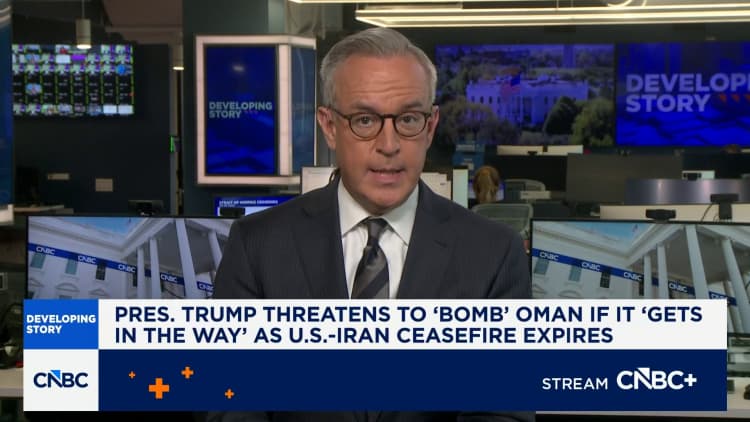
In a Fox News interview Monday, Trump threatened to “bomb the s—” out of Oman, a longtime U.S. strategic partner, if it “gets in the way” of U.S. operations
Ex-U.S. ambassador: ‘Clearly there is frustration in the White House’
watch now
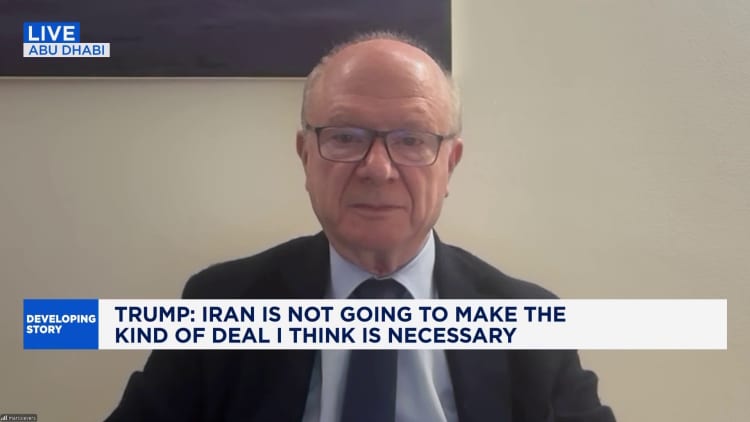
U.S.-Iran peace talks have effectively stalled, a former U.S. ambassador told CNBC on Tuesday, with Washington pursuing a diplomatic solution that was never “seriously on the table.”
Speaking to CNBC’s “Access Middle East” on Tuesday, Marc Sievers, who served as U.S. ambassador to Oman between 2016 and 2019, said Trump’s threat to bomb the country was an attempt to try “to get their attention more than a practical threat” — but he added that it appears Oman has “lost the support of the United States.”
“It’s very hard for me to imagine [U.S. Central Command] planning bombing raids on Omani targets when we’ve worked very closely with the Omanis and developed their ports and so forth for access for the U.S. Navy over a number of years, but clearly there is frustration in the White House that Oman seems to be partnering closely with the Iranians on developing a channel for the Strait of Hormuz,” Sievers said
“I don’t really know what the substance is at the moment, but I think it appears that the U.S. side wants the Omanis to leave it alone and let the U.S. take the lead in opening the strait,” he added
Trump calls the Strait of Hormuz ‘U.S. Territory’
A cargo vessel was struck by a projectile while transiting the strait, the U.K. Maritime Trade Operations agency said Tuesday, signaling persisting navigation risks in the waterway as Washington and Tehran harden their positions
The attack damaged the engine room and resulted in a crew casualty, the maritime agency said, adding that the remaining crew were being assisted by the Omani Coast Guard
The incident came after an Iranian military official repeated threats that the Islamic Republic won’t back down in the strait. Fox News reported Tuesday that Ebrahim Zolfaghari, Iranian military spokesperson, said vessels attempting passage through the strait will “find several beautiful holes in their hulls.”
Asked whether diplomacy has stalled as the 60-day window for a negotiated settlement between the U.S. and Iran closed without a breakthrough, Sievers said it was “a fair characterization.”
“For over a week now, the president’s been emphasizing the economic pressure that we’re putting on the Iranians … of course, they see the strait as their leverage over the president,” he said, noting that Iran was also threatening military escalation
“They have not gone down that path yet. I think that is a possibility, but we will have to wait and see. I don’t think it’ll go well for them. I think they bluster more than they have capability, but there certainly is some damage that they could do,” he said
While he said he was reluctant to criticize the Trump administration’s handling of the conflict, Sievers told CNBC he felt it had been “dragged out, perhaps unnecessarily, in search of a diplomatic solution that I don’t think was ever really seriously on the table.”
“Both sides will dig in for a longer standoff,” a team of analysts at Eurasia Group said in a note Monday, as neither side sees an urgent need to make concessions
Ceasefire expires
Earlier on Monday, Trump ruled out extending the ceasefire, saying Tehran won’t accept the terms he considers necessary to end their war. “They’re not going to make the kind of deal that I feel is necessary,” Trump said in the Oval Office
Iran’s hard-line leadership, for its part, has no intention of winding down the conflict, but instead widening the war to raise the costs for the U.S. and its regional allies, The Wall Street Journal reported on Sunday, citing intelligence obtained from unnamed Iranian and Arab officials
Eurasia Group no longer expects a peace deal by September, pushing back its timeline for de-escalation to year-end as the standoff drags on. The most likely outcome is “a limited deal” that allows Hormuz traffic to partially recover, the risk consultancy said, adding that pressure on Washington to push for an imminent reopening of the strait has eased
Success in routing oil around the strait has kept prices from spiking past $100 a barrel, while the global economy has adapted to the closure, giving the U.S. room to “afford to wait,” Eurasia Group said
watch now
Shipping in the strait remains near a standstill amid sporadic attacks on oil tankers. Just three vessels transited the strait on Sunday, according to ship-tracking data from Kpler
The Bab el-Mandeb Strait, where Yemen Houthis declared a naval blockade on Saudi Arabia in mid-July, also saw just 49 weekend transits by commodity vessels down from 55 in the prior week
Iranian Foreign Minister Abbas Araghchi said in a Telegram post Saturday that Iran’s negotiations with Oman remained ongoing to determine a new maritime route through Hormuz
“Any recovery in Hormuz flows will be partial,” said analysts at Eurasia Group, as the U.S. and Iran remain in a state of simmering hostilities, with heightened risks of renewed flare-up that disrupts traffic
