

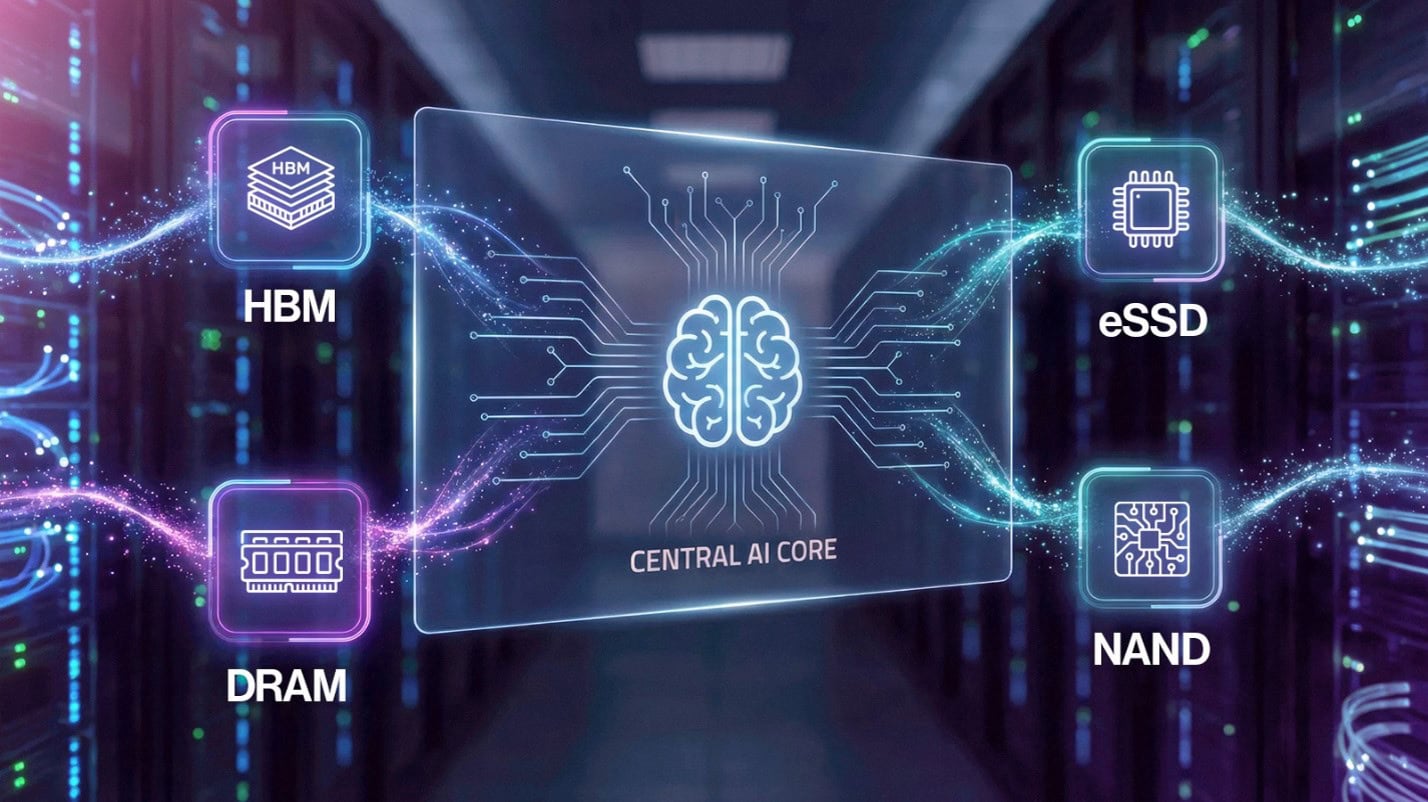
Artificial intelligence has been defined by a relentless race for more computing power.Nvidia‘s (NASDAQ:NVDA | NVDA Price Prediction) GPUs became the stars of that story because they delivered the horsepower needed to train ever-larger AI models. But every technology boom eventually runs into a new constraint.
According to a recent Morgan Stanley report, that next hurdle isn’t computing power — it’s memory. As AI models grow larger and inference workloads become more demanding, data centers need far more memory bandwidth and capacity to keep expensive accelerators fed with data. That shift could reshape where hundreds of billions of dollars in AI infrastructure spending flows over the rest of the decade
The Memory Wall Is Becoming AI’s Biggest Challenge
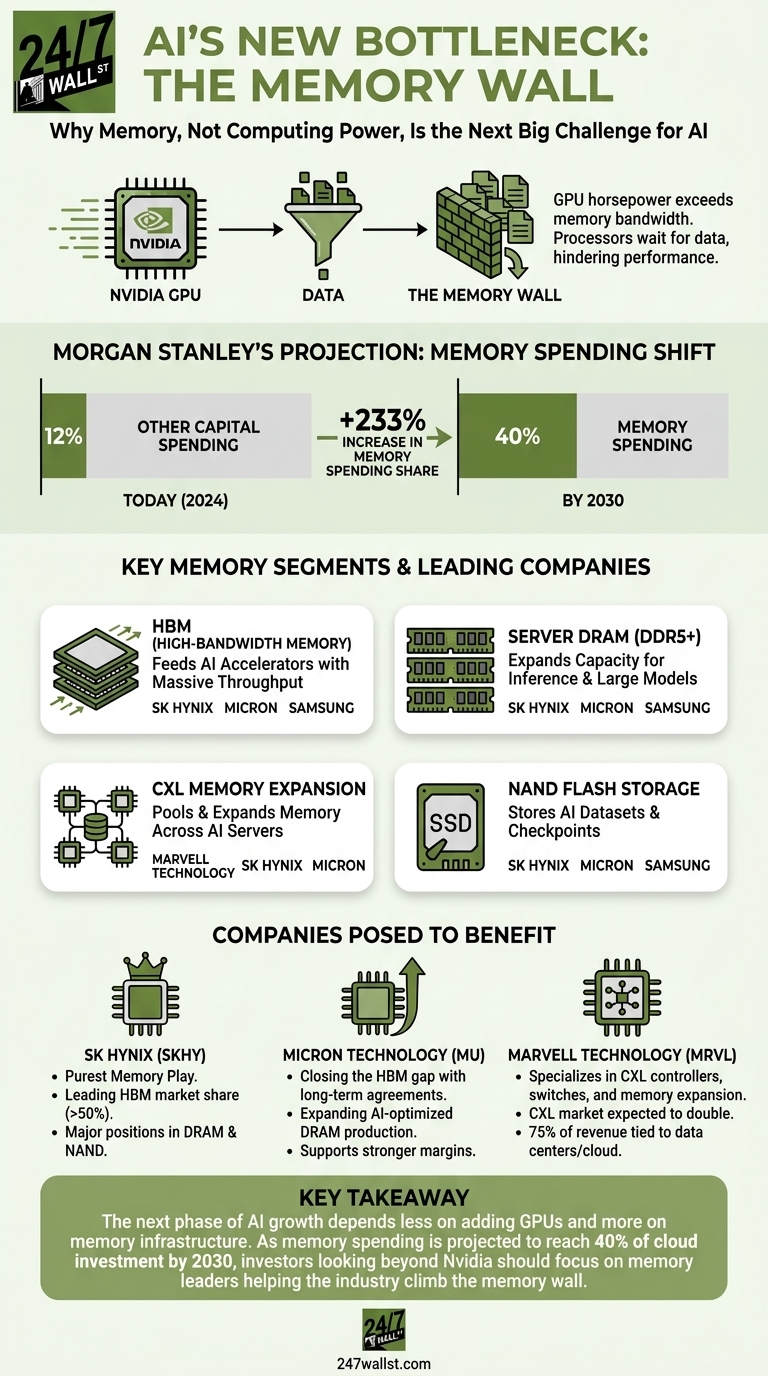
Morgan Stanley argues memory is becoming the new bottleneck for AI systems, a phenomenon long known in computing as the “memory wall.” GPUs continue getting faster, but they spend more time waiting for data to arrive from memory rather than performing calculations
The numbers help explain why this matters. Morgan Stanley estimates memory will account for roughly 40% of cloud and data center capital spending by 2030, up fromonly about 12% today. That increase reflects growing demand across several categories:
| Memory Segment | Primary AI Role | Leading Companies |
| High-Bandwidth Memory (HBM) | Feeds AI accelerators with massive data throughput | SK Hynix(NASDAQ:SKHY),Micron Technology(NASDAQ:MU),Samsung |
| Server DRAM (DDR5+) | Expands memory capacity for inference and larger AI models | SK Hynix, Micron, Samsung |
| CXL Memory Expansion | Pools and expands memory across AI servers | Marvell Technology(NASDAQ:MRVL), SK Hynix, Micron |
| NAND Flash Storage | Stores AI datasets and checkpoints | SK Hynix, Micron, Samsung |
Let’s put that into perspective. Every dollar hyperscalers spend on AI servers increasingly requires another dollar supporting the memory ecosystem. That broadens the investment opportunity well beyond GPU manufacturers
Morgan Stanley identifies several categories where pressure will build most, and three publicly traded companies appear positioned to benefit across multiple segments
© 24/7 Wall St.
SK Hynix (SKHY)
SK Hynix remains the purest memory play. The company holds 58% of the advanced HBM market, giving it the leading position in one of AI’s fastest-growing and highest-margin categories. Beyond HBM, it also maintainsmajor positions in DRAM and NAND, allowing it to benefit regardless of which part of the AI memory hierarchy grows fastest
Micron Technology (MU)
Micron is quickly closing the gap. The company has secured long-term HBM supply agreements with hyperscale customers while expanding production of AI-optimized DRAM. Unlike previous memory cycles driven by smartphones or PCs, AI demand is creating longer product cycles and richer pricing. That could support stronger margins than investors have historically expected from memory manufacturers
Marvell Technology (MRVL)
Marvell Technology offers a different way to invest in the trend. Rather than manufacturing memory chips, Marvell develops CXL controllers, switches, and memory expansion technology that lets AI servers share and pool memory more efficiently. According to Morgan Stanley, the CXL memory controller (MXC) chip market is expected to more than double in size to $2.1 billion. Marvell’s Structera product linehit all three CXL categoriesthat are expected to surge, and 75% of its total revenue is tied to data centers, cloud, and custom silicon. With a $165 billion market cap amid a seeming sea of trillion-dollar peers, it may see the most explosive growth.
Key Takeaway
In short, AI’s next growth phase may depend less on adding more GPUs than on ensuring those processors never sit idle waiting for data. Morgan Stanley’s projection that memory spending could climb from 12% to 40% of cloud infrastructure investment by 2030 suggests one of the largest shifts in AI spending is only beginning
Granted, memory has always been a cyclical business, and supply expansions can pressure pricing. That said, AI is creating structural demand for higher-value products like HBM and CXL-enabled memory systems that simply didn’t exist during previous cycles.
Ultimately, investors looking beyond Nvidia should pay close attention to SK Hynix, Micron, and Marvell. As the AI memory wall grows taller, these companies may become some of the most important builders helping the industry climb over it
Contact [email protected] for any questions or corrections
