

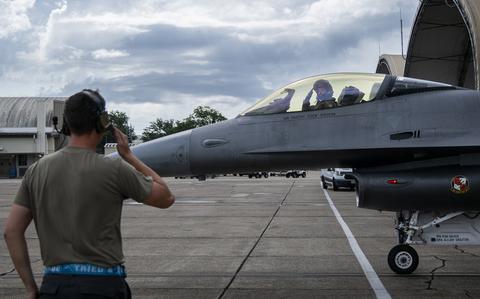
An F-16 Fighting Falcon pilot prepares for takeoff in a partially artificial intelligence-controlled jet at Eglin Air Force Base, Fla., in this undated photo. The pilot conducted takeoff and monitored the cockpit as the AI operated the jet for the majority of the flight, according to the Air Force and Defense Advanced Research Projects Agency. (Samuel King Jr./U.S. Air Force)
The Air Force has successfully flown a legacy fighter plane with artificial intelligence at the controls, marking a key step toward using AI to assist pilots in future combat
The F-16, which flew from Eglin Air Force Base, Fla., was equipped with new autonomous flight technology while a test pilot remained in the cockpit as backup, the Air Force and the Defense Advanced Research Projects Agency said last week
The human pilot handled the takeoff and was prepared to take over from AI at any time if needed, the agencies said
“Getting the aircraft into the air is always a monumental milestone for a complex test program,” said Tim Stevens, of the 40th Flight Test Squadron at Eglin.
Stevens is a test pilot for the program known as Viper Experimentation and Next-generation Operations Model, or VENOM
Six F-16s at Eglin that were modified with additional hardware, software and instrumentation are part of the program. The jets flew for the first time in June to ensure the aircraft could operate safely with all the technology upgrades
An F-16 Fighting Falcon modified to be piloted by artificial intelligence soars over Eglin Air Force Base, Fla., in this undated photo. A human pilot was in the cockpit to handle the takeoff and assume control if necessary, but the majority of the flight was piloted by AI, according to the Air Force and Defense Advanced Research Projects Agency. (Samuel King Jr./U.S. Air Force)
The modifications are made without changing the jet’s core software, which allows for a faster developmental pipeline
The technology kit added to the planes allows “a pilot to toggle between traditional human control and AI control with the flip of a switch,” DARPA said in a statement
The first fighter jets for the program arrived at Eglin in 2024 as part of a collaboration between the Air Force and DARPA to develop and leverage artificial intelligence to expand the capabilities of human pilots in combat
The testing builds on the experimental X-62 VISTA, built from an F-16D Fighting Falcon. In April 2024, the X-62A successfully engaged with a conventional, human-piloted F-16 in what the Air Force and DARPA said was the first-ever human versus artificial intelligence dogfight
“As we cross this starting line, we are excited to watch VENOM redefine the boundaries of autonomous flight,” Stevens said
The aircraft will serve as the cornerstone for the next phase of the Artificial Intelligence Reinforcements program, which leverages the VENOM fleet to test multiple AI agents in live-flight scenarios
The goal is to pave the way for human pilots to oversee teams of autonomous, uncrewed aircraft, DARPA said
Aviation
Drones
<img src="https://todaytrendnews7.com/wp-content/uploads/2026/07/Jennifer-20Svan.jpg” alt=”author picture”>
Jennifer H. Svan
Jennifer H. Svan
Jennifer reports on the U.S. military from Kaiserslautern, Germany, where she writes about the Air Force, Army and DODEA schools. She’s had previous assignments for Stars and Stripes in Japan, reporting from Yokota and Misawa air bases. Before Stripes, she worked for daily newspapers in Wyoming and Colorado. She’s a graduate of the College of William and Mary in Virginia.
