

The artificial intelligence boom has turned memory chips into one of the hottest corners of the semiconductor market. High-bandwidth memory (HBM) has become essential for AI accelerators, pushing demand for advanced DRAM to levels few expected just two years ago.
That enthusiasm is now spilling into U.S. markets asSK hynixbegins trading today on theNasdaqunder the ticker SKHY after pricing its American depositary receipts (ADRs) at $149 apiece. While it may not generate the same frenzy that followedSpaceX‘s (NASDAQ:SPCX) Nasdaq debut, the excitement surrounding the world’s leading HBM supplier is already creating a new wave of speculation — and even new leveraged exchange-traded funds — before the stock has traded a single session
Wall Street Is Already Raising the Risk
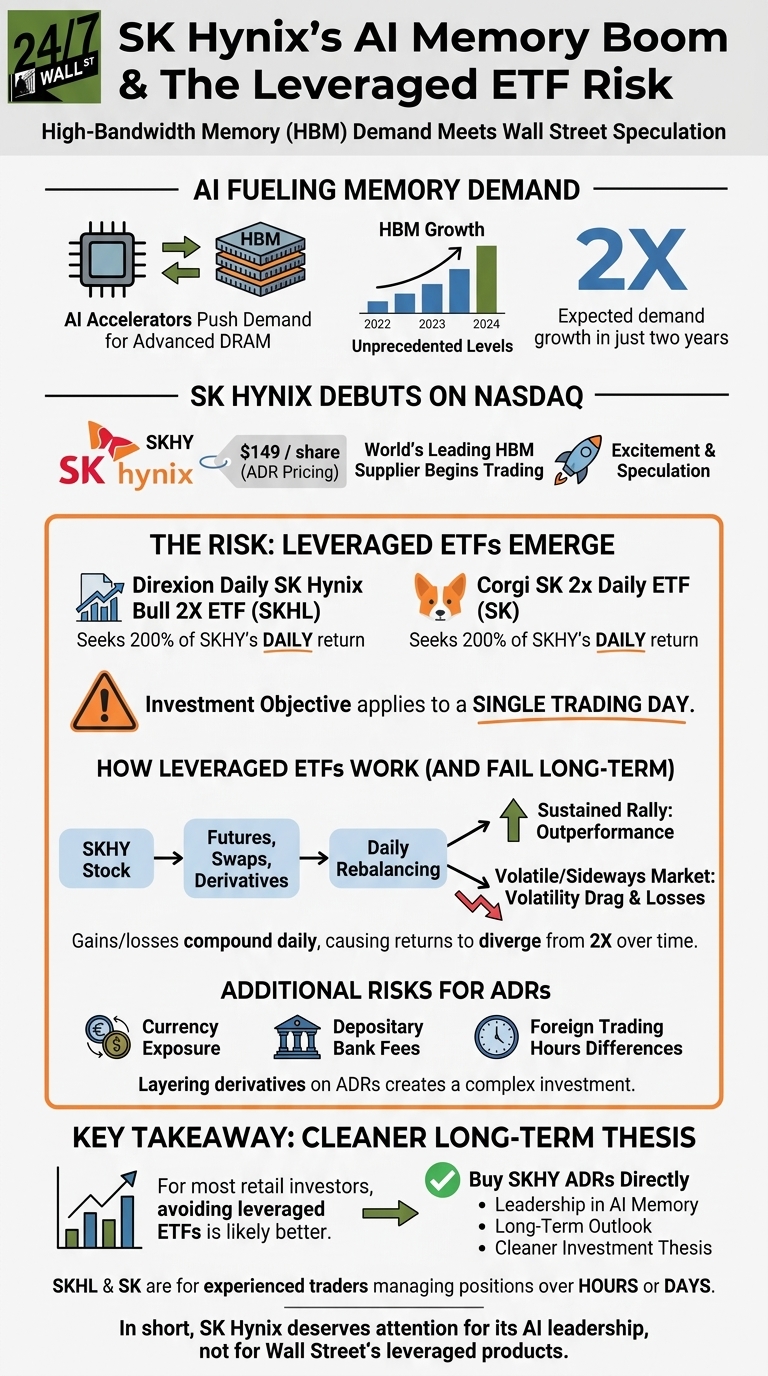
SK hynix’s debut has attracted more than just investors looking to own one of the world’s dominant memory manufacturers. It has also inspired at least two leveraged ETFs
According to their respective SEC registration statements and fund fact sheets, investors will soon have access to:
| Fund | Ticker | Launch Date | Objective |
| Direxion Daily SK Hynix Bull 2X ETF | SKHL | July 15, 2026 | Seeks 200% of SKHY’s daily return |
| Corgi SK 2x Daily ETF | SK | July 13, 2026 | Seeks 200% of SKHY’s daily return |
That last word —daily— is the one investors should pay attention to. Neither ETF is designed to double your returns over a year or even several months. Their investment objective applies only to a single trading day
To achieve that goal, both funds expect to usefutures contracts, swaps, and other derivativesrather than simply buying twice as many SKHY ADRs. Those instruments introduce counterparty risk, pricing risk, and volatility that can cause returns to diverge from investors’ expectations, particularly over longer holding periods
Daily Leverage Isn’t Long-Term Investing
Leveraged ETFs have their place. They’re useful tools for professional traders looking to capitalize on short-term market moves. They are poor tools for long-term investors
Because the funds reset exposure every day, they must continuously rebalance their positions. During volatile markets, that daily reset creates what’s commonly known as volatility drag, where gains and losses compound in ways that produce returns well below what investors might expect from simply doubling the stock’s long-term performance
Ironically, SK hynix carries another layer of complexity because it trades as an ADR rather than a direct U.S. listing. ADRs introduce currency exposure, depositary bank fees, and differences in foreign market trading hours. Layering derivatives on top of those additional risks creates an even more complicated investment than many retail investors realize
During sustained rallies, leveraged ETFs can outperform dramatically. Conversely, when markets decline — or even move sideways with large daily swings — thelosses can accumulate much fasterthan investors anticipate
© 24/7 Wall St.
The Long-Term Opportunity Still Looks Better
The memory market has enjoyed an extended bull run as AI infrastructure spending accelerated. SK hynix has emerged as the industry’s technology leader in HBM, supplying many of the chips powering today’s AI accelerators
That said, the sector has cooled in recent sessions as investors debate how long today’s elevated pricing can last. Memory has always been cyclical, and even industry leaders experience sharp corrections when supply eventually catches demand
Those cycles are exactly whyleveraged ETFs become so dangerous. A normal 10% decline can quickly become a 20% loss in a 2X fund before the effects of daily compounding are even considered
Key Takeaway
In short, SK hynix deserves attention because of its leadership in AI memory, not because Wall Street has rushed to create leveraged products around it. If you’re convinced the long-term outlook for HBM remains intact and SK hynix can continue leading the market, buying the ADRs directly offers the cleaner investment thesis
Regardless of how exciting the new ETFs may appear, SKHL and SK are designed for experienced traders managing positions over hours or days — not investors building wealth over years. For most retail investors, avoiding leveraged ETFs altogether is likely to produce better long-term results and far fewer unpleasant surprises when the next downturn inevitably arrives
Contact [email protected] for any questions or corrections
