

From the route students take to school to the transportation systems that move people and goods across entire regions, everyday mobility depends on decisions, coordination, technology, and infrastructure that often go unnoticed
Through the hands-on outreach program STEaM Tech, Virginia Tech’s System Performance Laboratory team is helping young learners see transportation not simply as something they use, but as a complex system they can understand, question, and help improve
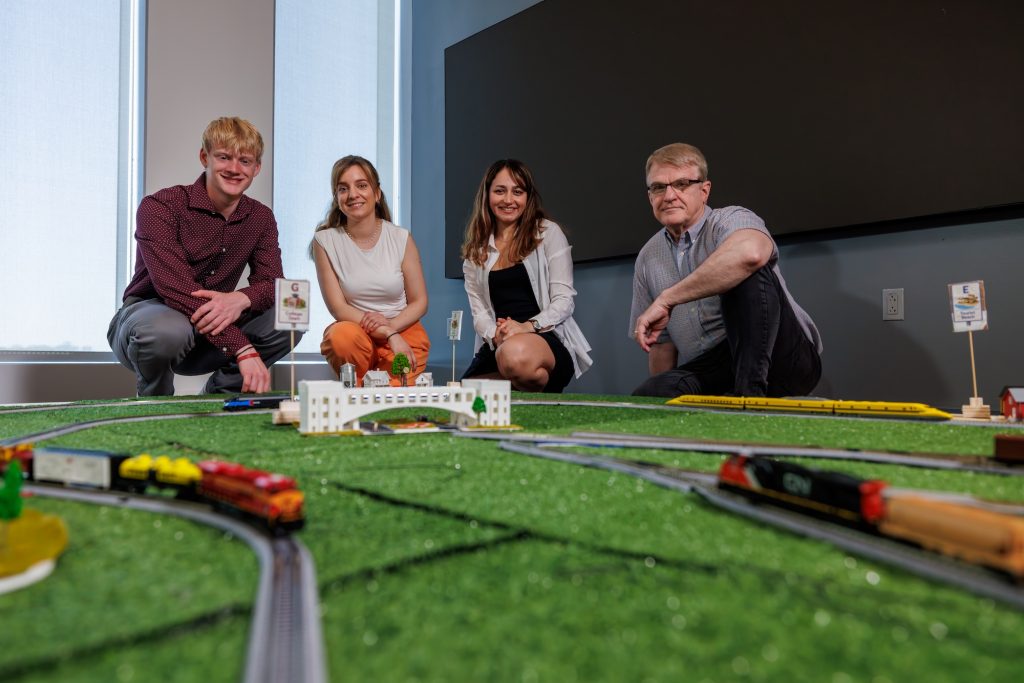
At the center of STEaM Tech — short for science, technology, engineering, arts, and mathematics — is a railway-based case study, realized as an interactive exhibit at Virginia Tech’s Academic Building One in Alexandria. Trains are familiar to many students, which makes them an effective starting point for introducing systems thinking, decision-making, automation, and safety. Through the program, students explore how transportation systems depend not only on vehicles and infrastructure, but also on people, communication, planning, technology, and real-time decisions.
For Maria Tomai, a postdoctoral associate, and Yasmin Mashayekhy Fard, a Ph.D. candidate, providing visibility is exactly what they hope to change through their work on the program. As part of the System Performance Laboratory team, they are pulling back the curtain on everyday transportation systems, sparking curiosity, and encouraging young people to discover fields they are passionate about and may want to pursue in their future careers
“We want to help students see transportation not just as something they use to move around, but as a complex socio-technical system they can understand, question, and eventually help improve,” Tomai said. “Model trains give us a tangible and playful way to make such a system visible, showing how tracks, signals, schedules, people, and technologies interact, and how one decision in one part of the system can affect everything else.”
The program was developed within the Grado Department of Industrial and Systems Engineering under the guidance of System Performance Laboratory Director Kostas Triantis and Co-Director Joseph Godfrey, with contributions from faculty members, researchers, graduate students, postdoctoral scholars, volunteers, and community partners. The outreach project was funded by Vibrant Virginia, support that enabled the laboratory team to translate its transportation and human-automation research into a hands-on educational program for students and community participants.
STEaM Tech builds on an National Science Foundation-funded research effort conducted by the System Performance Laboratory over the past five years. That work has focused on safety-critical transportation systems, infrastructure resilience, learning from errors and near misses, and human-automation interaction. Drawing from this research foundation, the team developed STEaM Tech to translate complex engineering ideas into activities that are accessible, collaborative, and engaging for younger audiences.
The location of the program strengthens the learning experience. Academic Building One in Alexandria is surrounded by multiple transportation systems, including Metro and rail lines, roads, pedestrian pathways, waterways, and nearby air transportation. Students can observe the transportation environment around them and connect those observations to activities inside the workshop
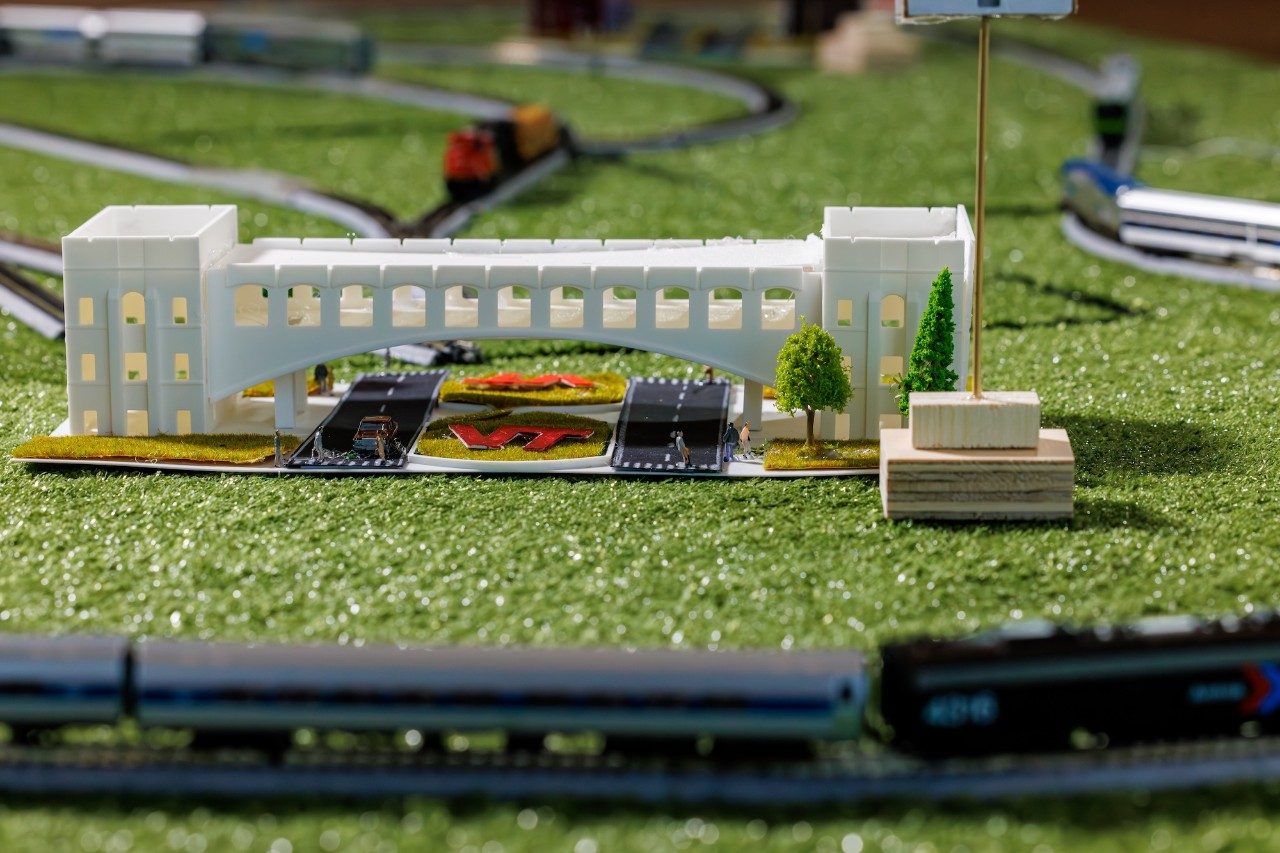
The STEaM Tech demonstration at Academic Building One in Alexandria. Photo by Craig Newcomb for Virginia Tech
Over the course of the program, students rotate through seven interactive stations. They observe transportation modes, learn about the history of trains and locomotives, compare routing options, build rail networks, manage train traffic, respond to maintenance challenges, and explore how drones and artificial intelligence support inspection and safety. Each station is designed to help students think like systems engineers by asking questions, testing ideas, weighing trade-offs, and working together to solve problems.
“We want students to see engineering is not only about formulas or machines,” Mashayekhy Fard said. “It is also about people, decisions, communication, and understanding how different parts of a system affect one another.”
The program has benefited from strong community partnerships. Collaborations with organizations such as Chrysalis Development Group, Urban Alliance, and Azist Inc. have helped connect the project with students, schools, community members, and youth development opportunities. These partnerships support the program’s broader goal of expanding access to STEAM experiences, especially for students who may not otherwise have early exposure to engineering, transportation, or systems thinking
STEaM Tech team has conducted three workshop sessions: two school-based ones with sixth grade students and one for adult participants. Together, these sessions have engaged approximately 70 Fairfax County Public School students and 15 adults
Early student feedback suggests the workshop format is engaging and effective. In a follow-up survey of one sixth grade group, the majority of students reported the workshop made them more interested in STEAM, engineering, or transportation. Students also identified important systems-thinking ideas, including the need for coordination among trains, the role of tracks and switches in changing direction, and the fact that different trains may serve different functions. Experiential building activities and teamwork were among the most-liked parts of the experience.
“The impact of the program goes beyond what we can capture in surveys,” Mashayekhy Fard said. “We also learn from the students. Each workshop helps us become better educators, better researchers, and better communicators.”
Contact:
Shannon Andrea
571-858-3262
