


This week, the UN Security Council will begin straw-polling for the next secretary general.ures adopted to make it more transparent, opacity will prevail
Nearly nine months after the first candidates to succeed the United Nations secretary general António Guterres were formally nominated, a secret process begins this week in the UN Security Council to pick one of the six contestants who have thrown their hat in the ring so far – and who may plan to do so later – to be then endorsed by the General Assembly. Speaking with journalists on condition of anonymity, a former diplomat familiar with the process recently described an elaborate choreography designed to preserve absolute discretion: representatives of the 15 Security Council members, including five permanent veto-holders, will receive same-coloured pens and white ballots “so that no one can guess who checked the boxes”.
Meeting behind closed doors in the Security Council Hall, each of the diplomats – who may bring one colleague – will be requested to tick one of three options next to each candidate’s name on the ballot: encourage, discourage or no opinion. The former ambassador, who witnessed the selection of a recent secretary general, recounted how, at an earlier straw poll, the presidency “asked us to fold the ballot three times in a very precise manner, so that even if you drop the paper, nobody could see what you had marked”.
Inscribed on the sheets will be the names of five contenders from the Americas – Chile’s Michelle Bachelet, Ecuador’s María Fernanda Espinosa, Rafael Grossi of Argentina, Costa Rican Rebeca Grynspan and Carolyn Rodrigues- Birkett of Guyana – and Senegal’s Macky Sall.The initial voting – intended “to test the waters” for likely front-runners – is repeated until the council’s permanent members decide it is time for the select group to switch to coloured ballots, while non-permanent members still vote on white ballots – to gauge any opposition among them. This continues until one clear favourite emerges – typically after backroom deals among the P5, as they are commonly known.
Going dark
Over the past decade, accusations of opaqueness and pressure from civil society have led to more transparency compared to previous elections when little was known about the candidates. This year, informal discussions in public fora have been held with the candidates, including at the Geneva Graduate Institute in June, as well as at the UN in New York in dialogues broadcast with member states and civil society
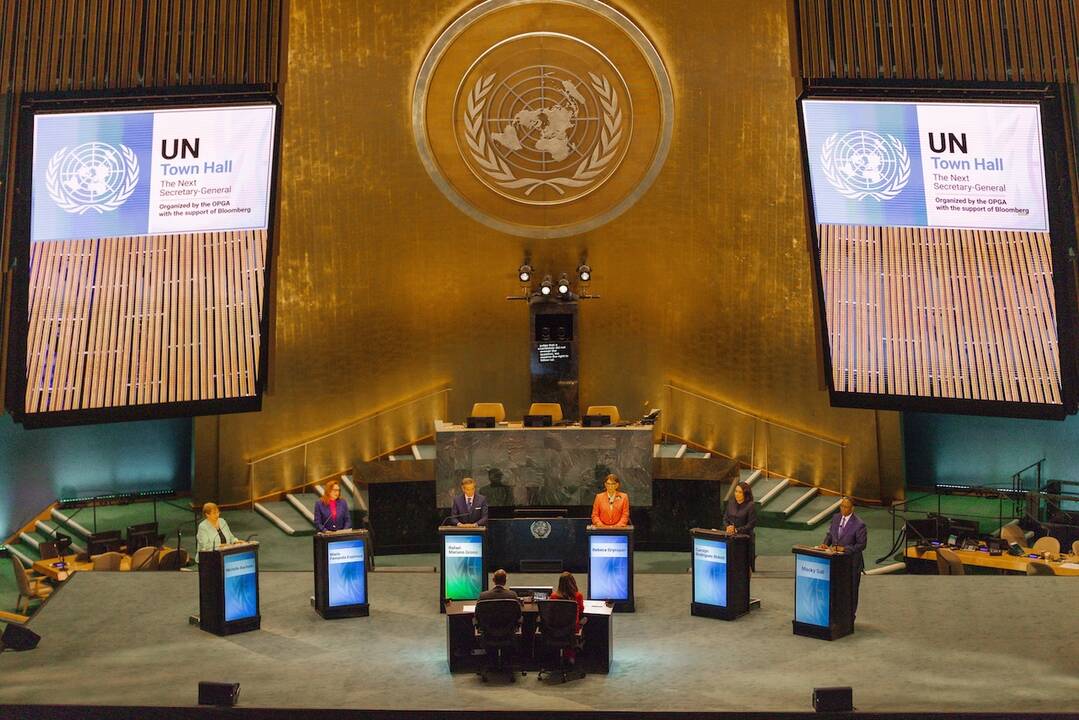
In their latest appearance, the six candidates faced off on Thursday in a 90-minute livestream from the General Assembly Hall, defending their platforms and answering questions from the public
But the way the straw polls are conducted reveals the extent to which the decision rests in the hands of a few. “No matter how much transparency we’re adding to the process with all the interactive dialogues and the interviews and the town halls, the selection of the secretary general is still in the realm of the five permanent members who can veto the election,” the western diplomatic source said. Despite strict voting rules, he added, results are promptly leaked by insiders after every balloting round.
For another diplomat who was also privy to earlier straw polls, the critical stage of the selection still falls short of expectations regarding transparency. “Even if we tried to call it democratic and very sacred, it’s not something which many people would expect from this straw polling,” he said. He noted that in 2016, the ten non-permanent delegations considered how they could act together to influence the choice, while cautioning not to “overestimate” the closed-door discussions, pointing to the unequal influence leveraged by the United States, Russia, China, the United Kingdom and France in anointing a nominee.
Dark horse nominations
In 2016, the 10 non-permanent members had also tried to impose a deadline on candidates entering the race. However, experts do not exclude a last-minute “dark horse” entering the race this time round if none of the current candidates receives the necessary support from the Security Council
Ten years ago, Kristalina Georgieva, who at the time was vice president of the European Commission, entered the race in September, only a month before Guterres was confirmed as secretary general.Latecomers would still be expected to engage in dialogues with member states and other interested parties under new transparency rules. But, according to one of the former diplomats, they would poorly represent the interests of the whole membership
Best foot forward
In last week’s televised town hall gathering, all six candidates appeared well prepared to respond to fast-paced questions from moderators, ambassadors, staff and civil society representatives
Grossi, director general of the International Atomic Energy Agency, who is often cited as a front-runner, underscored his qualifications as a peace-maker and mediator exemplified by his engagement with warring parties in Ukraine and Iran
Bachelet said as secretary general, she would “speak out loud” with moral authority and not allow herself to be bullied, echoing the pressure she faced as UN human rights chief.Espinosa, a former Ecuadorian foreign minister, spoke about the need to break silos among the multitude of senior management leaders at the UN working independently on thematic issues to manage crises better
When asked what she would do to protect the UN “at all costs” if selected, Unctad secretary general Rebeca Grynspan pushed back, saying “we don’t start by giving up”. She said it was important to build on a recent resolution that cancels the return of unspent contributions, while using funds wisely to demonstrate “the use of taxpayers’ resources in the best way possible”.While Sall called for a redesign of the global financial system, all candidates agreed that the private sector should be more involved in development.
