

OpenAI’s first gadget is the $230 Codex Micro macropad
OpenAI’s first hardware is a $230 macropad built with Work Louder. The Codex Micro’s Agent Keys light up to show what your coding agents are doing.
Jul 15th, 2026 12:01pm byFrederic Lardinois
OpenAI’s Codex is about to hit 9 million users, and at least some of those users will soon get a new way of using OpenAI’s agentic coding tool: a programmable mechanical macropad OpenAI developed in partnership with Work Louder
Launched on Wednesday in limited numbers, the $230 Codex Micro is a variation on Work Louder’s low-profile Creator Micro 2 keyboard (and the company previously launched a similar macropad in collaboration with Figma and currently offers a special edition for Framer users, too)
Orders are now open until supplies last
OpenAI’s first hardware product
Depending on how you define things, this is OpenAI’s first hardware product, but it’s worth noting that this isn’t the fabled Jony Ive collaboration. That’s a completely different product. This is basically a reskinned version of a previous Work Louder keyboard
As for the hardware itself, it looks like the Codex Micro is using Work Louders own low-profile mechanical switches, which is no surprise, given that Work Louder specializes in low-profile keyboards
Buyers get a choice between silent and clicky switches, and can connect the Codex Micro with a USB-C cable or over Bluetooth
Keys for your agents
Compared to the Creator Micro 2, the OpenAI version is more expensive, but there’s a reason
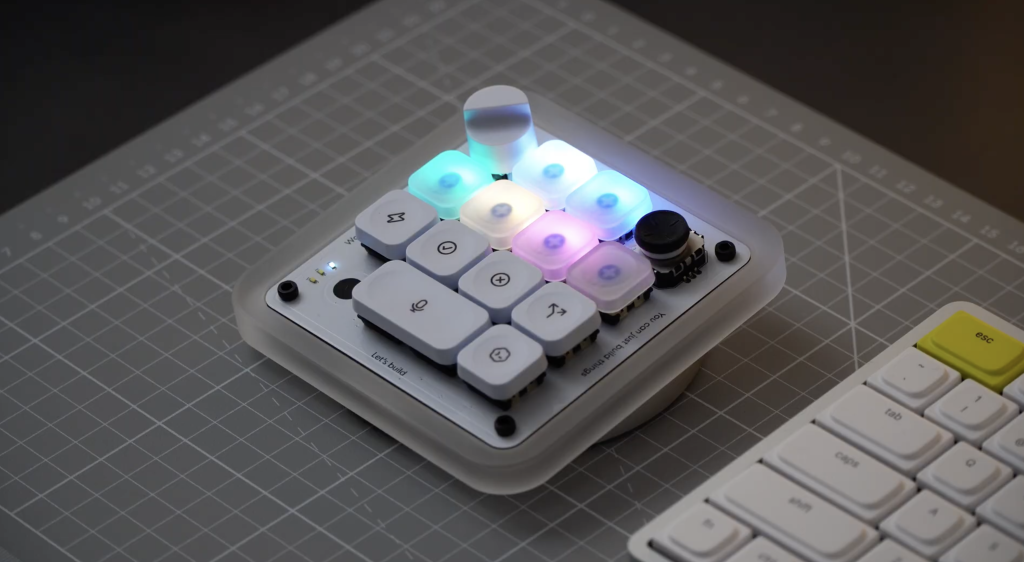
In addition to a dial and joystick, it features what OpenAI and Work Louder call ‘agent keys.” These are the six top keys on the pad that have shine-through keycaps that light up in different colors depending on the state of your agents. A single tap selects the agent associated with the key, a double-tap brings it to the foreground, and the color tells you what is happening at a glance: a white light means the agent is idle, blue means it’s thinking, green means it’s finished, red means there was an error.
Since everything on the Codex Micro can be customized using Work Louder’s proprietary Input tool, users get to choose whether those six agent keys represent pinned tasks in Codex, the most recent tasks, or priority tasks that need human input. For full control, there is also the option to assign a specific agent to a key
At the bottom of the macropad, there are six regular keys that, by default, are assigned to let the user accept or reject changes and branch threads. The larger button on the lowest row is set to activate the push-to-talk feature — because in Silicon Valley, using Codex by voice is seemingly the third step of enlightenment
The Codex Micro has an acrylic edge that is also LED-lit, so when Codex is recording, it will light up, so you know the mic is on
As for the joystick, by default, it controls the composer bar in Codex while the dial lets you make selections. But like with all things Codex Micro, it’s easy to map these to other features as well
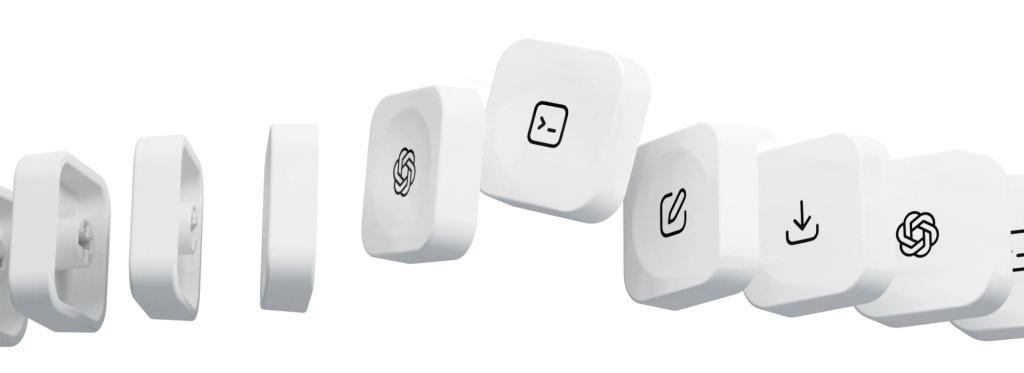
All of these keys can be remapped and the keycaps can be exchanged. The Codex Micro comes with 32 additional keycaps, including ‘yolo’ and ‘yeet’ caps for all your vibe-coding pleasure
Beyond Codex
And while Codex is the focus here, Work Louder’s Input app lets you create up to five additional layers and use them to with any other application as well
Do youneed
want it?
Do you need the Codex Micro? No
Is it a fun little toy? Sure
Will it make you more productive? Unclear
Is it worth $230? Only you can decide that
TRENDING STORIES
