

Getting your Trinity Audio player ready…
Michelle Lillywhite loves — really loves — flowers. Yes, of course, who doesn’t? But Lillywhite, a family photographer with three very young kids whom she homeschools — teaches floral workshops in her garden. While it’s also filled with fruit trees and edible plants, Lillywhite is very conscious of nurturing plants that will put out flowers in succession year-round
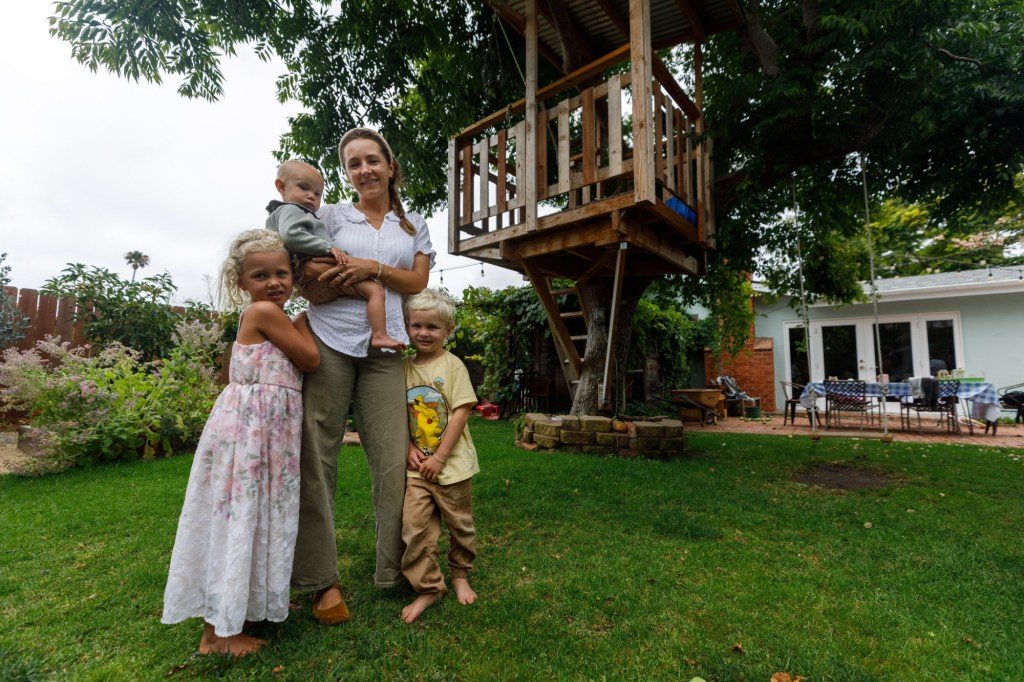
When I first saw the garden in May as part of the 2026 Clairemont Outdoor Living & Garden Tour, I was struck by the raised beds by the sidewalk filled with now-fading sweet peas alongside fat, vibrant dahlias. Walking along the driveway into the back, I then saw a spacious treehouse snuggled into a ginormous flame tree in the center of the garden that dominates the space
Along the two fences at the property line are the fruit trees that Lillywhite and her husband, Spencer, an aerospace engineer, planted when they first moved into the house in January 2020. The couple added two types of lemons, a lime, two types of oranges, a pomegranate, three types of guavas, a persimmon, an avocado, two types of peaches, cherimoyas, a fig, a mango and four varieties of bananas — all this on a tenth of an acre
There’s also a dragonfruit succulent as well as a variety of healing and cooking herbs, including lavender, borage bursting with purple flowers, cilantro, lemon balm, lemon thyme, oregano, lemon verbena and catmint
And there are the edibles, from blackberry, boysenberry and loganberry vines to climbing beans, onions and green onions and more passionfruit than one family can possibly eat in a season. The vines spread from a structure connected to the house to the flame tree, interwoven with the branches and string lights. In May, the fruit was green and there were still flowers lingering on the vines. Now the flowers are gone, and the fruit is just starting to change color. And the bunches of grapes that were also hanging nearby have since been harvested.
Oh, but the flowers!
- Chickens hang out in the patio area, which connects to a chicken coop. (Kristian Carreon / The San Diego Union-Tribune)
1 of 4
Chickens hang out in the patio area, which connects to a chicken coop. (Kristian Carreon / The San Diego Union-Tribune)
Expand
“We have about 25 rose varieties, including multiple David Austin and climbing roses,” Lillywhite said. “And heirloom zinnias from Dawn Creek and Floret Flower Farm, dahlias from growers across the country and also grown from seed from Floret. We have cosmos coming in shortly, and calendula.”
As if that weren’t enough, Lillywhite and her husband have five chickens and a whimsical coop he built alongside the garage with a fenced-in space behind the garage, complete with fire pit and four orange Adirondack chairs that the hens enjoy hanging out in
In short, it’s a charmingly irresistible space
When the family moved in, there was nothing but grass and, beyond the grass, “a mess,” as Lillywhite put it. So the couple got to work. They had had gardening experience from their prior home in Ocean Beach before moving into this house
“We were used to amending the soil, planning out,” she recalled. “I wasn’t doing seed starting there, but we were used to going to the nursery, shopping for plants, and planting in the other space. We hadn’t done any fruit trees prior to here, but growing up, my dad always had fruit trees on our property.”
Lillywhite grew up in Camarillo in Ventura County. “My dad always had a couple of garden beds, and he probably had 15 fruit trees he would tend to. I would pick things sometimes, but I wasn’t really actively involved. But I grew up appreciating homegrown produce.”
- Blueberries ripen in the Lillywhite yard, which has many varieties of fruit trees and bushes. (Kristian Carreon / The San Diego Union-Tribune)
1 of 5
Blueberries ripen in the Lillywhite yard, which has many varieties of fruit trees and bushes. (Kristian Carreon / The San Diego Union-Tribune)
Expand
“My dad told us when we moved in to buy our fruit trees first because that way we’d have fruit soon,” she said. “So that was the first thing we did.”
Once the trees were in, they put raised beds in the front, alongside the driveway fence and in the back for the herb garden
Spencer installed the decomposed granite pathways and relocated small boulders that had been scattered around the garden. Being the engineer he is, he built the coop and treehouse
“My sister moved down here and had chickens in Vista, and I thought, wait, we should have chickens,” she said. “So my husband built that coop that year, and then the treehouse. He just loved the idea of a treehouse, so he put that in last year, in 2025. He just really likes projects.”
- A catmint plant. (Kristian Carreon / The San Diego Union-Tribune)
1 of 5
A catmint plant. (Kristian Carreon / The San Diego Union-Tribune)
Expand
That includes fertilizing the fruit trees, pruning the trees and bushes, helping with the compost and lawn mowing. He also installed drip irrigation with the help of his father
“I mainly take care of the garden beds and prune the roses,” she said. “I’m kind of like the flower one and he does a lot of other stuff. It’s definitely a tag team. I think you both have to love it if you want to have a garden.”
In the six years Lillywhite’s been working on the garden, she has learned a lot
“I used to think that I could just do things out of order, like I could just pop a bunch of things in the ground without drip (irrigation) being set up, and I could have time to manually water, and then, you know, I’d have time to compost randomly,” she said. “But I feel like I’ve learned that there’s kind of like a flow: You got to get your soil prepped, your drip done well
“It’s kind of like building a house. You need a good foundation,” she explained. “And now I have my seed-starting setup over here on the table, so then I can pop in seeds to the good soil that are getting good drips. I think once the soil is good and the water is good, it becomes a really good ecosystem, so it’s easier to help things grow. I notice a lot of people, they don’t do those things first, and then they’re struggling with pests, disease.”
Lillywhite is big on mulching with the leaves that fall
“I told my workshop attendees that, about how, when you look out in nature, you look out of the fields, you have the season of growth and you have the season of fall, where everything dies, and then everything stays on the soil, so it’s composting down, and then it’s growing, and then composting down,” she said. “Unless you’re in the desert, you never just have bare dirt.”
That flow with the seasons extends to her planting calendar, especially for flowers
“I kind of know by now what things do well in certain seasons. So, in fall I’m planting, like, snapdragons, stock, ranunculus, a couple different types of ranunculus. What else am I doing? Spring sweet peas. Those will be in for the spring
“Right now, I’m just finishing up my summer planting. Then I’m putting in zinnias, cosmos and some strawflowers,” she noted. “In winter, you can start seeds and plant bulbs.”
Lillywhite does a lot of seed starting — she has some starts, as she mentioned, on the patio table, and is waiting for the sweet pea pods to begin exploding so she can gather seeds for next season and to sell in her neighborhood. Her sister in Vista has a farm store and sold her sweet pea seeds there
“We might eventually have a tiny farm stand out front here to sell things like seeds or extra fruit,” she said. “That’ll be next year’s project.”
For the plants she buys, Lillywhite shops at a variety of nurseries
“I go to Walter Anderson (Nursery) normally for my more mature plants. I buy a lot of my roses from David Austin, and my seeds I get from Johnny Seeds most of the time,” she said. “I buy my zinnias from Dawn Creek Farm.”
If Lillywhite has any advice for people just getting into gardening, it’s mostly about learning about soil health, overcoming fear of failure and being part of a community of gardeners
“Learning about soil and soil health is probably the best thing to learn before you start a garden,” she said, “And, I think, not being afraid to fail. I feel like so many new gardeners are like, ‘Oh, well, I kill everything.’ Well, I kill a lot of things. A lot of things die, too. So not being afraid to start again, try something new. And then I think getting connected with other gardeners is a really beautiful part of gardening, because you learn so much from talking to other people, and then you can say, ‘Oh yeah, I have that too.’ “
She suggested using the experienced people who work at nurseries as a great resource
“But I think there’s no substitute for getting connected in your community too. It’s like knowing your neighbors, or like sometimes even just walking around, you’ll see someone out front like, ‘Oh, what are you growing?’ The other day we saw someone on the corner starting a succulent bed, and she didn’t know that the dump had free compost. The San Diego Gardener group is really great on Facebook. Facebook groups are really helpful for answering questions.”
Farmers markets are also a great inspiration. “You can view what we can do in our area,” she said. “So are garden tours. I feel like in order to be a good gardener, you do kind of have to be a researcher
“I think the pace of life that you have when you garden, you can’t force it, and you kind of follow the rhythms of nature. I think it’s learning that you can create beauty wherever you are. And for us, we are home a lot, probably more than most other families, because we really enjoy our space. So, I think tending to your own space and reaping the benefits and the fruit of that is really a beautiful thing.”
