

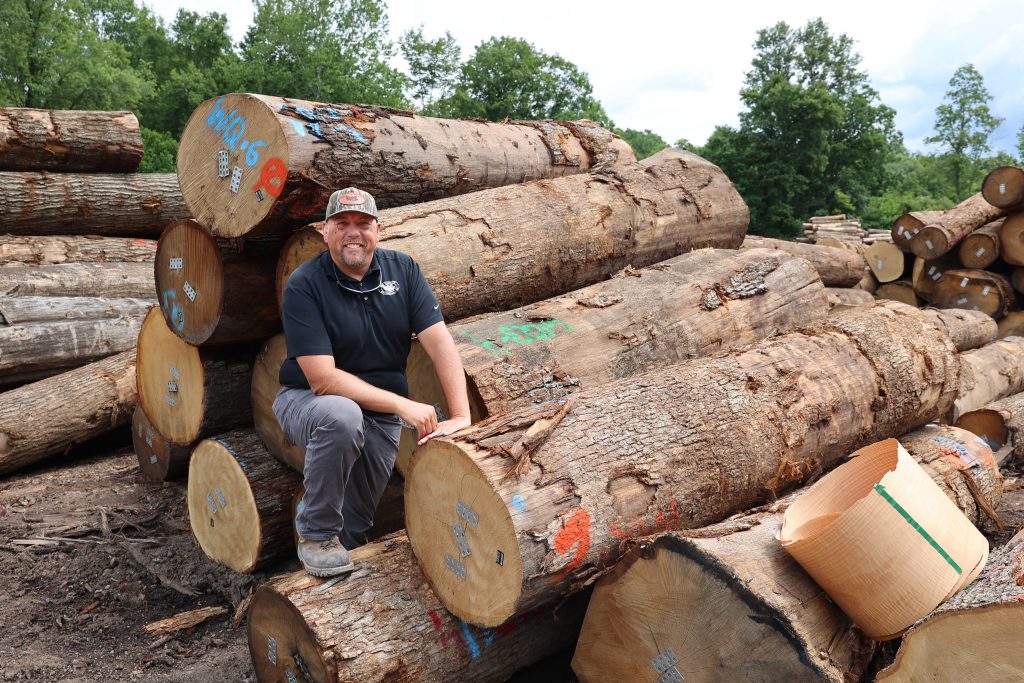
Kevin Smith ’00 was determined to be a Hokie. The list of universities he applied to while in high school was one: Virginia Tech.
That’s it. Virginia Tech and nowhere else
“I was such a diehard Virginia Tech fan that it was the only school I applied to,” Smith said. “I told myself, ‘If I get in, I get in.’”
That was 1996 and Virginia Tech boasted a football team coming off a Sugar Bowl win, but it wasn’t just athletic glory that made the university his aspiration. In high school, Smith found a calling in forestry and Virginia Tech offered the only forestry degree program in the commonwealth
Today, as vice president of Big Timber Hardwoods LLC., Smith returns to Blacksburg each April to give back to his alma mater. By spending a day in the field with forestry students, he provides them with a rare industry perspective: appraising the value of standing trees for wood veneer
Veneer is high-quality wood sliced as thin as half a millimeter to cover furniture and paneling. It requires flawless logs. Learning to identify these trees in the forest is a highly marketable, specialized skill
“Veneer potential can increase the value two to 10 times the normal amount or even more if it’s something crazy,” Smith said
“It was probably around 2006 or 2007 when I started coming to Virginia Tech to speak to the harvesting class,” Smith said. “They thought it was a good idea because guest speakers brought a unique perspective on the veneer side of things that students didn’t normally see.”
When Smith was working toward his degree in forestry, veneer was not mentioned in the curriculum
“That’s no downfall to Tech, they just didn’t have anyone with that specific industry experience,” Smith said. “It’s a unique part of the industry.”
Smith came to veneer by a circuitous route. It started with a job fair that led him to International Veneer Co. (IVC), which needed salespeople and log buyers. That led to a short winter break internship and a job offer
“I wasn’t convinced it was the right career path yet, so I turned the offer down initially,” Smith said. “My first job was as a procurement forester for Mullican Lumber in Southwest Virginia. I bought standing timber for that mill for about a year and a half. While I was there, we sold some veneer logs to different buyers and I realized what the veneer industry actually was. I figured I might like it better, so I called the guy back at IVC and he honored the original offer.”
When International Veneer Co. closed in 2012, Smith and business partner Scott Edwards opened Big Timber Hardwoods, now based in Elkins, West Virginia
Once Smith established himself in the veneer industry and became exceptional at appraising timber, he decided to be all-in on Virginia Tech again, this time in service to the students
Professor Emeritus Robert Shaffer first invited Smith to speak to his timber harvesting class. Today, he joins Assistant Professor Corey Green’s Forest Biometrics Laboratory in the Jefferson National Forest each April and demonstrates how to identify high-value, veneer-quality trees
Green said Smith offers valuable insight to the students
“This class is beneficial for students in the forestry major because appraising high-value standing timber is a unique, specialty skill,” Green said. “It prepares students with knowledge and awareness of a valuable product that can help maximize landowner management goals in the Appalachian region.”
Acing the hardest class
A native of Tazewell County, Smith was felt at home in the forests and mountains. The National FFA Organization opened his eyes to a future in forestry
“I got into forestry in high school through the FFA forestry judging program,” Smith said. “Before that, I had no idea what I wanted to do. I was pretty smart, but I didn’t want to sit behind a desk my whole life. I liked the outdoors, and that program led me to the field of forestry.”
In FFA, forest judging was more than a skill, it was a competition
“We learned species identification, which gave me a significant leg up because dendrology is notoriously the hardest weed-out class in the forestry program,” Smith said. “I already knew almost all the trees before I even started college because of that high school judging team. I actually won the individual state championship [in forest judging] in high school.”
As many students struggled in dendrology, Smith cruised to an A, which earned him a coveted peppermint patty that he proudly wore as a medal at graduation
“I only missed one tree that entire semester, and technically I didn’t miss the tree identification, I just misspelled the Latin name,” Smith said
Operating heavy equipment
At Big Timber Hardwoods, Smith can drive heavy machinery with the best of them. Ironically, it’s the equipment he hoped a college education would help him avoid
“My dad owned a very small construction company,” Smith said. “Nothing big, just a bulldozer and a backhoe, and he made me start working with him when I was 12 years old. Working every summer and after school made me realize I needed to do something different. That manual labor drove me to want a different path.”
The forestry industry is full of people who know how to manage a multimillion dollar firm and operate a skidder. Big Timber Hardwoods sells millions of dollars of logs, moving up to 500,000 board feet of timber a month, including 30,000 to 40,000 board feet of veneer
While Smith hits the road in his pick-up truck, travelling extensively in West Virginia, Virginia, Tennessee, North Carolina, Pennsylvania, and Ohio, he still has a hand in all levels of the business, from appraising entire stands of timber to contracting logging companies to cut it, or buying veneer-quality logs from suppliers who cut it to sell
“This is just something I really enjoy,” Smith said. “I get to do something different every single day.”
Contact:
540-231-6157
