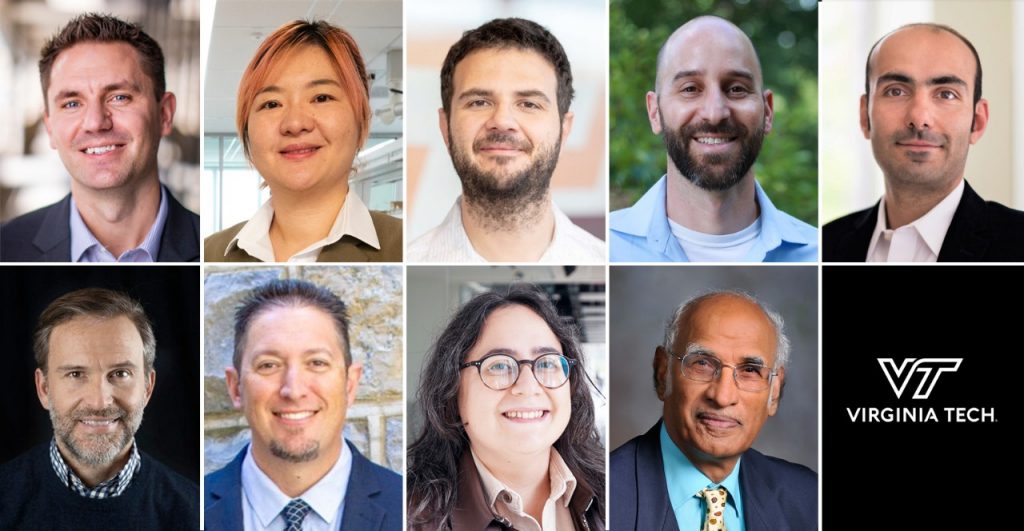
Nine Virginia Tech faculty members have received U.S. Fulbright Scholar Awards for the 2026–27 academic year
Over the coming year, the scholars will conduct research in aerospace materials, artificial intelligence, environmental health, water reext-generation wireless communications. Working with collaborators in Turkey, Japan, Italy, Spain, Germany, Australia, India, and Hungary, they aim to strengthen international research partnerships while addressing shared scientific and societal challenges
“Research thrives when diverse ideas and expertise cross borders,” said Dan Sui, Virginia Tech’s senior vice president for research and innovation. “Through the Fulbright Program, our faculty build international collaborations that spark innovation and strengthen our ability to address society’s most pressing challenges. These experiences expand Virginia Tech’s global research network while creating new opportunities for discovery and impact. We are proud of our Fulbright scholars, whose work exemplifies the university’s commitment to advancing research that improves lives and serves communities around the world.”
According to the website, the Fulbright U.S. Scholar Program supports faculty exchanges for teaching and research in more than 160 countries. Fulbright alumni include heads of state, Nobel laureates, Pulitzer Prize winners, MacArthur Fellows, and leaders across government, academia, business, and the arts. Since the Fulbright Program’s inception in 1946, nearly 185 Virginia Tech faculty members have been selected for Fulbright Scholar awards.
Fulbright Scholar Award recipients
Pinar Acar, Turkey
Acar, associate professor of mechanical engineering, will collaborate with researchers at Istanbul Technical University, her alma mater, to develop architected materials for aerospace applications that are both lightweight and structurally efficient. The project builds on her Virginia Tech research on modeling and designing advanced 3D-printed material architectures, including spinodal structures
Wenjun “Rebecca” Cai, Japan
At Tohoku University in Sendai, Cai, associate professor of materials science and engineering, will develop an artificial intelligence-assisted framework for designing more durable, wear-resistant alloys and coatings for aerospace and advanced manufacturing applications. The collaboration includes shared datasets, student co-mentoring, workforce development, and industry partnerships aimed at accelerating the translation of research into practice
Alasdair Cohen, Italy
Working with La Sapienza University and rural utilities in Italy’s Lazio region, Cohen, associate professor of environmental epidemiology, will study how sewer infrastructure, precipitation, and other factors affect wastewater composition and treatment effectiveness in rural communities. Building on research conducted in rural Virginia, the project addresses a significant gap in understanding wastewater systems in such settings
Hosein Foroutan, Spain
Foroutan, associate professor of civil and environmental engineering, will partner with researchers in Barcelona to investigate how microplastics and nanoplastics move between the ocean and atmosphere in the western Mediterranean Sea. Combining field sampling, laboratory analysis, and atmospheric modeling, the project aims to improve understanding of plastic pollution while informing monitoring strategies and strengthening U.S.-Spain scientific collaboration
Brook Kennedy, Germany
At the Technical University of Munich, Kennedy, professor of industrial design, will explore new design applications for cottonid, a biodegradable cellulose-based material experiencing renewed interest in sustainable manufacturing. Working with designers, industry partners, and graduate students, he plans to develop material samples that demonstrate the material’s potential for circular design
Landon Marston, Australia
Marston, associate professor of civil and environmental engineering, will collaborate with researchers at the University of Southern Queensland and the One Basin Cooperative Research Centre to develop new satellite- and machine learning-based tools for mapping irrigation infrastructure across Australia’s Murray-Darling Basin. The project aims to improve water accounting, drought planning, and agricultural resilience while developing methods applicable to agricultural regions around the world
Rangaswamy Muniappan, India
Based at Sri Konda Laxman Telangana Horticultural University in Hyderabad, Muniappan, entomologist and director of the Integrated Pest Management Program in the Center for International Research, Education, and Development, will help implement an integrated management program for melon fly, a destructive pest affecting cucurbit crops throughout tropical Asia and Africa. Working with university, government, and industry partners, the project aims to reduce crop losses and strengthen food security for farming communities. Muniappan previously served as a Fulbright research scholar in India during the 1980s.
David Schmale, Australia-United Kingdom–United States
Working with five host institutions across Australia and the United Kingdom, Schmale, professor of plant and environmental sciences, will lead a collaborative effort to improve the prediction, detection, and response to atmospheric incursions of invasive crop threats using advances in aerobiology, geospatial sensing, genomics, and modeling. This is his second Fulbright, following a previous appointment in New Zealand in 2020
Walid Saad, Hungary
Saad, the Rolls Royce Commonwealth Professor of Electrical and Computer Engineering, has received the Fulbright Program’s John von Neumann Distinguished Award in STEM. During his residency at Budapest University of Technology and Economics in spring 2027, he will work to develop artificial intelligence (AI) frameworks for AI-native 6G wireless networks capable of adapting to dynamic environments while meeting the ultra-low latency, resilience, and data management demands of future communications systems. The project aims to foster collaboration between U.S. and Hungarian researchers through joint publications, presentations, and community engagement.
For advice and reVirginia Tech’s Fulbright Fellowships webpage. For information on the Fulbright Student Program, contact the Global Education Office
Related story
- Article Item

Student Fulbright scholars extend the university’s global reach
, article