

Getting your Trinity Audio player ready…
From her postage-stamp-sized backyard near the BART tracks, Penny Barthel is growing a revolution
About 10 years ago, the longtime educator, gardener, author and foodie began to raise cannabis in her lush, colorful kitchen garden in Albany. A novice to cannabis, Barthel’s project was as extension of her love of “messing around with herbs” to formulate new recipes. She also wanted to help a friend grow the plant for a loved one with stage 4 cancer
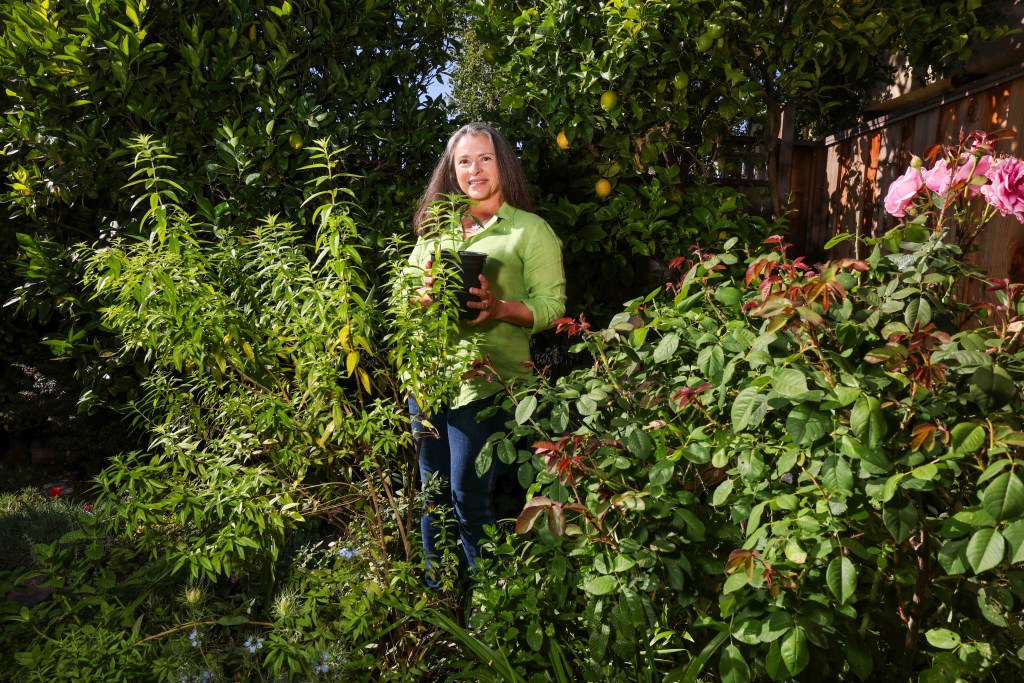
In mid-May, Barthel held up a roughly six-inch-tall “Blue Orchid” cannabis plant in a small pot that she’ll soon transplant into her garden, alongside her mint, thyme, blueberries, edible flowers and lemon trees. She expects this and the “Orange Cream Pop,” “Lemon Grass” and “Penny’s Pine” cannabis plants she’ll be growing this summer to shoot up as high as 6 or 7 feet during the season, which lasts until early October
“They really look like shaggy Christmas trees when mature,” she said
Barthel wants everyone to be able to grow cannabis in their backyards — because it’s fun and because they can put the plant to use in a variety of ways, including therapeutically. Cannabis is used medically to help people sleep, reduce anxiety, alle
Of course, Barthel’s mission would have put her on the wrong side of California law before 2016, when Proposition 64 made recreational use legal. Theoretically, her mission still puts her in the crosshairs of the U.S. government, because cannabis continues to be classified as a Schedule 1 drug with “no accepted medical use” by the feds
But Barthel wants to challenge what she calls the “unexamined narratives” that cannabis is a dangerous gateway drug or can only be appreciated by stoners. She doesn’t see why cannabis can’t become as much a summer fixture in backyard gardens as tomatoes, beans or other popular annuals
“I will say my real goal is pretty lofty. I want cannabis to be legalized and to be available and safe and legal for anyone who wants to grow it in their backyards,” said Barthel. “And the best way to do that is just to encourage people to grow it and see what happens.”
As part of her mission, Barthel published her 2021 book “The Cannabis Gardener” (Ten Speed Press), after her initial research into cannabis biology and its applications in medicine, food and even cosmetics prompted her to fall in love with it, she said. Four years ago, she began partnering with Emily Gogol, an Oregon-based grower and advocate for home cultivation, to give talks on cannabis at nurseries and garden clubs around the Bay Area, from Concord to Dublin to Cupertino
RELATED: Ziplines. Glamping. Pickleball. Inside the trends shaping Bay Area backyard design
The two women have booked an increasing number of speaking gigs over the past year, including at popular venues like Sloat Garden Centers and SummerWinds nurseries around the Bay Area, and even at the venerable Marin Art and Garden Center. To Barthel, who also serves on the board of the Berkeley Herbal Center, the uptick in speaking gigs signals a shift in public attitudes. So, too, does the fact that some nurseries have begun to stock and sell cannabis seeds themselves
Barthel’s talks tend to unfold like any hour-long gardening class at your local nursery. She introduces people to the basics of raising the plant from seed to flower and offers tips on best soils to use and best practices for growing in a pot, raised bed or in ground. For novice growers, Barthel likes to emphasize that cannabis is hardy and fast-growing like a weed. At the same time, she warns that the plant is highly sensitive to light and needs lots of direct sunlight – six to eight hours a day. That means that cannabis thrives in certain micro-climates and won’t work as an indoor plant unless the grower invests in a professional-level lighting set-up.
Barthel also discusses the advantage of using “feminized” seeds and how to harvest, dry, cure or store one’s grow. Her book, with its glossy color photographs, also offers recipes for turning dried buds into salves, tisanes and tinctures, and using home-made cannabutter to make treats such as CBD-infused vanilla gummies and cannabis chocolate sauce
But because cannabis isn’t just any plant, Barthel also touches on topics outside the usual gardening class curriculum. That includes the legal complexities of outdoor growing. State law allows people over 21 to grow up to six plants for recreational use — and that’s per household, not per person. Barthel also advises growers to check their city or county regulations. Local municipalities, as well as landlords and HOAs, may impose further restrictions, such as requiring that outdoor plants be kept in a secure, fenced-off area. Or they may ban outdoor cultivation altogether.
Any talk about growing cannabis has to start with helping people understand THC and CBD and how these compounds make people feel. THC, the plant’s primary mind-altering, psychoactive compound, is associated with euphoria and getting high, while non-psychoactive CBD is good for anxiety and other maladies or cultivars, come with different concentrations of either or both
Following a May 14 class, Barthel suggested to Chris Michon, a first-time grower, that he try “Penny’s Pine,” a cultivar sold by Gogol’s Grow It From Home nursery and named for Barthel. She said: “It’s one-to-one. Half THC and half CBD. It smells like pine, and it’s going to be uplifting. It will be a fun high.”
“I’ve been looking for that,” Michon said. “Not paranoid?”
“Not paranoid,” Barthel assured him
During the May 14 talk, the audience included members of the Sloat Garden Center staff, all of whom showed excitement about learning to raise a new plant or expanding on knowledge they already have. Barthel also passed around jars of dried cannabis buds for audience members to sniff, as if they were breathing in the aroma of a wine to get a full sense of its flavor
Every once in a while, Barthel meets someone who’s had very little experience with cannabis, but is dealing with a serious personal issue that has them wanting to explore cannabis
“This one woman came in,” Barthel recalls. “She was curious because her husband had been diagnosed with a brain tumor, and they had a 4-year-old. This caused her to do a lot of rethinking of her life and to think, ‘I need to go to herbal school,’ for her own use or maybe to help her husband endure treatment.”
At the May 14 talk, Michon’s friend Shawn Chan likewise said he had little experience with pot — “I don’t even smoke.” But Barthel’s talk convinced him to try growing a plant in his backyard
“I consider myself a zero green thumb, but I started growing some cherry tomatoes as a hobby,” he said. “Now that (this is) legal, I’ll give it a try.”
The only thing that made Chan hesitant about the project was the location of his home, close to the ocean. He worried that summer coastal fog would keep his plant from getting enough sun. Other than that, he was OK with not knowing yet what he wanted to do with the harvest. “I’ll figure that out when the time comes,” he said
Even among the curious, people in the gardening world remain “shy” about cannabis, Barthel said. One garden club consulted with their attorney to make sure it was legal to host Barthel. Some nurseries also won’t heavily promote her appearances. “They want to feel things out and see how customers will respond,” she said
As Barthel and other cannabis scholars say, the federal and state government crackdowns over the past century fueled the negative stereotypes and were always more grounded in culture wars than in evidence of medical harm. Starting in the 1910s and 1920s, anti-cannabis laws were introduced in the Midwest and Southwest to target Mexican Americans Later, John Ehrlichman, one of Richard Nixon’s top aides, admitted that the the president launched the war on drugs in 1971 to have a reason to prosecute Black people and hippies.
Hundreds of thousands of people have been incarcerated on cannabis-related offenses, and the DEA’s Schedule 1 classification effectively stalled medical research for decades. While medical use is now allowed in most states, adult recreational use remains illegal in nearly half of them. It’s also illegal to take cannabis across state lines or to possess it on federal lands, including national parks. Barthel laments that anti-cannabis laws encouraged growers to develop highly potent strains, just as Prohibition in the 1920s put potentially lethal moonshine into circulation.
“It turned cannabis into jet fuel,” Barthel said
The lingering negative narratives are reflected in the way that California’s legal cannabis dispensaries can be intimidating places for first-time users, where they have to show their IDs and pay for purchases in cash because most major banks and credit cards won’t process transactions, Barthel said
That’s another reason that people should be able to grow their own cannabis in their own backyards, said Barthel, who is excited about teaching more classes in the coming year and to even introduce cannabis cultivation at a major gardening show in 2027
“I’m hoping,” she said, “that as more and more of us grow and enjoy this plant we will learn a new story about cannabis, allowing it to be what it truly is: a healing, helpful, easy to grow garden herb.”
