

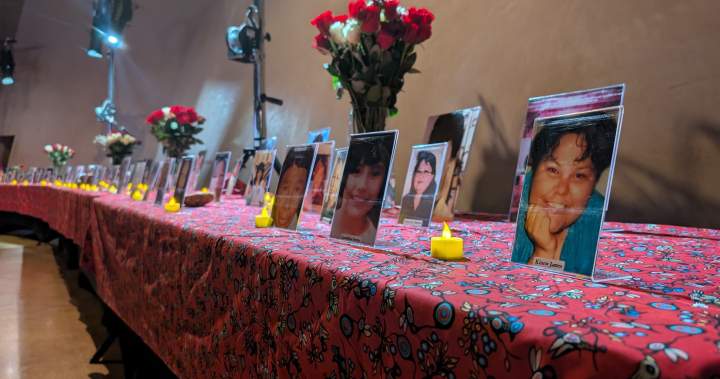
Beverley Courchene remembers her daughter as a bright, outgoing Anishinaabe woman with dreams and ambitions

“Leah was very outgoing,” Courchene said
Courchene says Leah Keeper, 32, was a loving mother of two daughters. She worked different jobs, did some modelling, and was a jingle dress dancer

View image in full screen
Randall Paull / Global News
“Her mindset was to always learn and experience different things,” Courchene said, adding that Leah had completed her goal of becoming a health care aide
“Things were good at that time of her life. She was happy. She was happy that she had this job, that she had reached her goal.”

View image in full screen
Courtesy / Beverley Courchene
But Courchene says things started to change as Leah started hanging out with the wrong crowd, and had addiction take hold of her life. She says she did seek treatment in Sagkeeng First Nation, but would fall back into the cycle of addiction while in Winnipeg
“She was always making excuses and falling deeper and deeper into addictions with people that she knew,” Courchene said. “That was very difficult at that time to see her go down that dark path.”
Courchene said Leah would regularly call to check in on her and her daughters. Then, she said, the calls became fewer and farther between
“When I hadn’t heard from her for awhile I was concerned why she wasn’t reaching out to us,” she said

View image in full screen
Supplied
Leah was last seen on July 25, 2023 near Salter and Selkirk avenues. She was officially reported missing on Nov. 21, 2023

Get daily National news
Get daily Canada news delivered to your inbox so you’ll never miss the day’s top stories.
By providing your email address, you have read and agree to Global News’ Terms and Conditions and Privacy Policy.
Courchene says that marked the start of an agonizing search for her daughter; putting up posters and searching with the Bear Clan
“It was really a difficult time for me. Especially (because) you’re dealing with that trauma. Your child is missing, your daughter is missing,” Courchene said
“I always prayed for hope that my daughter would be found, that she would come home.”

View image in full screen
Supplied
In November 2025, Winnipeg police said partial human remains were located in back alley between Selkirk and Pritchard avenues. Months later, DNA testing confirmed it was Leah. Courchene says it brought some closure, but also pain
“It gave us closure that she was found. I didn’t want her to be found deceased, but we take what get from the creator with our prayers,” she said
Courchene is now planning to lay Leah to rest, while the homicide unit is still actively investigating Leah’s case. So far, no arrests have been made
“As a mother, you still grieve for your child,” Courchene said. “Whether your child is a baby or an adult, you still grieve for them when they’re gone.”
Implementing the Red Dress Alert system
Sandra DeLaronde is the executive director of Giganawenimaanaanig, which is leading the development and implementation of Red Dress Alert system pilot project
Similar to an Amber Alert, the Red Dress Alert would quickly mobilize police and other agencies, Indigenous governments and organizations, service providers, and the general public in the critical hours and days after a community or family member is reported missing
But DeLaronde says it would go far beyond that
“The Red Dress Alert is not just a duress alarm, it’s a whole system that’s been designed by the community, many of whom have been directly impacted (by) family members and survivors of intimate partner violence,” DeLaronde said

View image in full screen
Marney Blunt / Global News
DeLaronde says the system wouldn’t just work to find missing persons, it would create a system that would follow up with the individual, understand their situation and life circumstances, and aim to move them to a place of safety and get them supports, she said
“The implementation of the Red Dress Alert system would help to move people that are missing to places of safety, so that we’re not having to support families whose loved ones’ lives have been taken.”
DeLaronde says they are aiming to have the project in effect by November
Missing persons units
A little over a year ago, the Manitoba Integrated Missing Persons Coordination Centre was formed — an initiative that brings together Manitoba RCMP, Winnipeg Police, Brandon Police, Manitoba First Nations Police, and other agencies and community groups to provide a 24-7 response to missing persons reports
“The partnerships that we have with the agencies are really critical to our success and finding missing people,” Insp. Rick McDougall of the Winnipeg Police Service’s specialized investigations unit told Global News
“Families phone, they’re concerned about their loved ones, they want them found as quickly as possible, and that’s our goal and the goal of our partnerships.”
According to data from the Winnipeg Police Service, during the first quarter of this year, there were 1,941 missing persons incidents reported to the coordination centre. Of those, 1,403 of the cases were female, and 1,266 of the cases involved youth
Lori Hawkins, the missing persons supervisor for the Winnipeg Police Service, says while there are some repeat cases, they are all taken seriously by the 18 missing persons coordinators in the centre, who are trained to risk assess and triage the calls
“They look into patterns of behaviour with the missing person — Has it changed? Are they hanging out with a new group of friends? Or they’re hanging out at different locations or people, or (has) there been new activities for them that’s just outside of their normal pattern?” Hawkins said
“We use past history with regards to pattern of behaviour, but it doesn’t matter if they reported one time or 10 times, we take each case seriously.”
The Assembly of Manitoba Chiefs has also launched a unit for missing and murdered First Nations peoples, which aims to work with police and help impacted families
“This is an ongoing crisis and we constantly have people coming to the Assembly of Manitoba Chiefs, even before the unit was established, asking for help, asking for support, with really no answers as to who they can turn to for support,” Grand Chief Kyra Wilson said. “And so that’s why the unit was created.”
