

Iran Update Special Report, August 2, 2026
The Institute for the Study of War (ISW) and The Critical Threats Project (CTP) at the American Enterprise Instituteare publishing daily updates to provide analysis on the war with Iran. The updates cover events from the past 24-hour period.
Note: ISW-CTP has revised its update structure due to the resumption of war between the United States and Iran. Iran is currently engaged in an information effort to frame its attacks on US bases and regional states as retaliatory and defensive. Iran is not merely responding to US strikes on Iran, however, but is engaged in proactive military operations to achieve discrete objectives. The revised update structure reflects some of these key objectives
Key Takeaways
- Iranian negotiators such as Foreign Affairs Minister Abbas Araghchi may be willing to make limited compromises with the United States over the extent of Iranian control over the Strait of Hormuz. The Islamic Revolutionary Guards Corps (IRGC) faction led by IRGC Commander Major General Ahmad Vahidi, which appears to be currently dominating regime decision-making, will likely reject any arrangement that meaningfully reduces Iranian control over the waterway, however.
- US President Donald Trump stated on August 1 that he canceled planned strikes on Iran after Iran — presumably referring to Iranian negotiators — and regional states informed him that they had agreed on the parameters of a deal that reportedly includes the “immediate, complete, and total opening” of the strait and “an end to Iran’s nuclear threat.”
- Israeli media also reported on August 2 that Araghchi agreed to a US- and Qatari-formulated proposal in which vessels would enter the Persian Gulf through Iranian waters and exit through Omani waters.
- An arrangement in which Iran controls inbound traffic in the Strait of Hormuz would still enable Iran to control which vessels can enter the Persian Gulf and thus continue to undermine the United States’ interests as well as global commerce. Iranian officials have repeatedly emphasized that they seek to prevent “hostile” vessels, including US Navy vessels, from entering the Persian Gulf.
- Some Iranian regime officials may be seeking to appease ultra-hardliners by emphasizing that the regime is exploiting pauses in US military operations and periods of diplomacy to reconstitute military capabilities and import new equipment. Iranian Artesh Spokesperson Brigadier General Mohammad Akraminia explicitly stated on August 2 that Iran “fully exploited” the MoU and ceasefire to import new equipment, repair and reconstruct damaged systems, and produce new systems.
Toplines
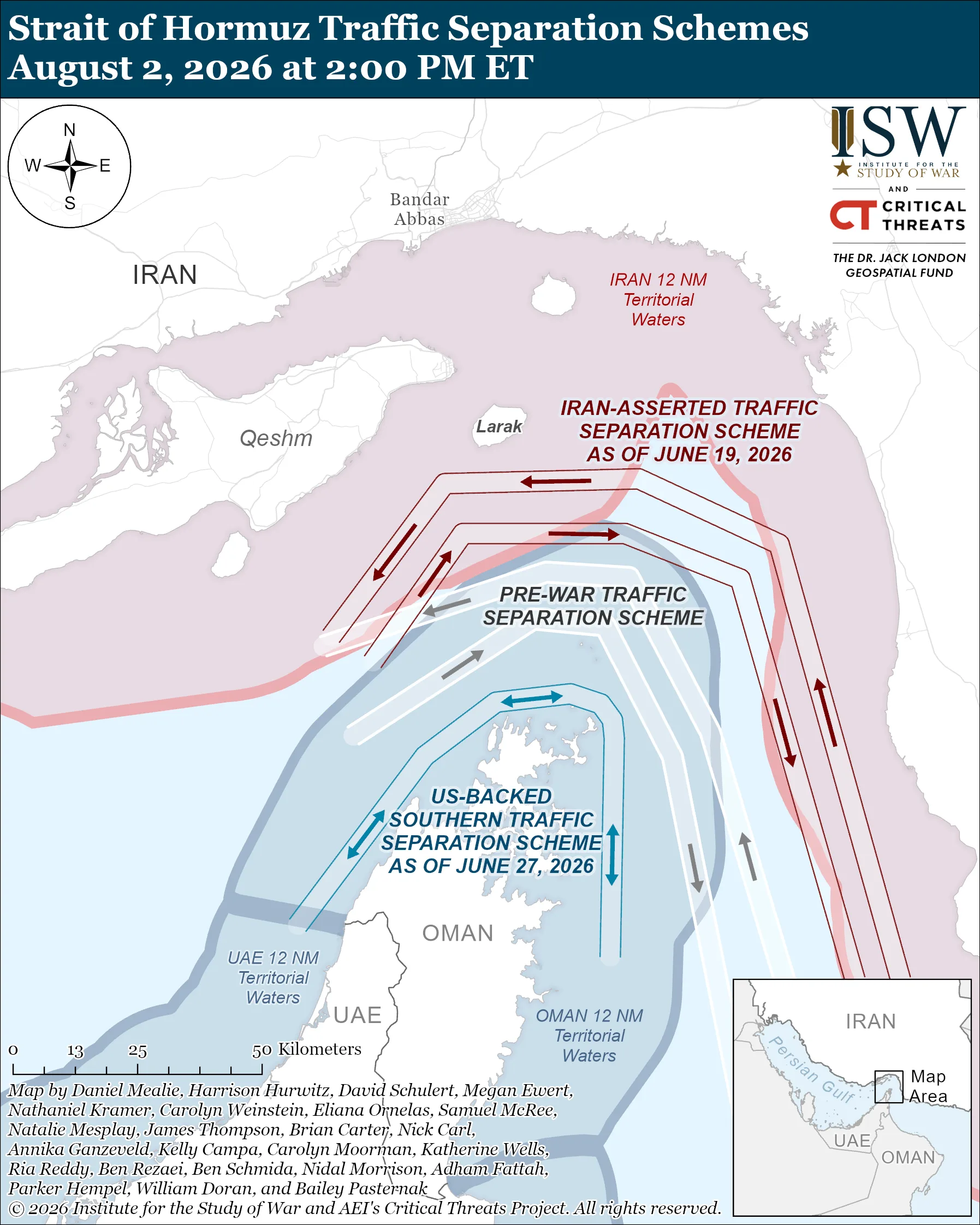
Iranian negotiators such as Foreign Affairs Minister Abbas Araghchi may be willing to make limited compromises with the United States over the extent of Iranian control over the Strait of Hormuz. The Islamic Revolutionary Guards Corps (IRGC) faction led by IRGC Commander Major General Ahmad Vahidi, which appears to be currently dominating regime decision-making, will likely reject any arrangement that meaningfully reduces Iranian control over the waterway, however.US President Donald Trump stated on August 1 that he canceled planned strikes on Iran after Iran—presumably referring to Iranian negotiators — and regional states informed him that they had agreed on the parameters of a deal that reportedly includes the “immediate, complete, and total opening” of the strait and “an end to Iran’s nuclear threat.”[1] The Wall Street Journal reported on August 2 that Qatari mediators presented Iran with a new proposal to reopen the strait and that Iranian diplomats responded “positively.”[2] Israeli media also reported on August 2 that Araghchi agreed to a US- and Qatari-formulated proposal in which vessels would enter the Persian Gulf through Iranian waters and exit through Omani waters.[3] An Iranian official previously told Reuters on July 29 that Iran must control the strait’s “entire inbound route” and “part of the outbound route.”[4] Iranian Foreign Affairs Ministry Spokesperson Esmail Baghaei stated on August 2 that the transit route agreed upon in the proposal is neither the current Iranian traffic separation scheme nor the southern route along Oman’s coast and emphasized that the proposal “has nothing to do with” opening the strait.[5] An arrangement in which Iran controls inbound traffic in the Strait of Hormuz would still enable Iran to control which vessels can enter the Persian Gulf and thus continue to undermine the United States’ interests as well as global commerce. Iranian officials have repeatedly emphasized that they seek to prevent “hostile” vessels, including US Navy vessels, from entering the Persian Gulf.[6]
IRGC-affiliated Fars News denied on August 2 that Iran agreed to a plan to reopen the strait.[7] An informed Iranian military source told Fars News that the strait will remain closed as long as the United States continues to conduct “hostile actions.”[8] The source added that vessels can only transit through Iran’s traffic separation scheme and with permission from the IRGC Navy.[9] This report highlights how some IRGC factions, likely including Vahidi’s faction, seek to retain full control over all traffic in the strait and likely oppose an arrangement in which Iran would only control inbound traffic in the strait. The IRGC controls the forces that have repeatedly attacked shipping in the strait in recent months, and it could therefore try to undermine an arrangement in the Strait of Hormuz that it deems contrary to the regime’s interests.
Iranian negotiators’ reported openness to the US- and Qatari-formulated proposal is consistent with Iranian “pragmatist” actors’ support for negotiating a diplomatic settlement to advance Iranian objectives. “Pragmatist” officials such as Araghchi, Parliament Speaker Mohammad Bagher Ghalibaf, and President Masoud Pezeshkian have consistently advocated for using diplomacy to secure Iranian interests, such as securing Iranian control over the Strait of Hormuz and obtaining economic relief.[10] Iranian President Masoud Pezeshkian has repeatedly voiced concerns about the economic costs of war, and he convinced Supreme Leader Mojtaba Khamenei to accept the memorandum of understanding (MoU) in June by highlighting the MoU’s economic benefits.[11]
Some Iranian regime officials may be seeking to appease ultra-hardliners by emphasizing that the regime is exploiting pauses in US military operations and periods of diplomacy to reconstitute military capabilities and import new equipment.Iranian Artesh Spokesperson Brigadier General Mohammad Akraminia explicitly stated on August 2 that Iran “fully exploited” the MoU and ceasefire to import new equipment, repair and reconstruct damaged systems, and produce new systems.[12] Akraminia made these remarks in response to criticism from ultra-hardline parliamentarians affiliated with the Paydari (Stability) Front who reject diplomacy with the United States.[13] Akraminia may have sought to reassure these critics that the ceasefire strengthened Iran’s military position rather than forced Iran to concede to the United States or abandon its objectives.
Akraminia’s remarks also corroborate ISW-CTP’s assessment that Iran has exploited pauses in fighting and the MoU to reconstitute its military capabilities in preparation for potential renewed conflict with the United States and Israel.[14] Akraminia added that Iran has developed new drones during the ceasefire that Iran recently used in attacks against US bases in Gulf states.[15] Iranian media reported on July 29 that Iran recently used an upgraded version of the Hadid 110 drone for the first time.[16] This drone uses a jet engine and solid-fuel booster to fly lower and faster with greater stealth, likely reducing air defense detection and interception time.[17]
Akraminia’s reference to “importing new equipment” may include Iran’s reported recent purchases of Russian Verba and Chinese shoulder‑fired man-portable air-defense systems (MANPADS).[18] Iran has reportedly used “Russian-enhanced versions” of Shahed drones and Russian targeting intelligence to attack US forces and assets during the war[19]
US and Partner Military Operations
See topline section
Iranian Strike Campaign
Assessed Iranian War Aims:
- Secure international recognition of Iranian control over the Strait of Hormuz
- Degrade the US ability and willingness to continue the war
- Restore deterrence vis-à -vis the United States and its regional partners
- Divide the United States and Israel from the Arab states
Nothing significant to report
US-Iran Negotiations
See topline section
Iranian Domestic Affairs
See topline section
Lebanon
Nothing significant to report
Nothing significant to report
Arabian Peninsula
Nothing significant to report

[1] https://www.trumpstruth.org/statuses/40453[2] https://www.wsj.com/world/middle-east/gulf-states-pressed-trump-to-hold-off-on-iran-strikes-and-pursue-talks-03bcdb52?mod=middle-east_news_article_pos1[3] https://www.mako dot co.il/news-world/2026_q3/Article-cf1b00b3d11cf91027.htm1 Heart reaction.[4] https://www.reuters.com/world/middle-east/iran-rules-out-regional-management-hormuz-strait-hitting-hopes-breakthrough-2026-07-29/[5] https://t.me/Tasnimnews/436066[6] https://www.ft.com/content/71c3295a-531a-4fa8-86bc-964b5bb821e2?syn-25a6b1a6=1 ;https://www.presstv dot ir/Detail/2026/05/04/768039/Iran-Navy-warning-shots-US-warships-Hormuz-Strait ;https://www.presstvdot co.uk/Detail/2026/06/02/769707/Iran-IRGC-Navy-vessels-transit-Strait-of-Hormuz-coordination-security-arrangements[7] https://t.me/farsna/454006[8] https://t.me/farsna/454006[9] https://t.me/farsna/454006[10] https://www.nytimes.com/2026/07/04/world/middleeast/iran-supreme-leader-funeral-divisions.html[11] https://www.nytimes.com/2026/07/04/world/middleeast/iran-supreme-leader-funeral-divisions.html ;https://www.ynetnews dot com/article/bjqqu4ui11e[12] https://t.me/sepah_pasdaran/207886[13] https://t.me/sepah_pasdaran/207886[14] https://understandingwar.org/research/middle-east/iran-update-special-report-july-3-2026/[15] https://t.me/sepah_pasdaran/207886[16] https://t.me/mehrnews/400622[17] https://t.me/mehrnews/400622[18] https://t.me/sepah_pasdaran/207886 ; https://www.reuters.com/world/middle-east/iran-strikes-cia-facilities-prompt-questions-about-possible-russian-role-2026-07-22/ ;https://www.reuters.com/world/china/iran-nears-deal-buy-supersonic-anti-ship-missiles-china-2026-02-24/[19] https://www.cnn.com/2026/03/15/world/video/gps-0315-zelensky-on-iran-drones ;https://www.wsj.com/world/middle-east/two-u-s-servicemembers-killed-one-missing-in-iran-missile-attack-on-jordan-a59f9699 ;https://www.reuters.com/world/middle-east/iran-strikes-cia-facilities-prompt-questions-about-possible-russian-role-2026-07-22/
