

What to know about the Canadian and US wildfires and their impact
22 hours ago

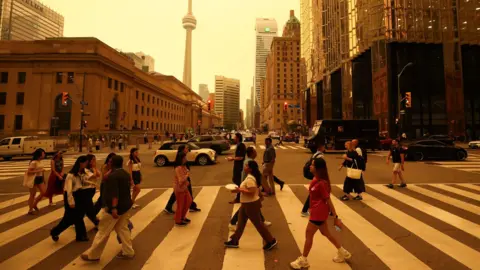
Cole Burston/ AFP/Getty Images
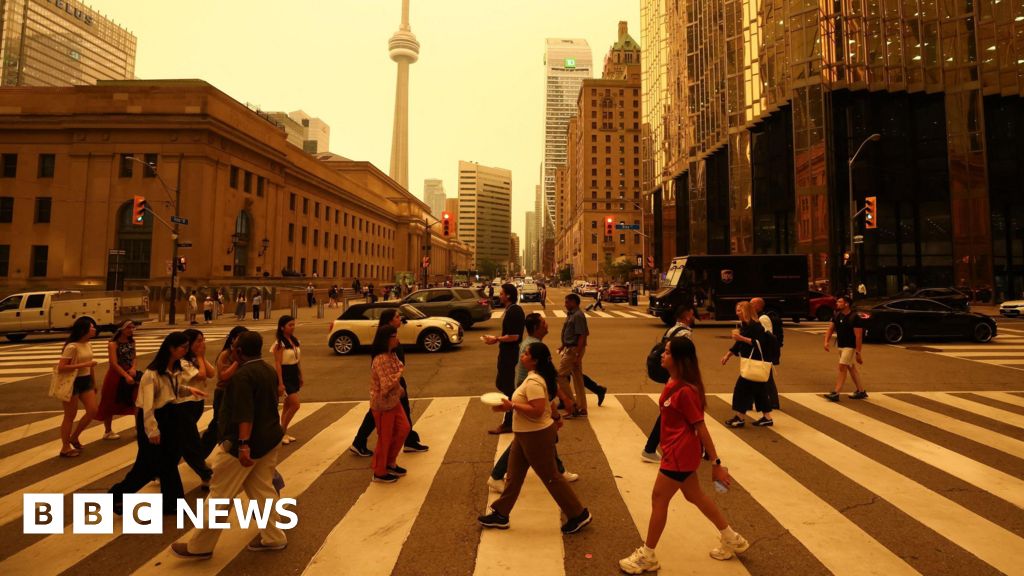
Cities across north-eastern Canada and the US are suffering from intense smoke brought on by wildfires burning across Ontario and Minnesota
Residents in New York, Boston and Toronto have been encouraged to avoid “strenuous activity” over potential health impacts caused by the pollution
Canada wildfires leave train ‘encased in flames’ as smoke drifts towards US
Where are the wildfires and how did they start?
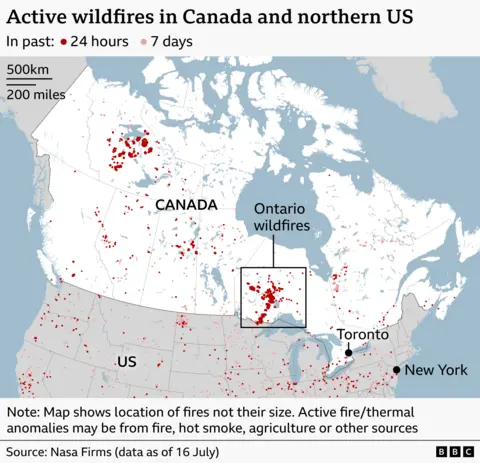
There are currently 858 wildfires actively burning across Canada – nearly 200 of those in Ontario – according to the Canadian Interagency Forest Fire Centre
Along the northern edge of Minnesota there are 17 fires that are still burning and an emergency declaration is in place to help mobilise suppression efforts
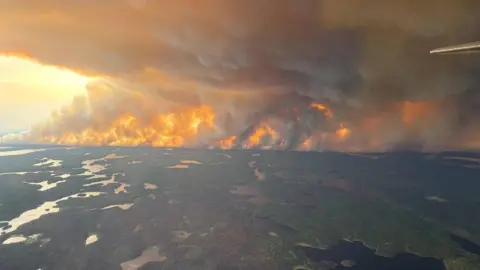
In Ontario, the fires are north of Lake Superior in more remote parts of the province, but within or close to national parks and First Nation communities
So far, six communities are under evacuation orders with reports of damage to properties
Grand Council Chief Linda Debassige said in a statement on Wednesday that the remote Namaygoosisagagun First Nation in northern Ontario was “devastated by an unexpected and fast-moving wildfire” that severely damaged homes and community buildings
Wildfires are very common in Canada, but the number of outbreaks has rapidly increased in recent weeks
The National Interagency Fire Centre in the US and Natural Reweather at the end of June across northern Ontario, and below average rainfall
This hot weather is being caused by a heat dome – an area of high pressure that gets stuck trapping warm air and the smoke underneath
Extreme and long-lasting heat draws more moisture out of soils and plants – this dry vegetation acts as fuel for fires
But this hot air can also become unstable causing the risk of storms which can produce strong winds – causing the fires and smoke to spread
Where is the smoke and what is the impact?
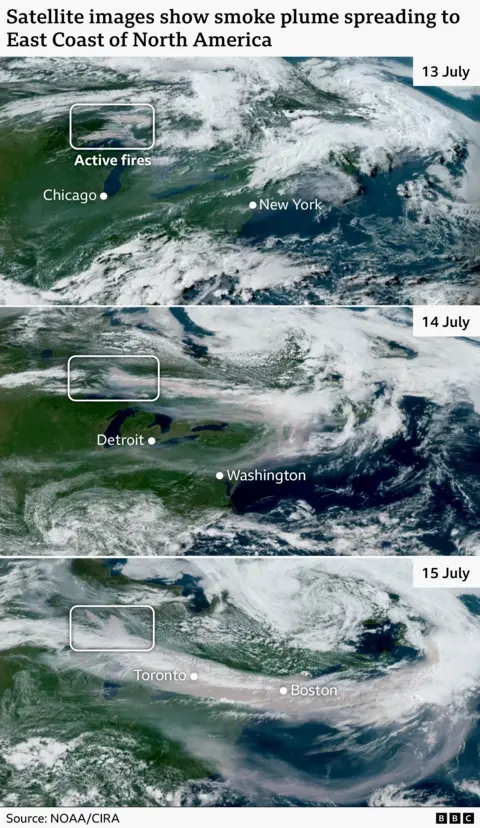
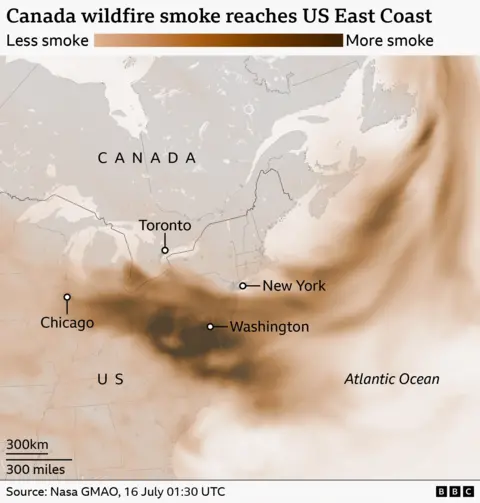
Satellite images over the past few days show the wind carrying smoke primarily south-east from Ontario across to Toronto, New York State and reaching Boston
IQAir, a company which tracks global air quality, ranked Detroit, Toronto and Minneapolis as the cities currently with the worst air quality in the world
Wildfire smoke is hazardous for humans as it contains a mixture of very small polluting particles like PM2.5 and nitrogen dioxide
“These particles when they get into our system get all the way down into our lungs, all the way down to our tiny breathing tubes and… they cause inflammation,” said Jim McDonald, New York State Department of Health commissioner, in a public address video on social media
The smoke can exacerbate existing respiratory, heart, kidney and eye conditions, according to the World Health Organization
Emergency responders, and vulnerable groups such as those with chronic illnesses and children – who are closer to the ground where the smoke can sink – are most at risk
Governments will issue warnings depending on the air quality level which advises people on precautions to take. For example, an orange alert means people are advised to:
- avoid strenuous outdoor activities
- stay indoors and close windows
- wear a well-fitting N95 mask
- seek medical attention for symptoms that include wheezing, breathlessness and chest pain
KN95 or N95 masks should be able to filter out 95% of these tiny particles – although there are still risks
There are fraudulent copies being sold online so make sure it is government certified
Many cities have activated their air quality emergency protocols and are distributing masks at local centres
For further information on your local air quality alerts, consult this site if you’re in Canada, and here if you’re in the US
How long is it expected to last?
Wind patterns suggest that the smoke will start to move south down to Virginia and parts of North Carolina – with their exposure ramping up until Friday
A second smoke plume has been forecast to hit New York and Boston later on Thursday
The Commissioner for the New York Department of Environmental Conservation, Amanda Lefton, said on social media: “Much of New York will see visible smoke throughout the state. This will likely be a prolonged effect, and we might see even worst air quality.”
There is some concern that smoke will still be lingering come Sunday when the final for the football World Cup is scheduled at MetLife Stadium in New Jersey – especially because it is an open-air venue
The long-term fire outlook for the season suggests the wildfire risk will continue to be above normal in the Canadian Northwest Territories, Ontario and Quebec throughout July and August
Are Canadian wildfires getting worse?
Government of Manitoba /Handout/Getty Images
Wildfires are a natural part of boreal forests – of which Canada has vast swathes. However, they have worsened in recent years
The 2023 fires razed 15 million hectares (37 million acres) – an area larger than England – while the 2025 blazes burned 8.3 million hectares (20.5 million acres)
In Canada, half of wildfires are sparked by lightning and the rest from human activity – but drier soils and vegetation increase the likelihood
Increasing global temperatures as a result of climate change is making heatwaves more frequent and severe, contributing to such conditions
Climate change is also increasing the temperature over winter
These milder conditions in the first part of the year can stimulate earlier plant growth providing more fuel for burning, and reduces the amount of snow cover
Snow, with its very white surface, helps to reflect the sun’s radiation and has a cooling effect. The less snow, the hotter it becomes
Canada wildfires spread smoke across North America, sparking air quality alerts
Air pollution
Wildfires
Climate
Canada
United States
