

Getting your Trinity Audio player ready…
For The Union-Tribune
California’s parks tell many different stories about our state. Some protect natural landscapes and provide places for outdoor recreation. Others conserve the buildings and landscapes that reveal how people once lived and worked
Leo Carrillo Ranch Historic Park is one such place, maintained by the city of Carlsbad. Today, it is one of San Diego County’s historic treasures
A park shaped by land and use
Leo Carrillo Ranch Historic Park preserves a 1930s working ranch and guest retreat. A canyon setting shaped the park’s landscape of gardens, buildings, and plantings. Visitors see how shade, adobe walls, courtyards, trees and drought-tolerant plants tempered the rugged canyon terrain to support both the daily labor of a working ranch and the hospitality of a private retreat
Behind the buildings and plantings was an owner with deep ties to California’s ranching past. Leo Carrillo is remembered as Pancho from “The Cisco Kid” television series in the 1950s. He was also a seventh-generation Californian from a family that once owned ranches under the Spanish and Mexican land system across Southern California
After the Land Act of 1851, many families, including the Carrillos, lost what they’d once held. In 1937, Carrillo bought this canyon property and named it Rancho de los Quiotes after the tall flowering agave stalks prevalent in the surrounding hills. He arranged his gardens to blend with the dense chaparral, planting native toyon alongside imported citrus and palms to recreate an early California look
Today, the park shows how Carrillo used elevation, plantings and shade to organize space for daily life, guests and agricultural work
Entering the canyon ranch
Visitors begin to see Carrillo’s physical layout as they take the switchback ramp from the parking area that leads down into the canyon. Toyon (Heteromeles arbutifolia) and coast live oak (Quercus agrifolia) line the hillside as part of the canyon’s original plant community. Carrillo later added Burbank spineless prickly pear (Opuntia ficus-indica) along the slope
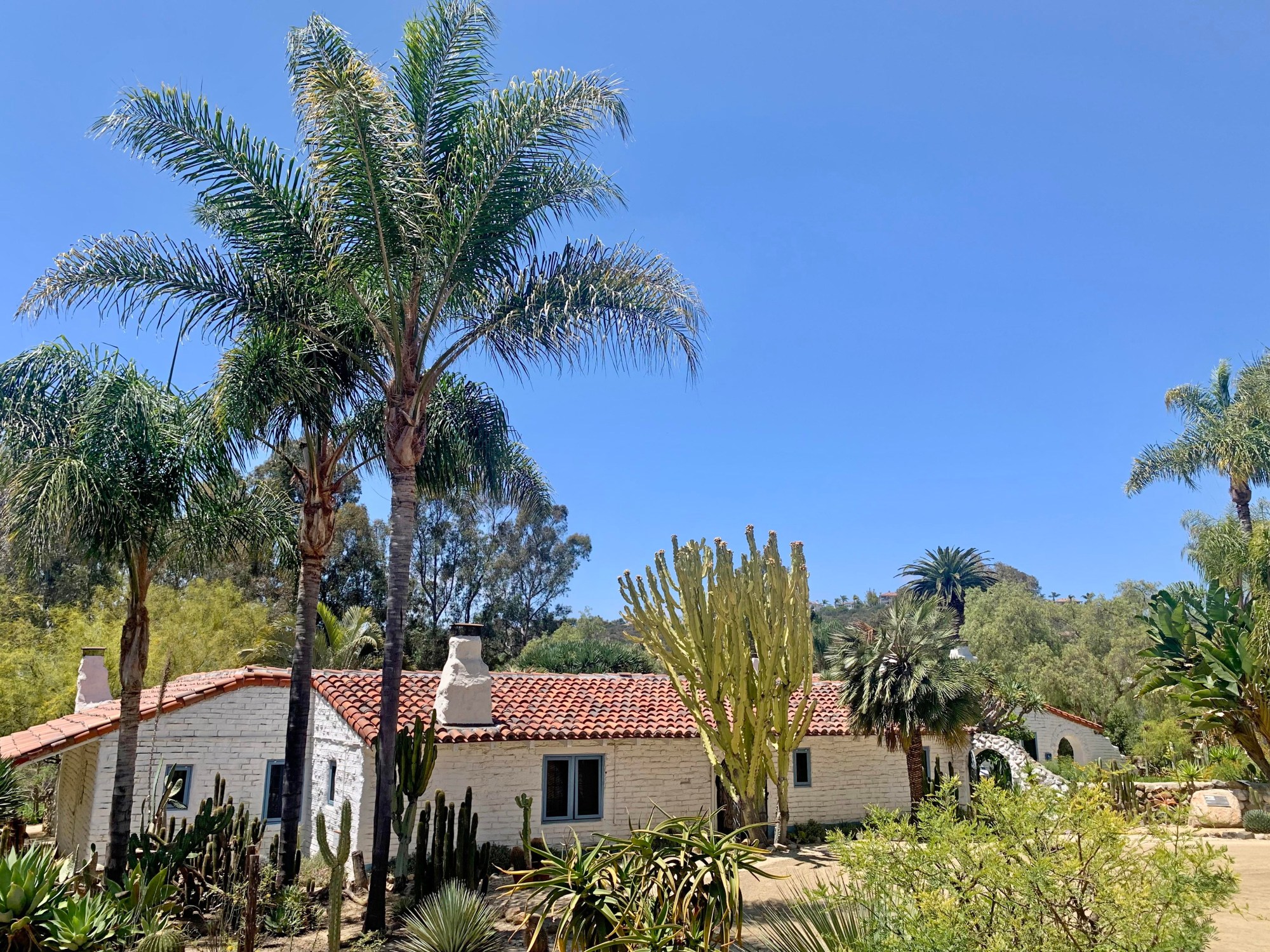
At the canyon floor, the caretaker’s house and Palm Lane mark the historic entrance into the ranch where guests arrived and checked in. Queen palms (Syagrus romanzoffiana) line the path and guide movement toward the adobe buildings ahead. Carrillo’s drought-tolerant planting choices combine different shapes and textures, with structured vertical palms and large, sculptural succulents contrasting with the softer foliage of pepper trees (Schinus molle), sycamores (Platanus racemosa) and willows (Salix lasiolepis).
Palm Lane leads to the restored adobe buildings and flagstone courtyard, the hub of the ranch where Carrillo lived and hosted guests. Decades-old trees mark the space: a candelabra tree (Euphorbia ammak) at the entrance and a dragon tree (Dracaena draco) at the back of the courtyard. Carrillo planted these exotic succulents to add architectural drama to his main entertaining areas
Beyond the courtyard, the stable, bunkhouse and citrus grove sit on higher ground, separated by eucalyptus, olive trees (Olea europaea), and coyote brush (Baccharis pilularis). These low-water plants functioned as practical windbreaks. Carrillo’s plantings in the upper ranch area concentrated labor in one location, separating work from where he lived and entertained his visitors
Preservation and what remains today
The same attention to terrain, planting and use that shaped this ranch also extended into Carillo’s wider involvement with California’s historic landscapes
He served as commissioner of the California State Beaches and Parks Commission from 1943 to 1961, during a period when rapid postwar development was reshaping the state’s coastline, valleys and open land. The desire to protect California’s landscapes and historic places for future generations guided Carrillo’s work
As commissioner, he supported efforts to conserve and protect places that remain central to California’s landscape and history, including Hearst Castle, the desert landscapes of Anza-Borrego, and Olvera Street in the historic El Pueblo district of Los Angeles
Purcell Montag)
After Carrillo’s death in 1961, most of the ranch land was sold for housing development, while the core 27 acres with its adobe buildings and working ranch structures were preserved. Mature trees are still part of the landscape, linking today’s park with the working ranch that Carrillo created. This continuity suggests how landscapes can evolve over time: Begin with what’s already in place. Let it guide what comes next
At the arched entryway, Carrillo’s welcoming message remains: “Su Casa, Amigo” — Your House, Friend. Come for a visit. Stay for a while. The ranch Carrillo built in this canyon nearly 90 years ago still holds native plants, old trees and restored adobe buildings. As the landscape shifts with the seasons, the thick adobe walls continue to absorb the afternoon heat and hold warmth through the chill of night. Walk the grounds and see how this historic park brings landscape and history together, shaped by time, use and care.
Leo Carrillo Ranch Historic Park, at 6200 Flying Leo Carrillo Lane in Carlsbad, is a designated California Historical Landmark and is listed on the National Register of Historic Places. The park offers a walking tour guide. Friends of Carrillo Ranch (carrillo-ranch.org) provides a self-guided tour, and the city of Carlsbad (bit.ly/LeoCarrilloRanch) offers free botanical tours at 9:30 a.m. on the second Friday of each month
Purcell Montag is an active UC Master Gardener who also enjoys history, travel, writing, genealogy and speaking Spanish
Get free gardening advice
UC Master Gardeners of San Diego County hotline: 858-822-6910
Email:help@mastergardenerssandiego.org
