

An experimental enzyme significantly reduced fire blight in apple orchard field trials, offering growers a promising new way to fight one of the fruit industry’s most destructive diseases
The findings, published in Environmental Science & Technology, mark the first major research milestone in a $5.7 million U.S. Department of Agriculture (USDA) Specialty Crop Research Initiative project led by Virginia Tech. Researchers from eight institutions across seven apple-producing states are combining expertise in engineering, plant pathology, robotics, and other fields to develop a new generation of fire blight management tools
“Our primary goal has always been to build a toolbox for growers rather than rely on a single solution,” said Srdjan Acimovic, principal investigator of the project and associate professor of tree fruit pathology in the School of Plant and Environmental Sciences. “This study shows one of those tools has real potential under orchard conditions.”
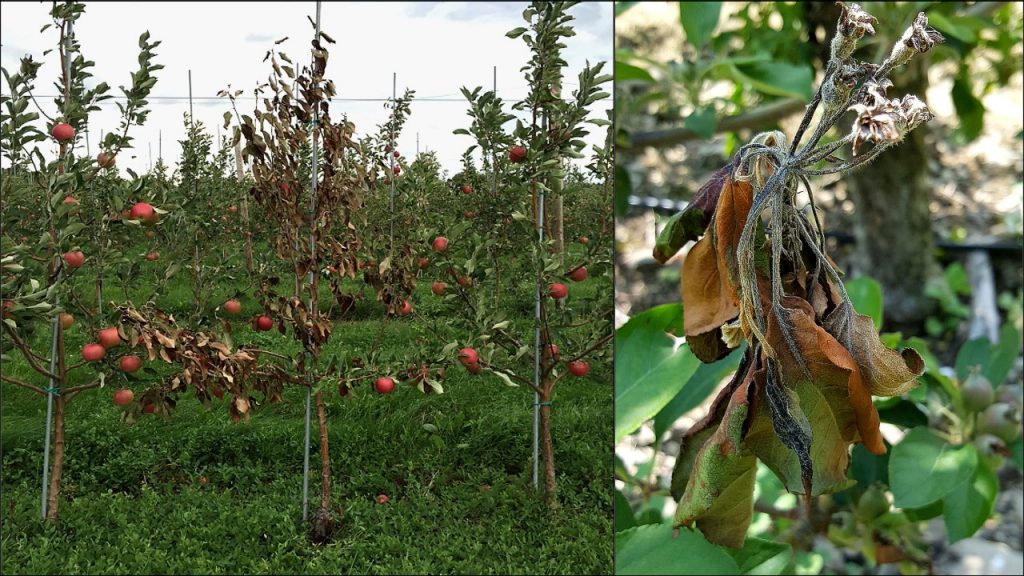
Fire blight, caused by the bacterium Erwinia amylovora, costs U.S. apple and pear growers an estimated $100 million annually. The disease has become increasingly difficult to manage as the bacteria develop resistance to antibiotics. At the same time, warmer, wetter spring weather has created more favorable conditions for infection, while modern high-density orchards allow the disease to spread more rapidly from tree to tree and kill entire trees
Disarming fire blight
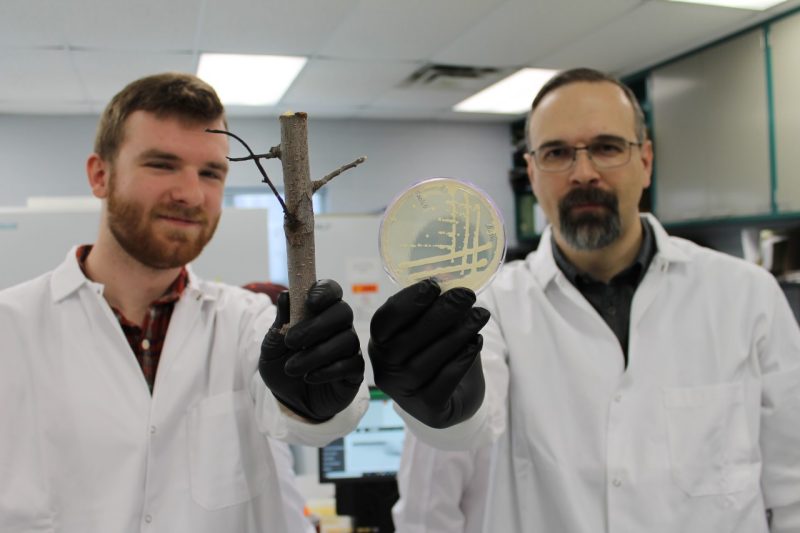
To explore one potential solution, Acimovic partnered with Bryan Berger, professor of chemical engineering at the University of Virginia, whose laboratory develops enzymes that target bacterial biofilms. Berger’s lab engineered the experimental enzyme, while Acimovic’s team tested it over two years in orchard field trials at Virginia Tech’s Alson H. Smith Agricultural Research and Extension Center
“Virginia Tech brought deep expertise in how fire blight infects apple trees and a willingness to test new approaches,” Berger said. “That gave us the opportunity to see whether this enzyme could work under real orchard conditions.”
The enzyme first breaks down the sticky protective coating — called a biofilm — that surrounds the fire blight bacterium. That coating helps the bacteria cling to blossoms, spread through trees, and protect themselves from environmental stress. Researchers also found the enzyme damaged the bacterium’s outer membrane, further weakening the pathogen
In orchard trials, the enzyme significantly reduced both blossom blight and shoot blight, showing the approach could work under real growing conditions
Berger’s startup, Lytos Technologies, is continuing to refine the enzyme and develop a sprayable formulation. While additional testing and regulatory review are still needed, Acimovic said he hopes the treatment will become available to growers within four to five years
Building a broader toolbox
The enzyme is one of several technologies under development through the USDA project. Other teams are advancing robotic disease detection, exploring new biological controls, and evaluating the most practical and cost-effective tools for growers
“No single discipline is going to solve fire blight,” Acimovic said. “This study shows what can happen when you bring together experts in engineering, plant pathology, and other fields to tackle the problem from multiple angles.”
Original study: DOI 10.1021/acs.est.5c16698
Contact:
540-232-2501
