

Diarrhea parasites, glass in bread: Is our food getting less safe? What experts told us
Advertisement

Updated: 4:30 PM EDT Aug 4, 2026Editorial Standards ⓘ
ByMadison Czopek, Politifact
Diarrhea parasites, glass in bread: Is our food getting less safe? What experts told us
Updated: 4:30 PM EDT Aug 4, 2026Editorial Standards ⓘ
ByMadison Czopek, Politifact
The eggs are contaminated with salmonella. Frozen berries have been linked to an E. coli outbreak. Iceberg lettuce and who knows what else might give you explosive diarrhea. Some people have endured the barrage of frightening food news with dark humor
“So the bread has glass in it, the lettuce has diarrhea bacteria, the eggs have salmonella,” wrote one Facebook user, poking at recalls of Pillsbury bread rolls for possible glass contamination and iceberg lettuce for cyclospora contamination. “At this point, grocery shopping is just an overpriced episode of Fear Factor.”
Advertisement
The jokescan befunny, but the unanswered question behind them is not: Is our food becoming less safe?
This story was originally published on PolitiFact.com
The U.S. food supply is “among the safest in the world,” said Steven Mandernach, the Association of Food and Drug Officials’ executive director. “It’s always been among the safest in the world. I see nothing that has changed.”
But it’s notoriously difficult to answer in real-time whether our food is getting less safe, food safety experts said. Most expect the Trump administration’s cuts to federal, state and local public health entities to weaken the nation’s food safety guardrails in the long run. Whether that is playing out in the short term is less clear
Here’s what else we learned from food safety experts, and diving into the data
The cyclosporiasis situation doesn’t prove food safety is rapidly declining
Yes, record-breaking numbers of domestically obtained cyclosporiasis cases recorded in 45 states have heightened food safety concerns
But cyclosporiasis outbreaks are difficult to catchquickly and the time it took for public health officials to identify a link between at least one product and the summer’s rising cyclosporiasis cases was “right on schedule with what we’ve seen with other cyclospora outbreaks,” Mandernach said. “If anything, maybe a tiny bit earlier than normal.”
That suggests the U.S. surveillance system is working, he said
Plus, previous cyclosporiasis outbreaks were likely undercounted, he said, because testing accuracy has improved in the past five years
Cyclosporiasis outbreaks vary from year to year, but during some seasons, multiple failures cause big outbreaks, said Don Schaffner, a Rutgers University food science specialist
“I don’t know that we have a perfect storm this year, but hopefully we will learn something more about why this particular outbreak was so bad,” he said July 22
Mandernach said this year’s uptick does signal that the U.S. hasn’t invested enough in cyclospora research and prevention in the past two decades. But it’s not a sign that food is getting less safe. However, if health officials never determine what went wrong to cause this record-breaking cyclosporiasis season, that could be cause for concern, he said
Summer is when foodborne illness is more common and gets more media attention
More foodborne illnesses happen in summer
“It’s hot,” Mandernach said. “Refrigeration sometimes fails.”
It’s also when pathogens like cyclospora and salmonella are most common
Increased news coverage makes people pay closer attention to food safety issues and notice subsequent headlines about other recalls for pathogens or other contaminants
What does data show about food recalls and illness outbreaks?
To really know if food is becoming less safe, it’s important to analyze cases of foodborne illness. Yet getting complete and current data is difficult
Historically, the best data on foodborne disease trends came from the FoodNet program, a collaboration between the U.S. Centers for Disease Control and Prevention, the U.S. Food and Drug Administration, the U.S. Department of Agriculture and 10 state health departments. Its most recent data is from 2024, and it showed that the incidence of infections acquired in the U.S. were rising for shigella, Shiga toxin-producing E. coli (STEC), Vibrio and Yersinia
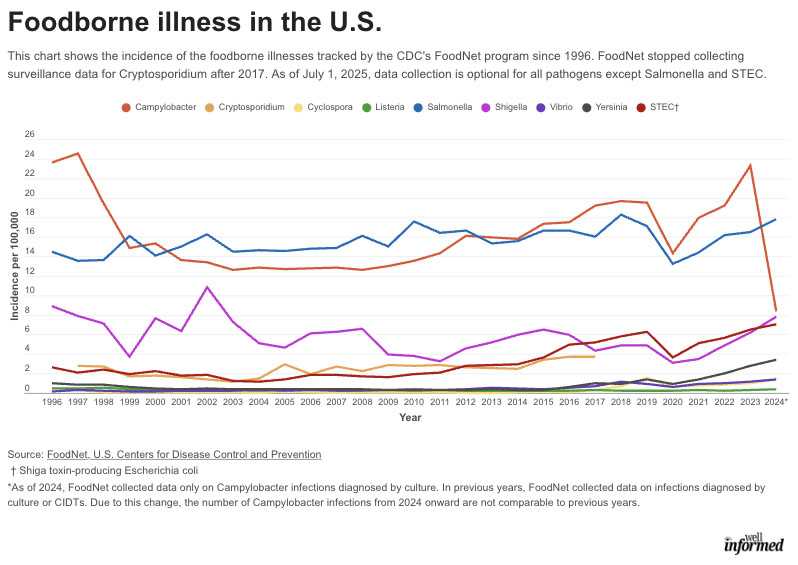
For years, FoodNet participants reported data on eight pathogens including cyclospora, but in July 2025, the Trump administration made it optional to report data for cyclospora and five other pathogens
Based on the data made public about the FDA’s Coordinated Outbreak Response & Evaluation Response (CORE) Teams’ investigations into foodborne outbreaks, we’re seeing slightly more outbreak investigations this year than before
So far in 2026, the FDA has posted approximately 2.71 investigations each month. In the first seven months of 2025, the FDA posted 2.29 investigations per month. In 2024, it was 1.43 per month; 1.86 per month in 2023; and 2.29 in 2022
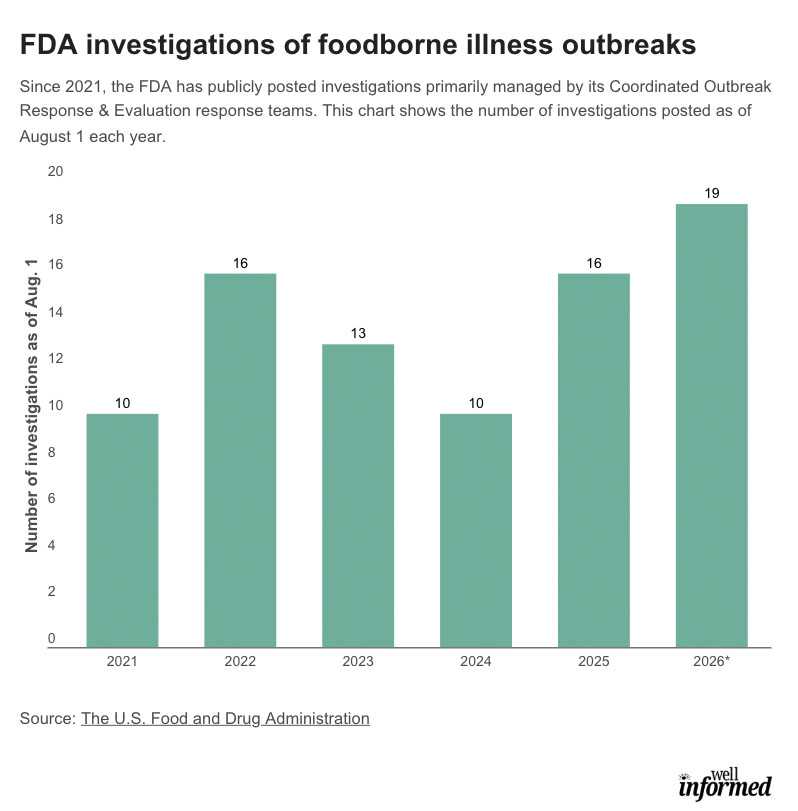
This data doesn’t include all investigations into outbreaks. It includes many multistate outbreak investigations that were assigned to a CORE team, but that’s a relatively small proportion of the total outbreaks that occur, said Rutgers University epidemiologist Craig Hedberg
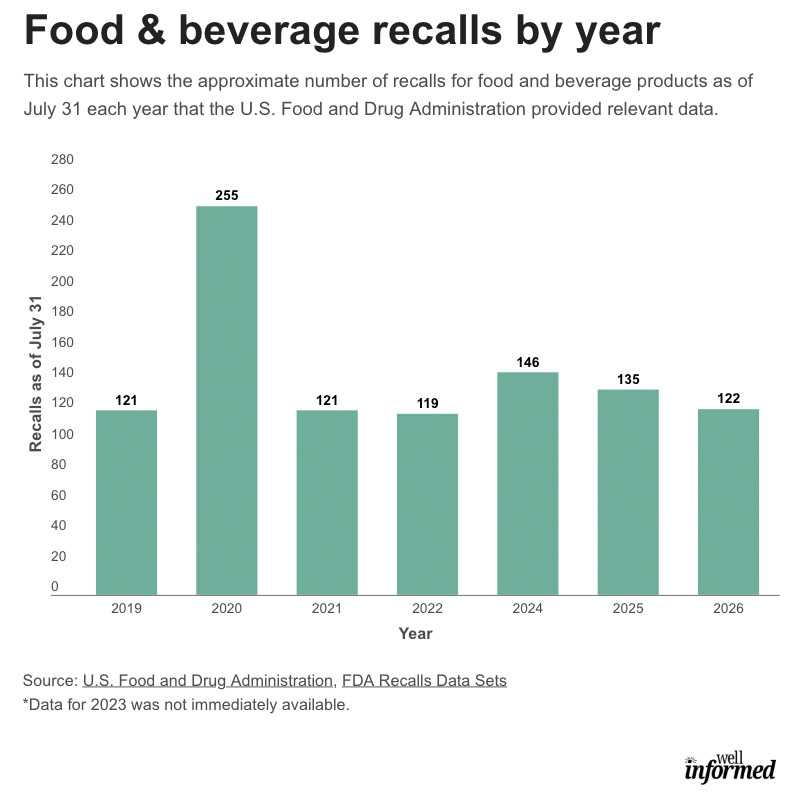
Available food and beverage recall data from the FDA and shows the number of recalls in 2026 is on pace with recent years — at least so far
Data from the USDA’s Food Safety and Inspection Service shows that in 2025, the U.S. recorded a 10-year high total of pounds of recalled meat, poultry and egg products
From 2015 to 2025, Food Safety and Inspection Services reported that manufacturers recalled an average of about 23.2 million pounds of meat, poultry and egg products. The USDA website’s recall data shows that in 2026, manufacturers have already recalled over 37 million pounds of these products
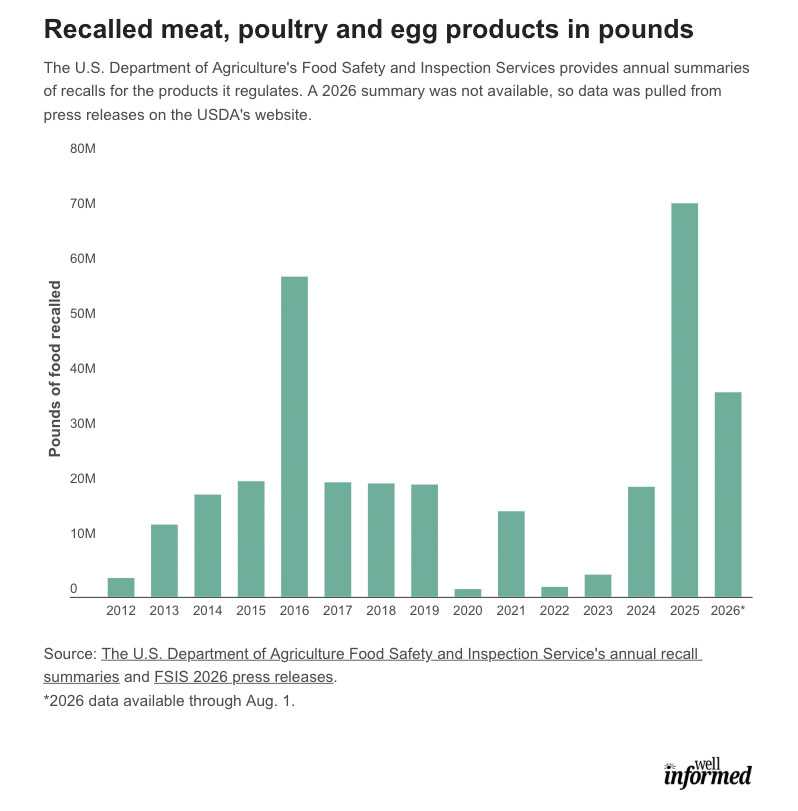
Even combined, this data doesn’t tell a comprehensive food safety story. It’s overly simplistic to view increasing outbreak investigations or recalls as proof that the system is getting worse
Upticks in investigations and recalls “could be a sign that more issues are being caught,” said Sarah Sorscher, the Center for Science in the Public Interest’s director of regulatory affairs
Trump administration policies could weaken food safety standards, experts warn
Some food safety experts say the administration’s cuts have hindered the government’s response and communication to the cyclosporiasis outbreaks, but Mandernach is among those who disagree
Mandernach said the cyclospora response played out as he would expect, suggesting the cuts had “very limited, if any impact.”
The cyclospora situation aside, other impacts are clear. In 2025, American inspections of foreign food facilities dropped to historic lows because of the cuts, Sorscher said
The administration has also deprioritizedcriminal enforcement for violating regulations, which might mean companies are less motivated to comply. She pointed to a stalled Boar’s Head investigation and the halted prosecution of Abbott Nutrition as examples
Future food safety is also uncertain, experts warned
Scaling back FoodNet’s pathogen surveillance will undermine future efforts to monitor trends in foodborne illness, Hedberg said
Sorscher said the FDA, CDC and state and local public health agencies are losing qualified experts to early retirement and struggling to maintain qualified staff to inspect food and solve outbreaks
“FDA and USDA have also dissolved advisory committees and de-prioritized enforcement and regulation,” she said. “Long term, this will have an impact on the safety of food as standards deteriorate.”
PolitiFact Staff Researcher Caryn Baird and PolitiFact Assistant Managing Editor Rebecca Catalanello contributed to this report
This story was originally published on PolitiFact.com
It is republished here as part of a reporting and fact-checking partnership between PolitiFact and Hearst Television
Make WBAL-TV a preferred source on Google
Add Preferred Source
