

China grew at its slowest pace in more than 3 years last quarter
1 of 5 |
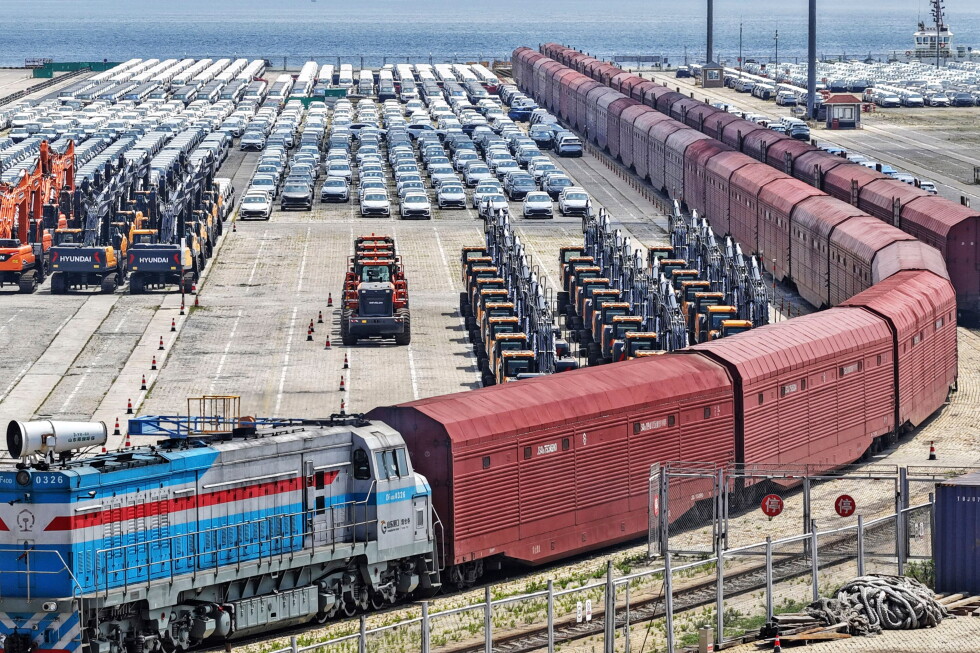
Heavy equipment and cars are prepared for shipment by rail in Yantai, eastern China’s Shandong province, on June 20, 2026. (Chinatopix CHINA OUT
2 of 5 |
Vehicles and heavy machineries wait for shipment to overseas markets in Yantai, eastern China’s Shandong province, Tuesday, July 14, 2026. (Chinatopix
3 of 5 |
Vehicles wait for shipment to overseas markets in Yantai, eastern China’s Shandong province, Tuesday, July 14, 2026. (Chinatopix
4 of 5 |
Trucks move past containers stored at a container terminal in Shanghai, China, Tuesday, July 14, 2026. (Chinatopix
5 of 5 |
Workers prepare cars for shipment by rail in Yantai, eastern China’s Shandong province, on June 20, 2026. (Chinatopix
1 of 5 |
Heavy equipment and cars are prepared for shipment by rail in Yantai, eastern China’s Shandong province, on June 20, 2026. (Chinatopix CHINA OUT
1 of 5
Heavy equipment and cars are prepared for shipment by rail in Yantai, eastern China’s Shandong province, on June 20, 2026. (Chinatopix CHINA OUT
2 of 5 |
Vehicles and heavy machineries wait for shipment to overseas markets in Yantai, eastern China’s Shandong province, Tuesday, July 14, 2026. (Chinatopix
2 of 5
Vehicles and heavy machineries wait for shipment to overseas markets in Yantai, eastern China’s Shandong province, Tuesday, July 14, 2026. (Chinatopix
3 of 5 |
Vehicles wait for shipment to overseas markets in Yantai, eastern China’s Shandong province, Tuesday, July 14, 2026. (Chinatopix
3 of 5
Vehicles wait for shipment to overseas markets in Yantai, eastern China’s Shandong province, Tuesday, July 14, 2026. (Chinatopix
4 of 5 |
Trucks move past containers stored at a container terminal in Shanghai, China, Tuesday, July 14, 2026. (Chinatopix
4 of 5
Trucks move past containers stored at a container terminal in Shanghai, China, Tuesday, July 14, 2026. (Chinatopix
5 of 5 |
Workers prepare cars for shipment by rail in Yantai, eastern China’s Shandong province, on June 20, 2026. (Chinatopix
5 of 5
Workers prepare cars for shipment by rail in Yantai, eastern China’s Shandong province, on June 20, 2026. (Chinatopix
By
CHAN HO-HIM
Updated [hour]:[minute] [AMPM] [timezone], [monthFull] [day], [year]
Leer en español
HONG KONG (AP) — China’s economy slowed sharply to a 4.3% annualized pace of growth in the April-June quarter, the government said Wednesday, the weakest in over three years
The official data fell short of forecasts and was far below the economy’s strong 5% pace of growth in January-March, despite a surge in exports driven partly by the boom in artificial intelligence, and by robust global demand for Chinese electric vehicles
China has largely shrugged off wider economic impacts from the Iran war as soaring energy prices pushed up global inflation. Exports rose 17.6% in the first half of the year from a year earlier, and 27% in June, according to customs data
But domestic spending and investment have lagged, limiting the boost from export manufacturing for an economy that has struggled to regain momentum since parts of China were locked down during the COVID-19 pandemic
“This was the slowest growth in any quarter since the lockdown-impacted fourth quarter of 2022,” said Lynn Song, chief economist for Greater China at ING Bank in a note
Some economists say China’s economy is becoming increasingly unbalanced as heavy state support and private investments pour into frontier technologies like AI, computer chips and robotics while other areas such as lower-value manufacturing and jobs creating services industries languish
Exports of high-tech products such as electric vehicles, computer chips and other electronic equipment have risen sharply, helped by hefty government support since China’s leaders have made development of advanced technologies a top priority

AI chatbots are at risk of spreading government restrictions on online speech, a new study says
4 MIN READ
China and Xi are seen more favorably than the US and Trump in many nations, new survey says
4 MIN READ

Family says US seismologist has been detained in China for nearly 2 years with no trial
3 MIN READ
China ran a record $1.2 trillion global trade surplus last year, drawing complaints from policymakers in other countries over their trade imbalances with the world’s second-largest economy. Many have pointed to those heavy state subsidies, which they say contribute to an oversupply of manufactured goods that end up being exported overseas. Industrial output by value rose 5.4% in the first half of the year from a year earlier
As is true in many countries, the expansion of AI and robotics has also raised worries at home over whether businesses will create enough jobs to sustain growth in the longer term
Chinese families have cut back on big purchases, their appetite for spending constrained by a prolonged property slump and uncertainties over jobs and wages
As China remains reliant on its exports to sustain overall growth, “China’s growth model has become increasingly imbalanced,” said Eswar Prasad, a professor of economics and trade policy at Cornell University. Substantially increasing domestic demand will be tough as confidence remains weak, he added
Mao Shengyong, deputy head of China’s National Bureau of Statistics, told reporters that given the increasingly unstable and uncertain global situation, the imbalance between strong supply and weak demand “remains acute” at home
As China focuses on high-tech manufacturing and pursues “higher-quality economic growth,” it will work to build a robust domestic market and offer support to keep employment stable, he said
Highlighting weaker points in the economy, investment in fixed assets, such as factory equipment, fell 5.7% year-on-year in the first half of the year, while retail sales of consumer goods climbed a meager 1.3%. Housing prices continued to fall
China’s economy is going through a “significant transition,” said Wei Li, Head of Multi-Asset Investments at BNP Paribas Securities (China)
For the whole of 2026, Chinese leaders have set a growth target of 4.5% to 5%, slower than last year’s 5%. Overall economic growth for the first half of the year was at 4.7%, the data released Wednesday showed
The International Monetary Fund recently raised its forecast for China’s annual growth by 0.2 percentage point to 4.6%. It expects China’s economy to expand just 4.1% in 2027
CHAN HO-HIM
