

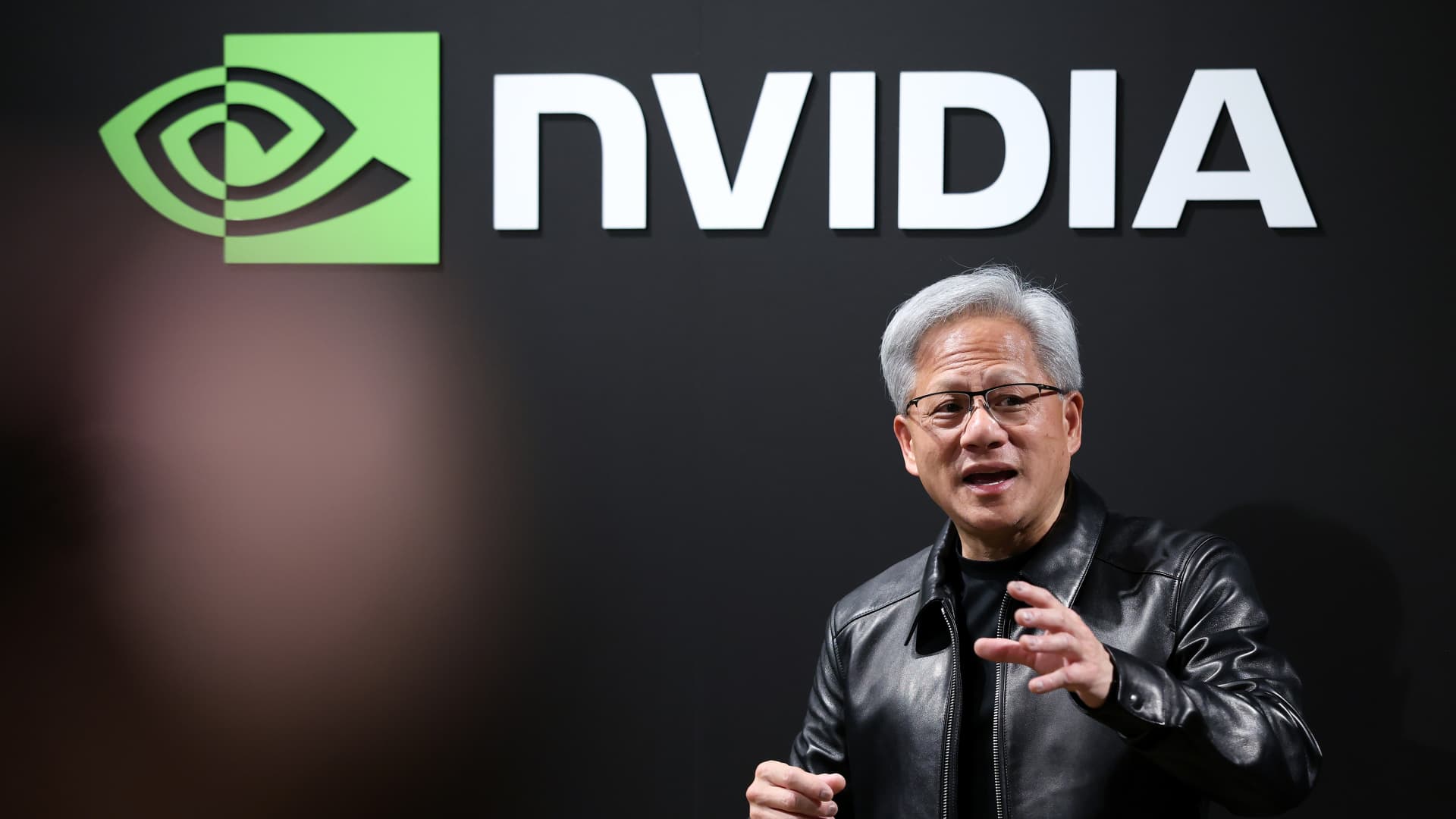
- Nvidia CEO Jensen Huang revealed what he expects to be the next phase of financing, backed not by corporate balance sheets, but by Wall Street’s top power brokers.
- Firms including Goldman Sachs and BlackRock say they see the potential to make money by raising funds from their institutional investors to fund the AI infrastructure buildout.
- “You can think about it as a revenue stream, and you can securitize it or effectively divide that risk and sell it,” said Waldemar Szlezak, KKR’s head of digital infrastructure.
Jensen Huang, chief executive officer of Nvidia Corp., speaks to members of the media following the company’s “Japan AI Ecosystem” reception in Tokyo, Japan, on Thursday, July 16, 2026.
Kiyoshi Ota | Bloomberg | Getty Images
The first three-plus years of the artificial intelligence buildout has been paid for through record amounts of equity and debt issued by the world’s leading tech companies, some of whom are spending so much of their existing capital that they’ve turned cash-flow negative
Nvidia CEO Jensen Huang just revealed what he expects to be the next phase of financing, backed not by corporate balance sheets, but by Wall Street’s top power brokers
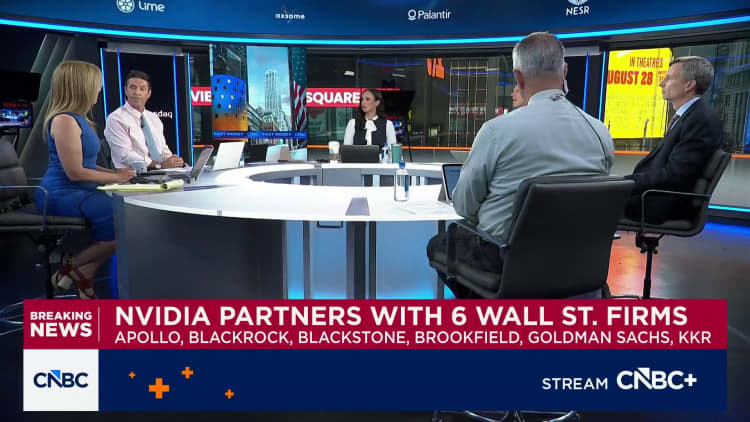
In an interview with CNBC on Monday, Huang called his plan a “big concept,” unveiling it on camera alongside leaders from Goldman Sachs, BlackRock, Blackstone, KKR, Apollo and Brookfield. Together, those firms say they’re willing to raise $500 billion, and potentially more, for the construction and buildout of new AI factories, as chipmakers and hyperscalers race to meet seemingly endless demand
Huang and his big-money partners, one by one, described what they view as a fundamental shift in the tech industry: AI infrastructure has become a new asset class
“These systems are not like our PCs, not like our phones,” Huang told CNBC’s Becky Quick. “These are revenue-generating assets now. They’re productive, they’re long lived, they’re fungible, they’re flexible.”
The discussion was thin on specifics as far as the types of borrowers that will emerge, what interest rates will look like, where the facilities will be constructed and when it will all kick off. Their joint press release said the companies had signed memos of understanding, with no reference to any contracts
The details matter. Almost 11 months ago, Nvidia announced a partnership to invest up to $100 billion in OpenAI as part of a plan to build out data centers requiring a combined 10 gigawatts of power. That investment never materialized, but Nvidia contributed $30 billion to the record-breaking funding round that OpenAI closed earlier this year
Monday’s announcement struck a different tone, with the companies collectively pushing the message that money won’t be the problem as the AI buildout hits what McKinsey expects will be $7 trillion in global outlays by the end of the decade
‘These are real assets’
So far this year, Alphabet, Amazon, Meta, Microsoft and Oracle have raised well over $150 billion combined by selling debt and equity to build data centers and fund the development of new AI models and support the explosion of AI agents. Intel just announced a $15 billion stock offering, then upsized it to $20 billion
Financial firms are now gearing up to jump into the market in a different way, as executives like Goldman Sachs CEO David Solomon and KKR’s Waldemar Szlezak see AI equipment attaining familiar money-making characteristics
“You’re starting to see, in a sense, you know, asset-based financing against this infrastructure buildout,” Solomon said on the CNBC panel. “That’s not surprising because these are real assets. They have real value.”
Goldman Sachs CEO David Solomon speaks during an interview at the Economic Club of Washington, Oct. 30, 2025.
Kevin Lamarque | Reuters
Instead of seeing supercomputers as devices that customers buy and use — the argument goes — these systems, filled with Nvidia’s graphics processing units that can cost $3 million per rack, look like profitable investments. Huang says the systems can be improved through his company’s CUDA software, and their lifespans extended, leading to better economics
“You can think about it as a revenue stream, and you can securitize it or effectively divide that risk and sell it to investors who want to participate anywhere in that stack,” said Szlezak, KKR’s head of digital infrastructure
When Wall Street starts getting noticeably excited about securitizing physical assets, a natural question emerges: What could go wrong?
One of the hallmarks of the financial crisis of 2007 to 2009 was the packaging of subprime mortgages into bundled securities that were then sold to investors as another way to make money from the housing boom. When mortgage defaults started going up, the whole system began to unwind
Famed short-seller Michael Burry, who made a fortune betting against subprime mortgages, suggested late last year that companies including Meta, Oracle, Microsoft, Google and Amazon were overstating the useful life of their AI chips and understating depreciation
The subprime meltdown wasn’t part of the conversation on Monday, but several of the financiers acknowledged a certain amount of risk in the AI trade
“There will be excesses, there will be pullbacks,” said Jim Zelter, president of Apollo Global Management, adding that the number of participants in the project alle
“There’ll be big companies that win,” Solomon said. “There’ll be big companies that turn out to be not what people expected.”
watch now
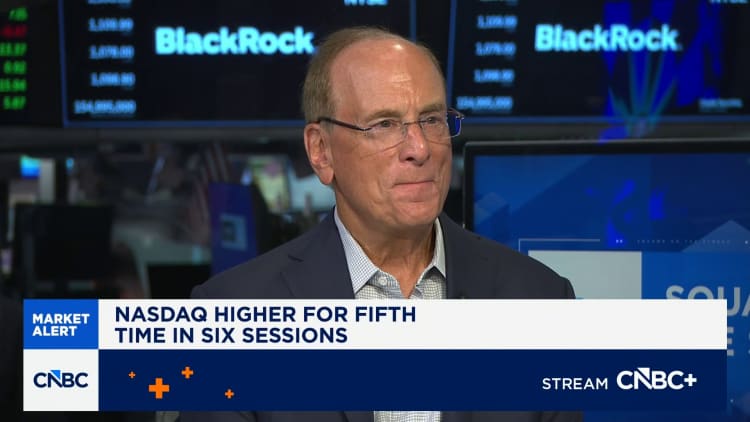
In discussing BlackRock’s role in Monday’s agreement, CEO Larry Fink made a direct comparison to the mortgage market, though he referenced a period decades before the housing boom and bust
“This is the very beginning, like what it was when I started in the mortgage-backed securities market in the 1970s,” Fink said. “I look upon this as as a next future for financial engineering.”
All six of the financiers will make their own lending decisions, Huang said in the interview, noting that Nvidia will connect customers with financing partners
Nvidia said it will have the option of backstopping 25% of every loan, a structure that should result in more favorable interest rates for companies that have previously had to rely on their own credit rating. Borrowers will have to use system architectures specified by Nvidia that would allow another company to take it over and operate it “if something were to happen,” Huang said
Nvidia still has plenty to iron out with its financing partners, but Monday’s gathering marked a major step in showing the kind of money available to others in the ecosystem. Brookfield CEO Bruce Flatt said Huang created the necessary format for investors
“Jensen’s leading this to create structures,” Flatt said. “Because there’s hundreds of trillions of dollars of money in the world.”
watch now
Choose CNBC as your preferred source on Google and never miss a moment from the most trusted name in business news.


Read More
