

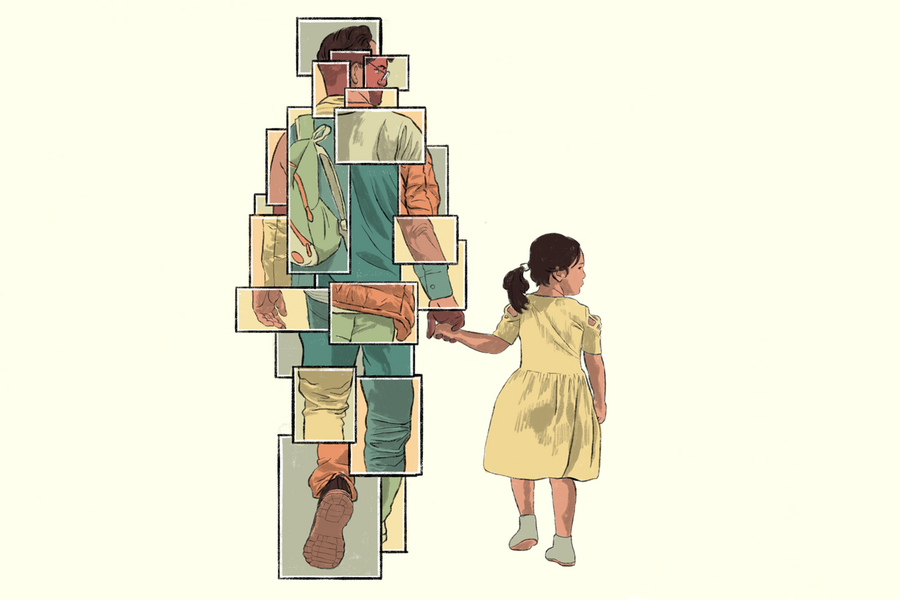
A US agency listed an AI immigration tool online. The disclosure vanished after our inquiry
|Jacob Turcotte/Staff
Loading
- By
The Trump administration appears to have deleted evidence of an artificial intelligence tool it said could have a significant impact on individual rights from a government inventory, following an inquiry about the product by the Monitor
The AI tool, one of two bearing the “high-impact” designation by the Department of Health and Human Services, was being developed to vet sponsors of unaccompanied immigrant children who end up in government custody. Congress requires agencies to publish detailed information about AI tools online
A description of the product, removed this month from the department’s website, classified the AI tool as “computer vision.” Computer vision is a field of AI in which machines interpret large amounts of digital images and videos to reach conclusions. Common computer vision techniques include facial-recognition software, license plate readers, and tools used to process surveillance footage captured by drones
Why We Wrote This
Federal law and Trump administration rules lay out transparency requirements for the U.S. government’s use of artificial intelligence. When the Monitor asked about one tool designed to vet immigrant children’s sponsors, information about it disappeared
As of this writing, it is unclear whether a contract was ever awarded or whether this AI tool had been deployed. HHS has not responded to repeated attempts to get answers to those questions
The Monitor asked a public affairs office at HHS about the AI tool’s status and vendor after seeing it listed in the agency’s online inventory on July 10
The agency never responded to that inquiry, either. Ten days later, the Monitor noticed evidence that the AI product had disappeared
Keeping a public registry of the government’s “current and planned uses” of AI – known as an AI use case inventory – is mandated by Congress
Legal experts, including former agency officials, say the removal of information about the AI tool was potentially illegal and raises troubling questions about the Trump administration’s commitment to the safety of immigrant children
“It would appear that HHS is in violation of the law, and the whole situation comes across as the agency trying to hide something,” says Jeramie Scott, senior counsel at the nonprofit Electronic Privacy Information Center
Deirdre Mulligan, a faculty director at the Center for Law & Technology at the University of California, Berkeley, adds: “When a reporter asks about something and it’s removed – that’s problematic.” Professor Mulligan, who also served as director of the National Artificial Intelligence Initiative Office during the Biden administration, says the disappearance merits congressional scrutiny
Under President Donald Trump, the Office of Management and Budget issued guidance last year requiring agencies to “inventory all AI use cases in pre-deployment, pilot, deployed, or retired.” AI products must not be deleted even when their “development and/or use has since been discontinued” to preserve a record of the government’s action, at least for the following year, the OMB said
AI tools deemed “high-impact” because they serve “as a principal basis for decisions or actions that have a legal, material, binding, or significant effect on rights or safety” are to undergo additional scrutiny, including an independent assessment of potential impacts on “privacy, civil rights, and civil liberties.” High-impact AI uses must also have an appeals process that includes human review
The OMB declined to comment for this story, referring the Monitor to HHS
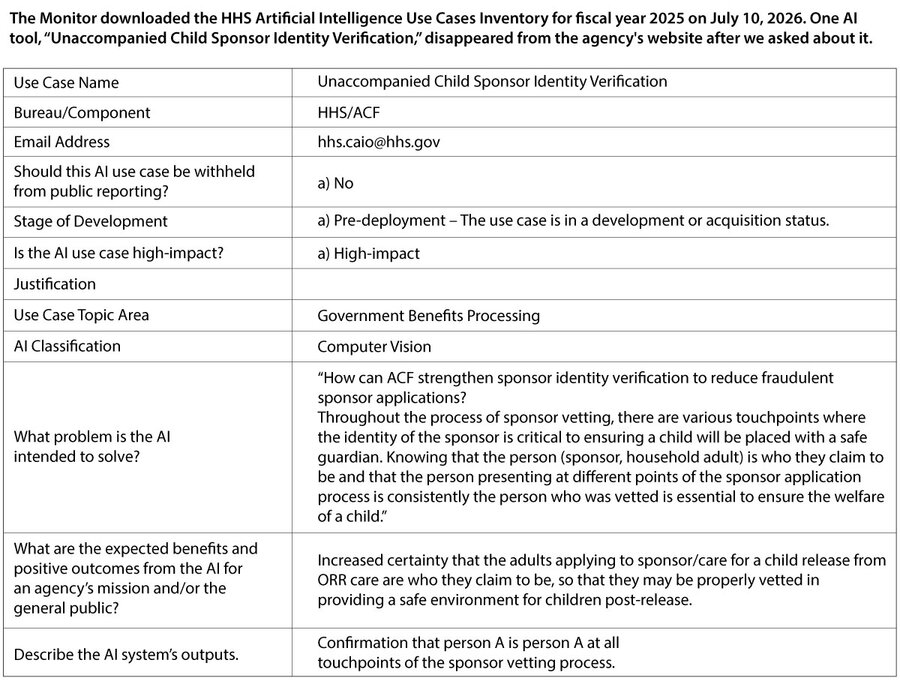
Before it disappeared, the online description of the “Unaccompanied Child Sponsor Identity Verification” AI tool was minimal
Knowing that a potential sponsor “is who they claim to be and that the person presenting at different points of the sponsor application process is consistently the person who was vetted is essential to ensure the welfare of a child,” the description read
With little information on the AI tool, immigrant rights advocates worry data from AI-enhanced vetting could be shared with other agencies to help the Trump administration meet its deportation goals, potentially depriving children of their best caregivers
In a whole-of-government crackdown, HHS has partnered with Immigration and Customs Enforcement, as well as other federal and local agencies, to check on children and sponsors nationwide. Along with other application steps, the Trump administration has required fingerprinting of those adults. HHS has shared leads with ICE, leading to the arrest of thousands of individuals, Reuters reported Tuesday.
As scrutiny of those adults ramps up, HHS in recent months has held unaccompanied minors in custody longer – more than half a year on average
No matter their immigration status, “We want sponsors to come forward … who have the kids’ best interests at heart,” says Samuel Bagenstos, who was general counsel at HHS from 2022 to 2024. But those caregivers won’t come forward, he says, “if they feel like coming forward just puts them on the radar screen for some ICE raid.” Traditionally, the HHS office that oversees unaccompanied children hasn’t operated with a law-enforcement mission
Mr. Bagenstos, who also served as general counsel at OMB during the Biden presidency, says it would be illegal for an agency not to follow the budget office’s directives. The disappearance of the AI case “raises a pretty serious question about whether HHS is complying with the law,” he says
Trump administration officials, along with Republican lawmakers, have alleged rampant immigration fraud and accused the Biden administration of losing track of unaccompanied children. Immigrant rights advocates say those concerns are overblown
Advocates for unaccompanied children are wary of potential data sharing with the Department of Homeland Security for immigration enforcement against sponsors, rather than “making good decisions about if a home is safe for a child,” says Jennifer Podkul, chief of global policy and advocacy at Kids in Need of Defense. Losing aonger, she says
Under President Trump, DHS has developed, deployed, or piloted at least 51 “computer vision” tools. This includes more than a dozen that utilize facial recognition, among them Mobile Fortify, which immigration and border agents have used to scan people’s faces in the field and make arrests
We’re interested in learning more about the Trump administration’s use of artificial intelligence. We welcome tips at matuseks@csmonitor.com and glantza@csmonitor.com or sarahmatusek.54 and AaronGlantz.63 on Signal
SOURCE:
U.S. Department of Health and Human Services
You’ve read of free articles.
Subscribe to continue.
Thank you for contacting The Christian Science Monitor.
