


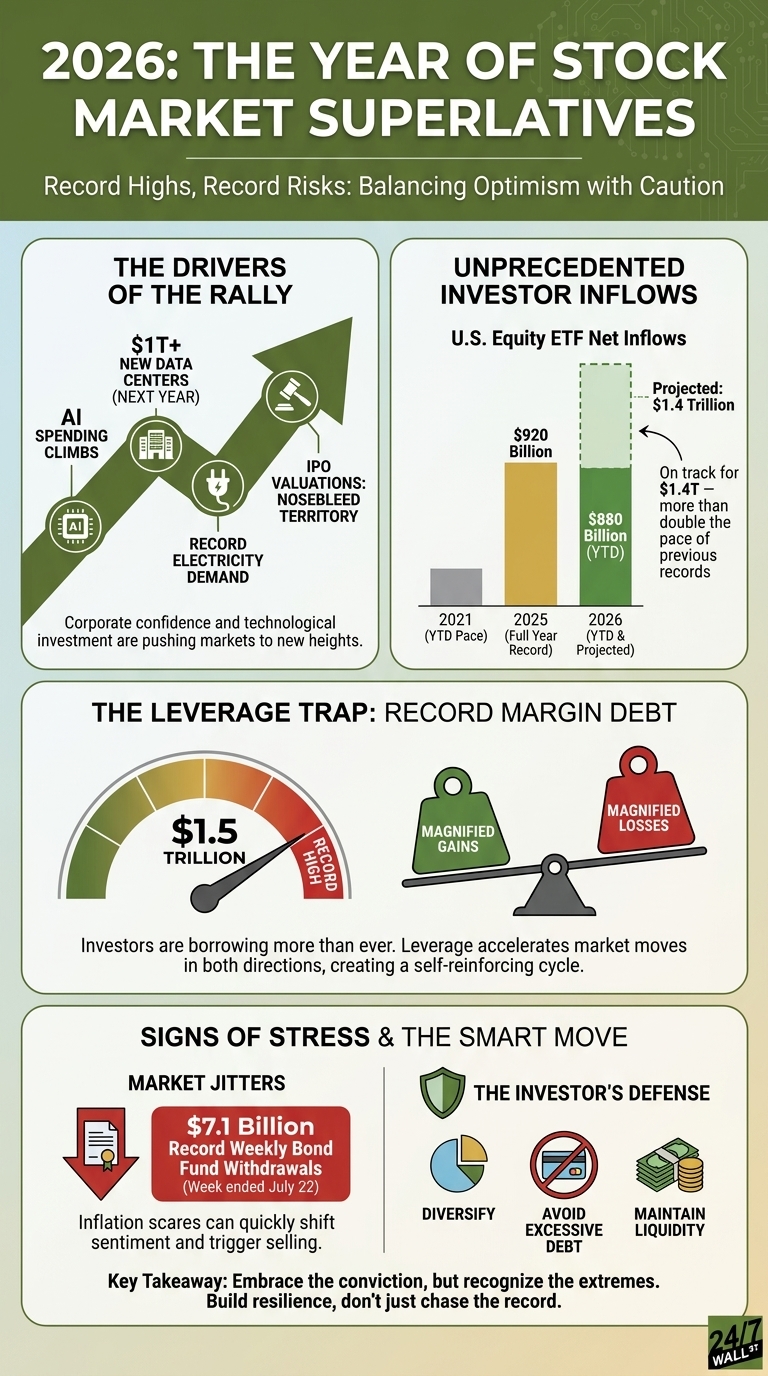
The stock market has spent much of 2026 rewriting the record books. Artificial intelligence spending continues to climb, hyperscalers are expected to commit over $1 trillion to new data centers next year, electricity demand is reaching levels utilities have never planned for, and IPO valuations have returned to nosebleed territory. Even Washington is setting records, with U.S. debt-to-GDP surpassing peaks last seen during World War II. It is becoming the year of superlatives.
Yet history shows that when every trend reaches an extreme at the same time, investors should spend as much time thinking about risk as they do opportunity
Investors Have Never Been This Eager to Buy Stocks
The clearest sign of investor enthusiasm comes from data from Strategas Research Partners and Bloomberg, which shows U.S. equity exchange-traded funds have attracted $880 billion of net inflows so far in 2026 — or more than every full-year total except the record set in 2025
Even more striking, inflows are running more than twice the pace seen at this point in both 2021 and 2025. If the current trend continues, investors will pour more than $1.4 trillion into U.S. equity ETFs this year — roughly $500 billion above last year’s record of approximately $920 billion. Those aren’t just healthy inflows. They’re unprecedented
The surge reflects investors’ confidence that AI investment, corporate earnings, and economic growth can continue supporting higher stock prices. Given the scale of spending announced by companies includingNvidia(NASDAQ:NVDA | NVDA Price Prediction),Microsoft(NASDAQ:MSFT),Amazon(NASDAQ:AMZN),Alphabet(NASDAQ:GOOG), andMeta Platforms(NASDAQ:META), that optimism isn’t difficult to understand
Granted, strong inflows don’t automatically signal a market top. Bull markets often attract more buyers as confidence grows. The problem is that record optimism usually leaves less cash on the sidelines to cushion markets when sentiment changes
© 24/7 Wall St.
Record Buying Is Being Fueled by Record Leverage
Investor enthusiasm isn’t showing up only in ETF purchases. FINRA data shows margin debt has climbed to arecord $1.5 trillion, meaning investors are borrowing more money than ever to buy stocks
Leverage is a powerful accelerator. Rising markets magnify gains because borrowed money increases purchasing power. Conversely, falling markets can trigger margin calls that force investors to sell into already declining prices, creating a self-reinforcing cycle
Ironically, another corner of the market is already showing signs of stress. According to Reuters and LSEG Lipper data, U.S. investment-grade bond funds and ETFs suffered a record $7.1 billion in weekly withdrawals for the week ended July 22 after an inflation scare pushed Treasury yields higher
That shift highlights how quickly investor positioning can change when inflation expectations or interest rates move unexpectedly
Records Don’t Last Forever
None of this means a crash is inevitable. Corporate profits remain healthy, AI investment continues expanding, and many technology leaders are generating enormous cash flows that justify continued spending. Those fundamentals are real
That said, markets rarely move in a straight line forever. Today’s combination of record ETF inflows,record leveraged ETF buying, record margin debt, record AI capital spending, record data center construction, record electricity demand, record IPO valuations, and record federal debt creates a market with very little room for disappointment
Whether the catalyst is sticky inflation, higher interest rates, slowing earnings growth, geopolitical tensions, or an unexpected economic shock, markets that become crowded on one side can reverse faster than many investors expect
Key Takeaway
In short, the numbers tell a simple story: investors — domestic and foreign — haveembraced U.S. stockswith unprecedented conviction. That confidence has been rewarded so far, but it has also pushed positioning to historical extremes
Smart investors don’t need to abandon the market simply because optimism is high. They should, however, recognize that record inflows and record leverage often amplify both gains and losses. Ultimately, the best defense isn’t predicting the next correction—it’s building a diversified portfolio, avoiding excessive borrowing, and keeping enough liquidity to take advantage of opportunities when others are forced to sell
Contact [email protected] for any questions or corrections
