

- Short Reads
August 18, 2026
Young adults in the U.S. are increasingly wary of AI, concerned it will take jobs
ByColleen McClainEugenie Park
Americans have become increasingly worried about artificial intelligence over the years, and young adults’ concern has continued to climb. Worry over job loss, too, is on the rise
% of U.S. adults who say the increased use of artificial intelligence (AI) in daily life makes them feel …
Note: Those who did not answer are not shown.
Source: Survey of U.S. adults conducted June 22-28, 2026.
PEW RESEARCH CENTER
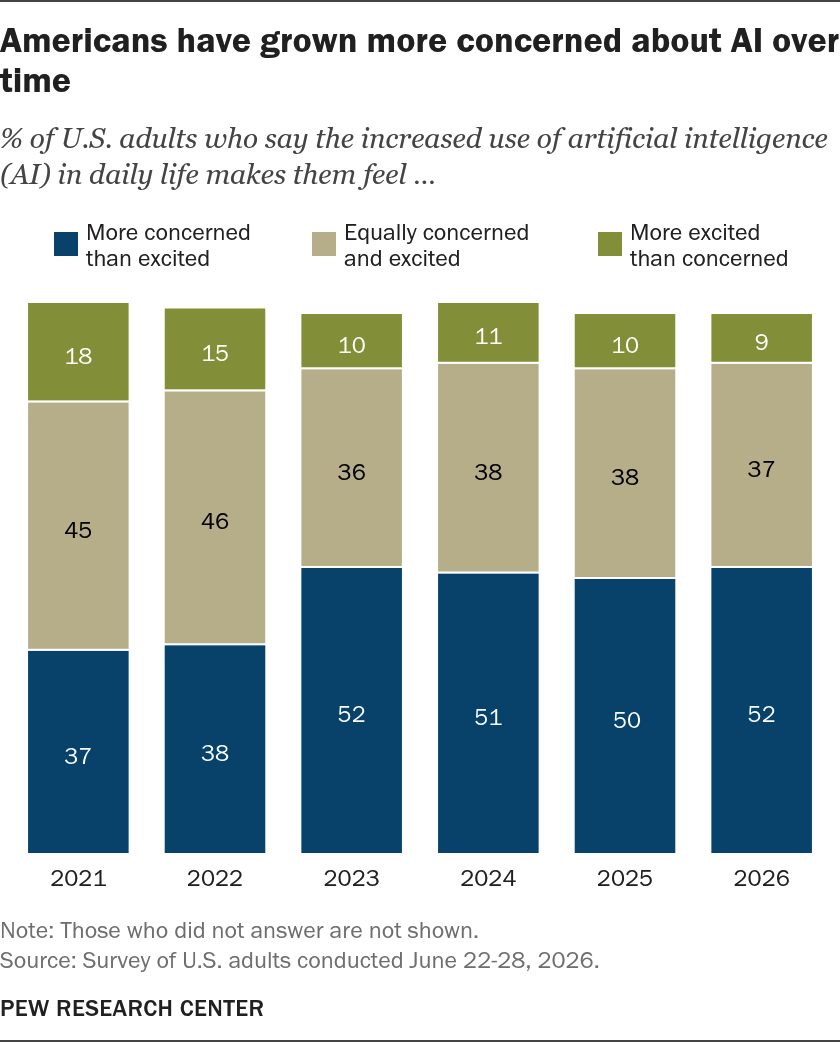
Americans have grown more concerned about AI over time
% of U.S. adults who say the increased use of artificial intelligence (AI) in daily life makes them feel …
| More concerned than excited | Equally concerned and excited | More excited than concerned | |
|---|---|---|---|
| 2021 | 37 | 45 | 18 |
| 2022 | 38 | 46 | 15 |
| 2023 | 52 | 36 | 10 |
| 2024 | 51 | 38 | 11 |
| 2025 | 50 | 38 | 10 |
| 2026 | 52 | 37 | 9 |
Note: Those who did not answer are not shown.
Source: Survey of U.S. adults conducted June 22-28, 2026.
PEW RESEARCH CENTER
Today, 52% of Americans say they are more concerned than excited about the increased use of AI in daily life – up from 37% in 2021. Another 9% are more excited than concerned and 37% say they’re equally excited and concerned, according to a Pew Research Center survey conducted June 22-28, 2026
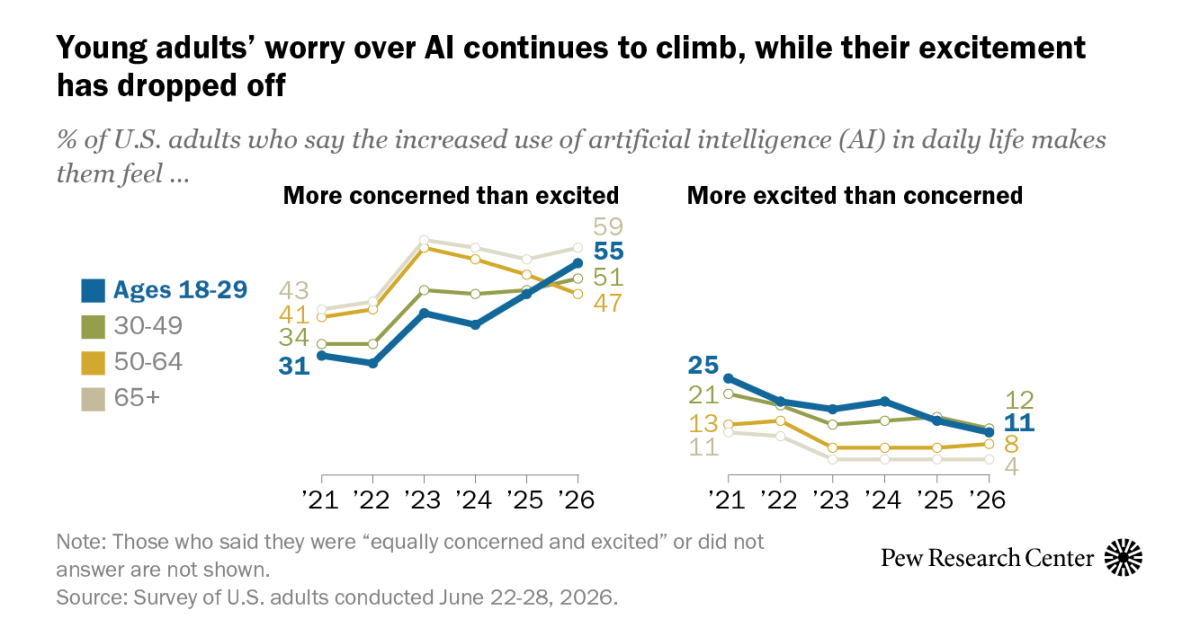
Concern about AI is up among younger and older Americans alike since we first asked this question in 2021. But while the rise was mainly in the first two years for Americans ages 30 and older, concern continues to climb for adults under 30 – whose skepticism of AI has made headlines in recent months
Young adults’ worry over AI continues to climb, while their excitement has dropped off
% of U.S. adults who say the increased use of artificial intelligence (AI) in daily life makes them feel …
Note: Those who said they were “equally concerned and excited” or did not answer are not shown.
Source: Survey of U.S. adults conducted June 22-28, 2026.
PEW RESEARCH CENTER
Young adults’ worry over AI continues to climb, while their excitement has dropped off
% of U.S. adults who say the increased use of artificial intelligence (AI) in daily life makes them feel …
| Year | Ages 18-29 | 30-49 | 50-64 | 65+ | |
|---|---|---|---|---|---|
| More concerned than excited | 2026 | 55 | 51 | 47 | 59 |
| 2025 | 47 | 48 | 52 | 56 | |
| 2024 | 39 | 47 | 56 | 59 | |
| 2023 | 42 | 48 | 59 | 61 | |
| 2022 | 29 | 34 | 43 | 45 | |
| 2021 | 31 | 34 | 41 | 43 | |
| More excited than concerned | 2026 | 11 | 12 | 8 | 4 |
| 2025 | 14 | 15 | 7 | 4 | |
| 2024 | 19 | 14 | 7 | 4 | |
| 2023 | 17 | 13 | 7 | 4 | |
| 2022 | 19 | 18 | 14 | 10 | |
| 2021 | 25 | 21 | 13 | 11 |
Note: Those who said they were “equally concerned and excited” or did not answer are not shown.
Source: Survey of U.S. adults conducted June 22-28, 2026.
PEW RESEARCH CENTER
For the first time, a majority of adults under 30 (55%) now say they’re more concerned than excited about AI. About one-in-ten say they’re more excited than concerned, and roughly a third feel both equally. Their concern is now on par with those in their 30s and 40s, and those 65 and up
Across age groups, about half or more say they’re more concerned than excited about AI. Excitement, in turn, has dropped off since 2021 among all age groups
About this research
This Pew Research Center analysis looks at how Americans feel about AI and its impact on jobs, both overall and by age
Why did we do this?
Pew Research Center does research to inform the public, journalists and decision-makers. This research builds on our past work on how people feel about AI, what they think it will do to jobs, and how their views and experiences differ by age
How did we do this?
We surveyed 3,488 U.S. adults from June 22 to 28, 2026. Everyone who took part in this survey is a member of the Center’s American Trends Panel. The survey represents the views of the full U.S. adult population
Here are the questions we used for this analysis, the topline and the survey methodology
AI and jobs
% of U.S. adults who say they think artificial intelligence (AI) will lead to __ in the U.S. over the next 20 years
Note: Those who were not sure (16% in 2024 and 14% in 2026) or did not answer are not shown.
Source: Survey of U.S. adults conducted June 22-28, 2026.
PEW RESEARCH CENTER
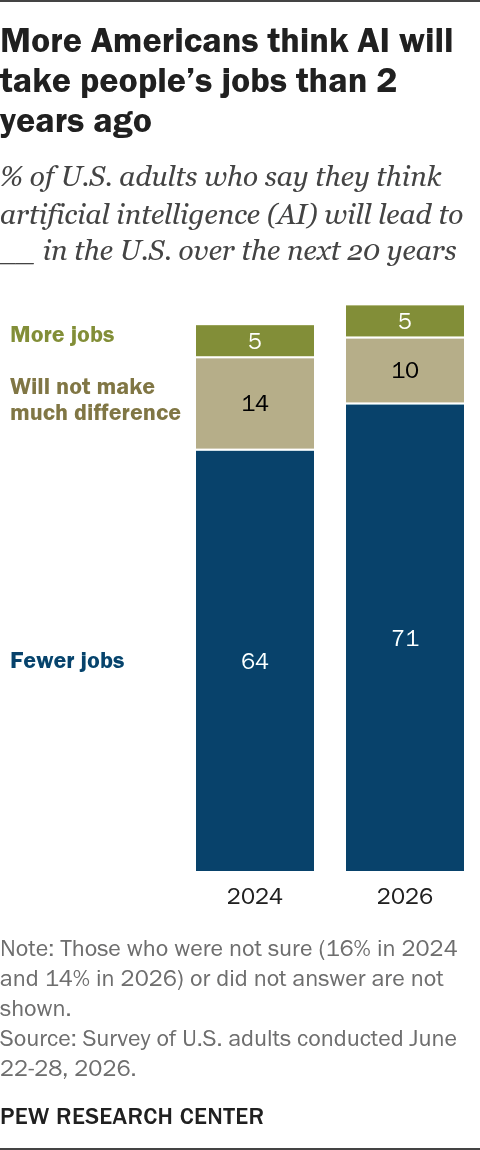
More Americans think AI will take people’s jobs than 2 years ago
% of U.S. adults who say they think artificial intelligence (AI) will lead to __ in the U.S. over the next 20 years
| Fewer jobs | Will not make much difference | More jobs | |
|---|---|---|---|
| 2024 | 64 | 14 | 5 |
| 2026 | 71 | 10 | 5 |
Note: Those who were not sure (16% in 2024 and 14% in 2026) or did not answer are not shown.
Source: Survey of U.S. adults conducted June 22-28, 2026.
PEW RESEARCH CENTER
Even in 2021, job loss was one of the top reasons behind Americans’ concern about AI. Today, Americans largely – and increasingly – think AI-related job loss is on the horizon
In our new survey, 71% of adults think AI will lead to fewer jobs in the United States over the next two decades, up from 64% in 2024. Few (5%) say AI will lead to more jobs. One-in-ten say it won’t make much difference, and a slightly larger share are unsure
Across most age groups, it’s become more common for Americans to foresee job loss from AI. For example, 73% of adults under 30 now say AI will lead to fewer jobs, up from 61% two years ago.
The youngest adults are now just as likely as those ages 30 to 64 to hold this view. Americans 65 and older are a bit less likely to think AI will lead to fewer jobs, though this is still the majority view among this age group
Young adults are now just as likely as those 30 to 64 to think AI will take people’s jobs
% of U.S. adults who say they think artificial intelligence (AI) will lead to fewer jobs in the U.S. over the next 20 years
Note: Those who said “more jobs,” “will not make much difference” or “not sure” or who did not answer are not shown.
Source: Survey of U.S. adults conducted June 22-28, 2026.
PEW RESEARCH CENTER
Young adults are now just as likely as those 30 to 64 to think AI will take people’s jobs
% of U.S. adults who say they think artificial intelligence (AI) will lead to fewer jobs in the U.S. over the next 20 years
| 2024 | 2026 | |
|---|---|---|
| Ages 18-29 | 61 | 73 |
| 30-49 | 66 | 74 |
| 50-64 | 69 | 72 |
| 65+ | 58 | 63 |
Note: Those who said “more jobs,” “will not make much difference” or “not sure” or who did not answer are not shown.
Source: Survey of U.S. adults conducted June 22-28, 2026.
PEW RESEARCH CENTER
Worry over job loss has shown up throughout our research about AI, including among workers and even teenagers. And there’s no shortage of expert debate – many warn AI is a threat to jobs, while others have argued it creates them
Young adults aren’t the only ones concerned about AI’s increasing use in daily life, or about job loss. Still, our past work shows they stand out in other ways
Adults under 30 are most likely to think AI will be bad for society – and for them. They largely think it will make connection and creativity harder to come by. And though most say they use chatbots, they’re just as likely to say these tools hurt their own creativity as help it
Note: Here are the questions we used for this analysis, the topline and the survey methodology
Topics

Colleen McClainis a senior researcher focusing on internet and technology research at Pew Research Center

Eugenie Parkis a research analyst at Pew Research Center
