

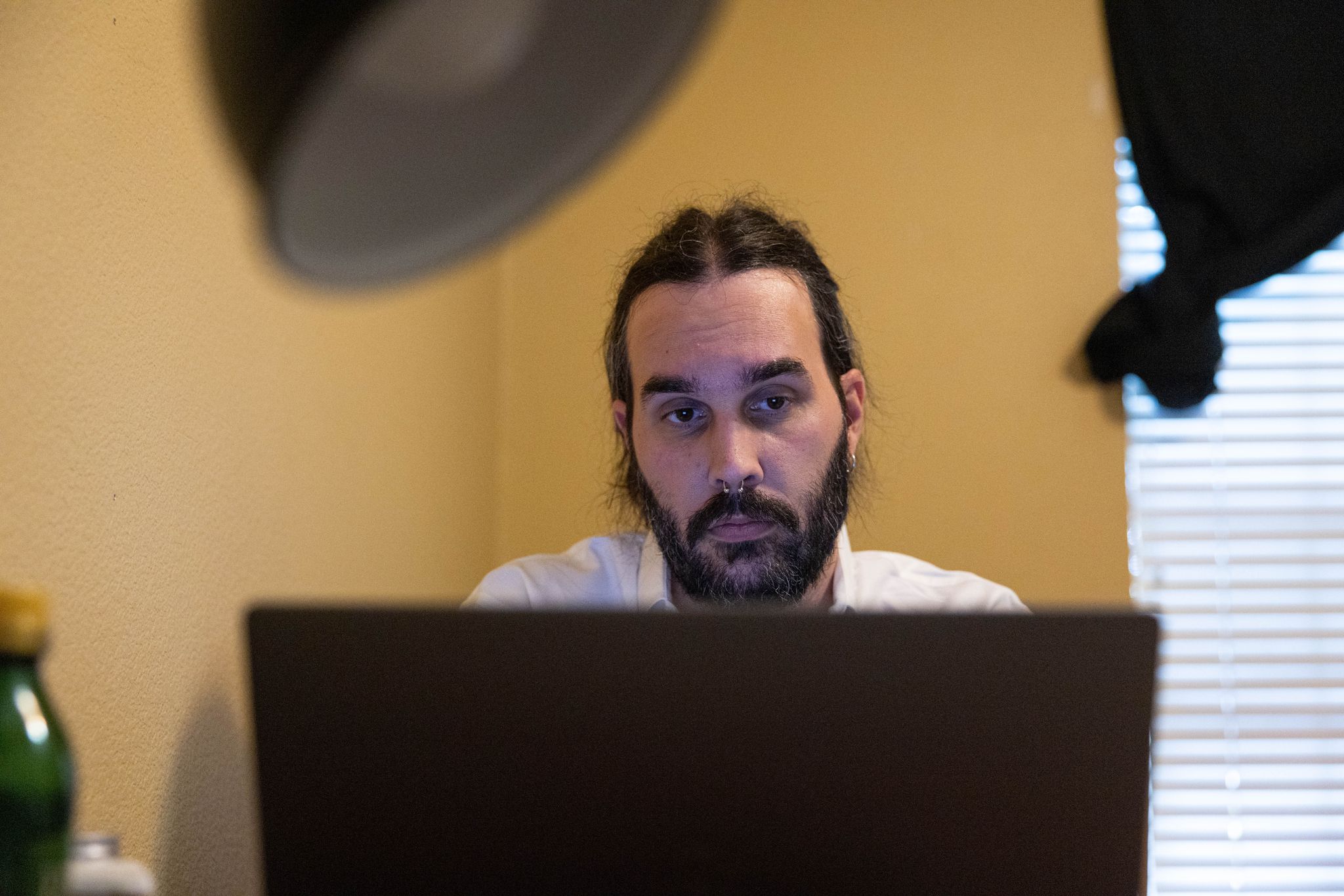
Maturon Miner spends his weekdays in a rented room in Plano, away from the East Texas home he shares with his wife and 5-year-old daughter.
Every weekend, he drives back to see them. Then he returns to North Texas for another week of coding, hands-on projects, and cybersecuritytraining.
Article continues below this ad
After about 15 years in the craft beer industry, Miner, 43, decided he needed a career that could offer his family more stability. He enjoyed working in breweries and behind the bar, but the pay was no longer enough to make ends meet. Now he hopes the sacrifice of living apart during the week will eventually help him save for his daughter’s college fund and put money away for a house.
“I’m not looking to get rich or anything like that,” Miner said. “I just want to be able to provide for my family.”
Miner is part of nuKudo’s first Dallas training cohort, one of several efforts across North Texas trying to widen the path into cybersecurity as employers search for workers and artificial intelligence reshapes both cyberattacks and the jobs meant to stop them.
Universities, training companies and workforce organizations are building programs for recent graduates and adults changing careers. Their approaches differ, but they describe a common need — technical knowledge, practical experience, and problem-solving skills. The push comes as artificial intelligence is amplifying cyber threats.
The Dallas area employed about 3,670 information security analysts in 2025, with employers projected to add an additional 1,627 jobs by 2032, according to the Texas Workforce Commission. Hundreds of openings are expected each year across the Dallas, North Central Texas and Tarrant workforce areas. Median annual wages exceed $130,000 in Dallas, Tarrant and Collin counties, though those figures reflect the occupation overall rather than entry-level pay.
Article continues below this ad
North Texas demand fueled by growing cyber threats
The labor demand is growing alongside a threat landscape Texas Cyber Command describes as “extensive and dynamic.” Jonathan King, assistant director of the Texas Information Sharing and Analysis Organization, said Texas’ size, economy and critical infrastructure make the state strategically important and at greater risk of cyber threats.
Related: What to know about Texas Cyber Command, the state’s new watchdog
Phishing remains one of the most common and effective threats, King said. Artificial intelligence is making spreading malicious messages easier, while also giving defenders new tools to identify weaknesses and harden networks.
Article continues below this ad
“Everyone is a target,” King said.
North Texas faces increased risk because of its size and critical infrastructure, including water systems. Defending it, King said, requires technical knowledge, critical thinking, communication, and adaptability.
That same message surfaced among employers, educators, and training providers.
When the University of North Texas at Dallas designed its new Bachelor of Arts in Cybersecurity, administrators asked executives what graduates would need to land jobs and advance.
Dean Jason Garrett said employers emphasized communication, teamwork and project management alongside technical skills. That feedback helped shape the Bachelor of Arts program, which begins Aug. 24.
Article continues below this ad
The university pathway is only one piece of the region’s emerging cybersecurity workforce pipeline. nuKudo takes a different approach, hiring trainees as full-time employees. The program pays trainees during several months of intensive training and then places them with partner companies. The model is designed to remove the tuition and lost income that can prevent adults from leaving a job to retrain.
Changing careers and sacrificing for a better future
Miner said a traditional boot camp was not realistic because he could not stop working, pay tuition and hope a job materialized. He had spent years teaching himself and earned an offensive security certification, yet the pace remains demanding. Earlier in the program, Miner said trainees completed dozens of small Python exercises before shifting to larger, real-world assignments.
The hardest part has been living away from his family during the week.
Article continues below this ad
“It was a lot of discussion, but we figured it out,” Miner said.
Jerry Sinayuk had been accepted to medical school, but work in a medical office made him question that path. A longtime technology hobbyist, he joined nuKudo’s first U.S. cohort and now works as a solutions engineer at cybersecurity company Island.
Related: Seeking better pay? North Texas short-term job programs might help
The role fit a skill he had used informally for years.
“You’re telling me you want me to talk to people and explain to them why and how they need this cool new technology in their lives, and you want to pay me for that?” Sinayuk recalled thinking. “I’ve been doing that for free my whole life.”
Article continues below this ad
He said nuKudo’s financial incentives distinguish it from a traditional boot camp.
“I’m not paying them money,” Sinayuk said. “They’re actually paying me money from day one.”
UpskillU helps veterans, displaced workers, and other adults gain experience through online training, mentoring and projects. CEO Andy Najjar said employers are often reluctant to place inexperienced workers in roles where mistakes carry significant risks.
Joe Stewart, 29, works as a technology technician for Lancaster ISD. He enrolled in UpskillU’s year-long apprenticeship to build experience for a cybersecurity role.
“Entry-level jobs want five years of experience,” Stewart said. “You just have to tough it out. Something’s going to stick.”
Others are turning to cybersecurity after years of unstable employment.
Tiffany Gillespie, 42, enrolled after repeated insurance layoffs. While studying cybersecurity, the Irving resident has driven for Uber and cared for her mother.
“I’m tired of starting over,” Gillespie said.
She hopes the transition leads to more than another short-term job.
“It’s a different tax bracket,” she said. “I don’t have to worry about being evicted from my home.”
Addressing the experience gap on resumes
The experience gap is also what employers notice.
Paul Johnson, CEO of Richardson-based HEXA Innovation, said companies want applicants who can demonstrate what they have done. His company’s experience with UpskillU involved training an existing employee in digital marketing rather than cybersecurity, but he said the same lesson applies across technical fields.
“Show me your book of work,” Johnson said. “Show me that you’ve done things.”
Johnson compared AI to giving a skilled carpenter modern power tools. The craft remains the same, but the work becomes faster, more efficient, and more productive.
Employers and educators said workers must use AI without outsourcing judgment. They must question results, explain recommendations, and connect technical work to a real need
Miner said the appeal of cybersecurity is partly that the learning will never stop. Technology changes, attackers adapt, and defenders must keep solving new problems. He is interested in penetration testing or red-team work but is also open to a customer-facing role that uses the communication skills he developed while bartending.
The career change is not guaranteed. Miner still has months of training ahead, and the entry-level market is shifting as AI automates some work once used to train junior employees.
But Miner said that’s not a reason to stop trying.
“I’ve got the same dreams as everyone else,” he said.
This reporting is part of the Future of North Texas, a community-funded journalism initiative supported by the Commit Partnership, Communities Foundation of Texas, The Dallas Foundation, the Dallas Mavericks, the Dallas Regional Chamber, Deedie Rose, Lisa and Charles Siegel, the McCune-Losinger Family Fund, The Meadows Foundation, the Perot Foundation, the United Way of Metropolitan Dallas and the University of Texas at Dallas. The News retains full editorial control of this coverage
