

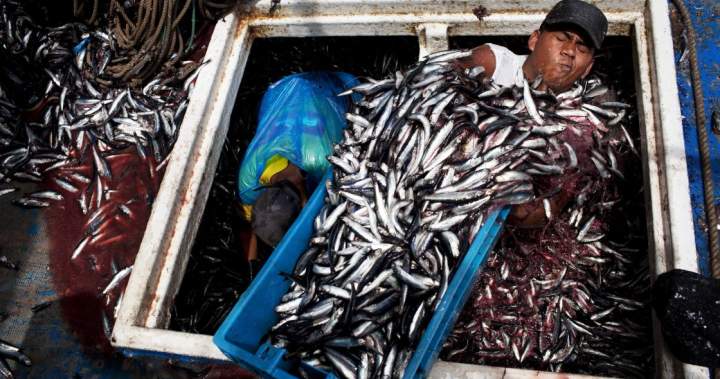
Love them or hate them, anchovies could end up making your grocery bill more expensive

A key ingredient in fishmeal — feed used for farmed seafood, pigs and even chickens — the polarizing fish is in short supply
The retail price of fish in Canada was already up about four per cent in May compared to a year earlier with canned salmon up a whopping 14.3 per cent over the same time span
At the same time, fishmeal prices are skyrocketing
A metric tonne of Peruthe International Monetary Fund. That’s up about 12.5 per cent from $2109.25 a month earlier
Food economist Mike von Massow of the University of Guelph calls anchovies “a critical part” of the food supply chain, since roughly two-thirds of the fish people buy — including salmon — is farmed using fishmeal as feed
“This [anchovies] is an important source of food for Canadians and for the world. And so it’s easy to say, ‘Oh, well, anchovies, who cares? I don’t particularly like them,’ but they are an important part of that food value chain for products that are, in fact, very much in demand,” he says.
“So we have this factor that is further up the supply chain, but that has the potential to significantly impact the prices of, particularly, fish.”
Here’s what’s going on
Related Videos
2:10
Carney aims to slash grocery bills with $3.2B food security strategy
- Carney aims to slash grocery bills with $3.2B food security strategy

Food insecurity concerns continue to climb
Manitoba’s inflation rate among highest in Canada
Canadian farmers face soaring diesel, fertilizer costs amid Iran war
Easter meal to cost more with food prices surging



Anchovy supply under pressure
Anchovies are considered high in protein and rich in nutrients like Omega-3 acids relative to their small size, which explains their critical role
Peru is the world’s largest supplier of anchovies, according to the Food and Agriculture Organization of the United Nations, and it makes up about a fifth of the global supply

Get daily National news
Get daily Canada news delivered to your inbox so you’ll never miss the day’s top stories.
By providing your email address, you have read and agree to Global News’ Terms and Conditions and Privacy Policy.
But high demand for anchovies worldwide has led to overfishing
As a result, fewer mature fish are caught, leaving younger, or juvenile, fish. If fish populations are not given enough time to reproduce, they risk extinction if fisheries don’t scale back their catches
This has led to catch quotas, where industries in Peru, like others, are limited by regulators on how much they can fish at a given time
In April, the Perus used for indirect human consumption (like with fishmeal) that was 36 per cent lower than in 2025
This means the global supply of anchovies is under pressure not only because fewer mature fish are being caught due to overfishing, but also because government regulations further limit the catch allowed per season
“The shortage is, currently, because they’ve cut quotas on fishing, because there are too many juveniles in their catch. So what we’re doing is we’re trying to incur some shorter-term pain so that we have a long-term sustainable harvest of anchovies,” he says
Similar biological challenges affecting supply chains have also led to higher beef prices in North America. Although for different reasons than with anchovies, it speaks to the sensitivity of biological necessities in food and agriculture that can have financial impacts on consumers down the line
“If you harvest too many of those small fish, you don’t have the factory, you don’t have theem,” says von Massow
Anchovy alternatives?
Substituting all or part of anchovies for fishmeal ingredients, however, changes the nutritional makeup of the feed and, therefore, the aquaculture and livestock that consume it
Von Massow says this is why anchovies are “difficult to substitute out.”
“We can do small degrees of replacement of fish proteins with other plant-based proteins like soy, which is, in fact, a cheaper the same, and so we don’t get the same kind of fish product on it,” he says
“We get lower yields of fish, but also lower levels of omega-3 in fish like salmon. And that’s one of the reasons we eat that salmon. So you have this conundrum that you could grow those fish with other proteins, but then they wouldn’t be the same product anymore.”
