

US launches ninth night of Iran strikes as strait of Hormuz standoff sees oil price pass $90 a barrel
After the US military confirmed that a service member had been killed in Iraq – the third in recent days – Donald Trump said the new attacks were ‘in honour’ of the dead
Middle East crisis live: follow latest updates
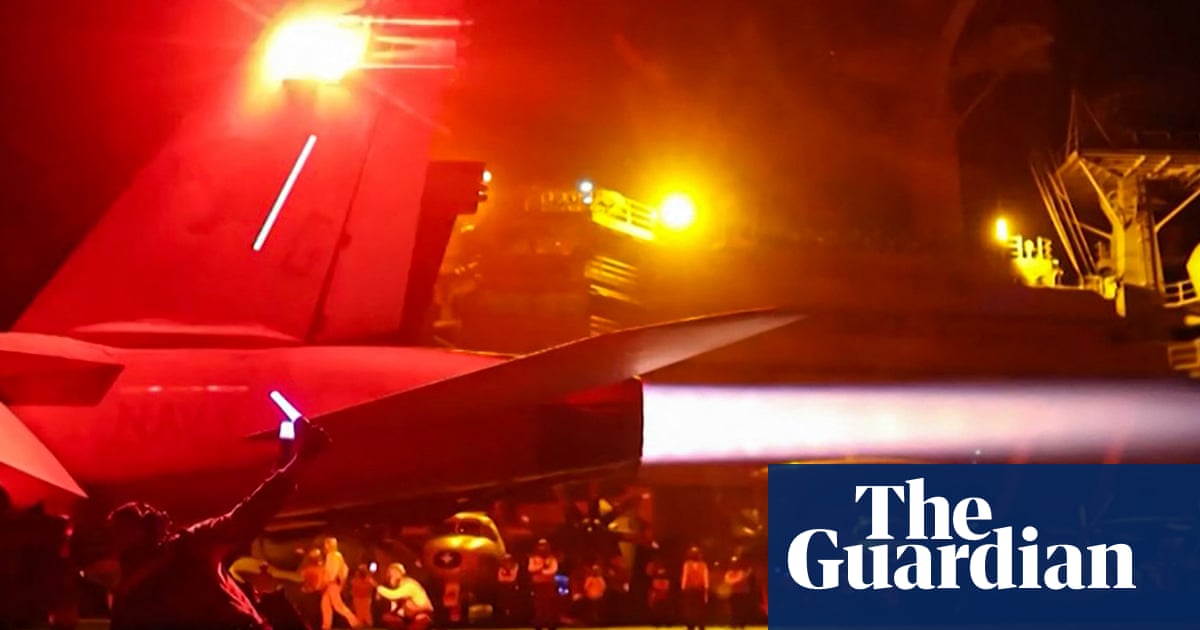
The US launched a ninth night of strikes targeting Iran early Monday, after announcing the death of another American service member, as the price of Brent crude oil climbed above $90 a barrel, the highest level since June
The US military said the service member was killed on Saturday in northern Iraq, where the US has military bases, during a controlled detonation of what was called unexploded ordnance on a downed Iranian attack drone
“We hit them very hard again tonight,” Donald Trump said as he returned to Washington after the World Cup final, adding “we did that in honour of the, probably three, it’s probably three great patriots.”
Why is Trump risking midterm disaster by resuming the unpopular Iran war?
Read more
It was the third US death in recent days, after two military service personnel were killed in an Iranian attack on a Jordanian airbase on Friday, with a third missing in action. Since the war began, 17 US service members have been killed
As the strikes began early Monday, a ship caught fire in the strait of Hormuz near the coastline of Oman, the British military said. It was unclear what sparked the blaze off Oman, in the southern corridor the US military has encouraged ships to use to avoid Iran’s control. The Revolutionary Guards later claimed twooil tankers were blown up after attempting to transit through the southern route of the strait, but there was no independent confirmation
The US and Iran have inched closer to all-out war as last month’s interim deal meant to permanently end the fighting has crumbled and shipping traffic in the strait of Hormuz has largely stalled
Why is Trump risking midterm disaster by resuming the unpopular Iran war?
Read more
Iran continued to retaliate by hitting US-allied countries throughout the Middle East, with sirens heard in Bahrain early on Monday. The US embassy in the country warned: “Iran may seek to target unspecified locations in central Manama”, the capital, without elaborating
Iran’s Revolutionary Guards also claimed to have launched a “surprise attack” on an enemy command centre in the Al-Tanf region of Syria, in a statement reported by state news agency IRNA
After Iran targeted sites in Jordan on Sunday, Israel warned of the danger of the strikes spilling across its borders, reigniting a direct regional conflict that had been restrained even as tensions between the Trump administration and Iran have soared again
“If Iran fires missiles at Israel, we will attack them with full force,” said the Israeli defence minister, Israel Katz, on Sunday. The US is expected to send dozens of additional refuelling planes to Israel as part of a reinforcement of its force posture in the region, a US official told Reuters
Trump has threatened to target Iran’s power stations and bridges to try to compel Tehran to loosen its hold on the strait of Hormuz, which saw one-fifth of global oil supplies transit before the war
Last week the US reimposed a naval blockade on Iranian ports to halt its shipments of crude oil. The military on Saturday said it had redirected six ships and disabled one since then
Oil prices rose at the opening of trading in Asia on Monday, with the price of Brent crude climbing 2.72% to $90.50 a barrel
On Saturday, Iranian supreme leader Mojtaba Khamenei warned in a statement of “unforgettable lessons” if the US kept attacking the Islamic Republic. An Iranian negotiator said Tehran was suspending its commitments in the interim deal agreed last month and accused the US of violating it
The halfway point has passed in the 60 days the deal set out to negotiate the permanent end of the war and other issues, including Iran’s nuclear program
On Sunday, US energy secretary Chris Wright defended the Trump administration’s strategy for the war, but argued that the mission had since shifted toward ensuring oil shipments could move through the strait of Hormuz
“We did a pause to try to get an agreement with the Iranian people to allow oil to flow without them attacking it,” Wright said. “They’ve proven unwilling to do that, and we’ve pivoted. Now, what we’re doing is assuring that that oil and gas and other products can flow through the strait of Hormuz with or without Iranian cooperation.”
With the Associcated Press and Agence France-Presse
Explore more on these topicsShare
Reuse this content
