

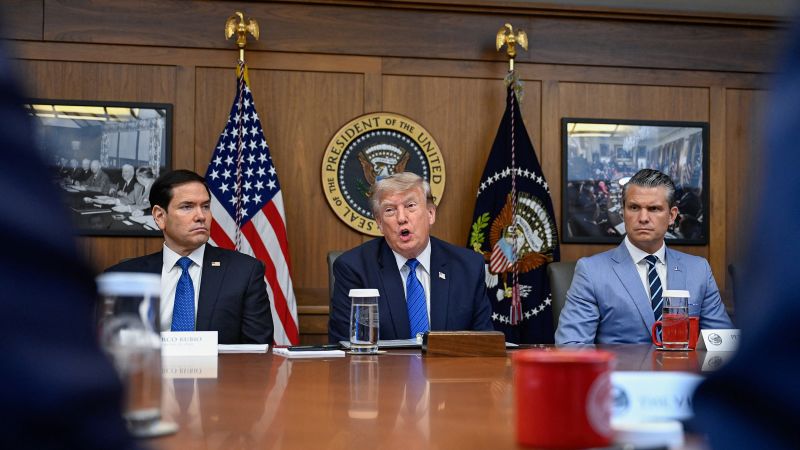
President Donald Trump, Secretary of State Marco Rubio and Secretary of Defense Pete Hegseth participate in a cabinet meeting at Camp David in Thurmont, Maryland, on July 31.
See all topics
President Donald Trump has privately complained in recent days that disclosures on the dwindling US munitions stockpile make the United States look weak at a critical juncture, senior US officials said, as he repeatedly threatens additional military action to try and motivate Iran to agree to a deal
The topic was front and center during last week’s Cabinet meeting at Camp David, when a frustrated Trump raised media coverage of the low munitions stocks, according to six has been well aware of any potential problems regarding munitions for months and was not blindsided by the reports
But he was angry that the information had been exposed at an inflection point in the conflict and that it continues to be an increasingly public issue at a time when he wants to project a position of strength, they said
“The U.S. has massive amounts of ‘munitions,’ especially of certain types,” Trump wrote on Truth Social just after midnight on Thursday. “Additionally, large amounts are being manufactured and shipped to the U.S. as needed. Defense companies are building the largest number of plants and factories in our country’s history.”
Still, Trump appeared to acknowledge that at least some of the information circulating about the stockpiles was accurate. He said his administration would seek “long term jail sentences” for those found to have made the information public. And later, in the Oval Office, he admitted that certain munitions are in “tighter” supply, adding that there’s a “virtual unlimited supply” of less-advanced weapons
So far, the president’s ire has not been directed specifically at Defense Secretary Pete Hegseth, White House officials insist. In another Truth Social post on Thursday, Trump said he was “extremely happy with the job that Pete Hegseth is doing.”
“He has never blamed Pete. This is all about the leakers,” one official said
Trump has tasked the Justice Department with finding what he calls “treasonous” individuals within the administration who are disclosing the information, according to officials
His anger came to a head over the last several weeks, after a number of news stories described the US military being low on munitions
CNN reported this week the military has burned through nearly four-fifths of its THAAD missile inventory compared to pre-war numbers and roughly half of its Patriot interceptors since the start of the war, according to two
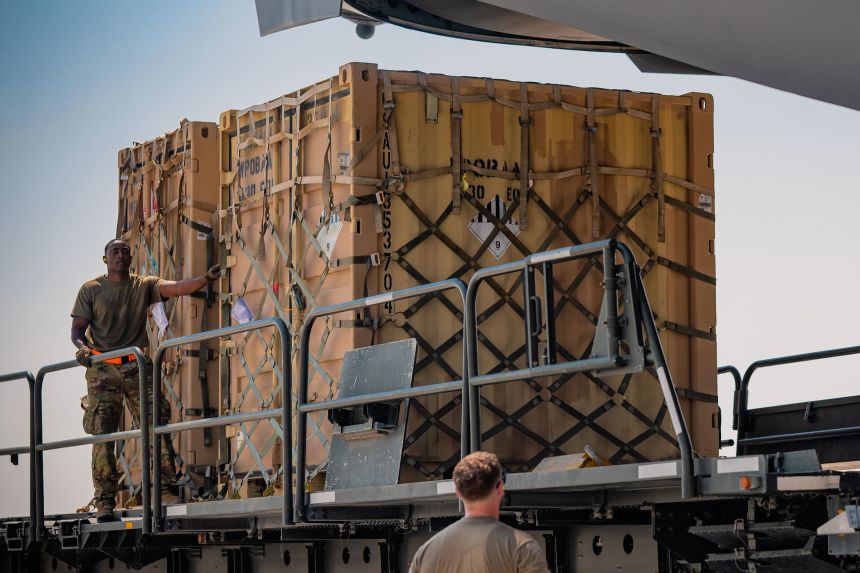
US Air Force aerial porters prepare to load Terminal High-Altitude Area Defense (THAAD) support equipment onto a C-17 Globemaster III in October 2024.
The Center for Strategic and International Studies estimates the United States had around 2,200 Patriots (of the platform’s two most-modernized variants) and 452 THAAD missiles in its stockpile before the Iran war started
The numbers worry not only American officials, but also leaders in the Gulf, who have raised fresh concerns about how a shortage of air defense systems could impact their ability to ward off potential Iranian retaliation if Trump decides to escalate the ongoing conflict
Several of those countries rely on US air defense systems. Gulf leaders have acknowledged the stockpile shortage could hinder their own ability to intercept incoming Iranian missile and drone attacks, multiple officials said
Iran has conveyed to Gulf nations that renewed American attacks would result in retaliation on energy sites or desalination facilities across the region, according to a regional official familiar with the conversations. Trump has spoken to the leaders of Qatar and Saudi Arabia over the past week about the war
As Trump grows angry at the narrative emerging on the stockpiles, officials in the White House have speculated the leaks come from anti-war officials within the administration who are determined to push Trump to extricate the United States from the conflict, the senior White House official said
The stockpile issue was raised again prior to the president’s decision last weekend to cancel new strikes on Iran, CNN has previously reported. It marked at least the second time in recent weeks that Trump’s senior military advisers have specifically voiced concerns about the dwindling number of key US munitions during discussions about potentially escalating the conflict with Iran
Questions about the munitions stockpiles date back to the early days of the conflict. In meetings then, Trump raised the issue with Hegseth after news outlets reported on the concerns. At that time, Hegseth assured the president that the Pentagon was working to address the issue
And before the war began, Joint Chiefs of Staff Chairman Gen. Dan Caine and other military leaders warned Trump that a protracted military campaign could impact US weapons stockpiles — particularly those that support Israel and Ukraine, multiple
Since then, Trump has blamed the previous administration for allowing the stockpiles to be depleted, including through weapons shipments to Ukraine
“We have a lot. I’d like to have more, to be honest, but so much was given to Ukraine by Biden,” Trump told reporters aboard Air Force One on July 27
The Pentagon has long had concerns about the defense industry’s ability to produce weapons quickly enough. Those concerns were only exacerbated by the US war with Iran, after conflicts in Gaza and Ukraine both saw the US contribute weapons to Israel and Kyiv
In July, Trump met with the CEOs of top defense contractors at the White House as his administration presses the firms to ramp up production of critical weapons. The participants included Lockheed Martin, which produces both the THAAD and Patriot interceptors. A similar meeting took place in March, at the onset of the war
Also last month, Trump invoked the Defense Production Act to force defense companies to manufacture more weapons. In a document, he wrote that he finds “that conditions exist which may pose a direct threat to the national defense or its preparedness programs.”
But those steps could take years and are not likely to immediately boost production
This story has been updated with additional developments
See all topics
