

Will Trump Accounts deliver for American children?
2 days ago

Getty Images
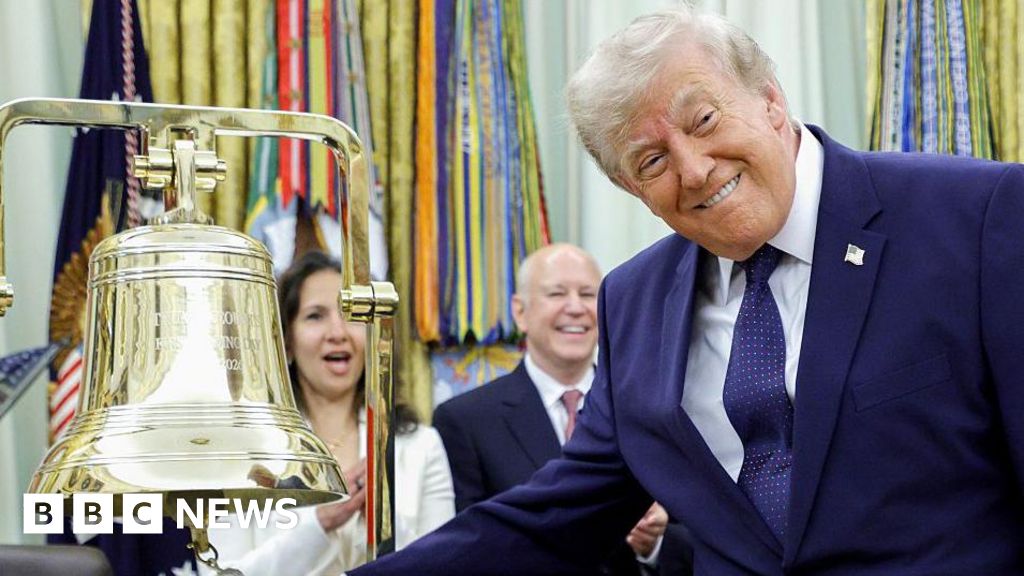
The launch of Trump Accounts, the new savings scheme aimed at encouraging investing among American children, was marked with an historic ringing of the Wall Street opening bell in the Oval Office this week
But not everyone is convinced the project will prove a success in giving new generations a stake in the so-called American dream, with sceptics suggesting that it will not live up to the hype
The savings accounts are now available to all US children under the age of 18, with babies born between 2025 and 2028 qualifying for a $1,000 contribution to kickstart savings
The move comes as the cost of living remains a major issue ahead of November’s mid-term elections, but tax experts told the BBC families on lower incomes could lose out and that the scheme is too complicated
How do Trump Accounts work?
The accounts named after the president are available nationwide and can be created for anyone under the age of 18 with a valid social security number. Parents can simply download the app
Families, friends and employers can contribute up to $5,000 per year per child, who can access the funds when they turn 18
To avoid such a penalty, the money must be assigned to pay for certain things, such as higher education, buying or building a first home, or for personal emergency expenses
Trump Accounts add to other existing tax-efficient savings schemes that Americans can use for retirement, such as IRAs, or for educational purposes, such as 529 plans, which parents use to save for their children’s college fees
According to a Congress report, Trump Accounts are a new form of traditional individual retirement account (IRA), but differ because of certain rules
What’s the reaction been?
While the White House has been keen to push the scheme, reaction to it has been split
The White House’s argument is that Trump Accounts offer millions of children a way into stock ownership in the US, which it says has historically been “unevenly distributed, with many households – especially younger and lower‑income families – having little or no exposure”
However, Will McBride, chief economist at the Tax Foundation think tank, says the scheme is too complicated to sign up to, which will lead, in his view to a “minority that benefits”
He suggests those that will take advantage will be the parents of children who are “relatively well-informed, relatively well-off, relatively tuned in [and] have their act together”
However, Andy Blocker, head of policy, regulatory and government relations at financial services firm Edward Jones, believes the $1,000 contribution for babies born during Trump’s second term in office will remove a “barrier of having nothing to start with”
“If by year-end more families have a clear on-ramp to begin saving and investing for their children’s financial futures, that’s success,” he suggests
Adam Michel, director of tax policy studies at the Cato Institute, says the idea of the scheme is admirable, but warns it might “not live up to the rhetoric”
He says the main benefit is the $1,000 starting subsidy but suggests many families would be better off using existing savings accounts
He also points out barriers such as penalties for early withdrawal, as seen for other savings accounts, adding that lower-income children may feel compelled to take the money out when they turn 18 to “help make ends meet”, and therefore have to pay a penalty. “Trump Accounts do not fix that problem.”
How many people have signed up?
It is understood some six million families had signed up before Trump Accounts went live on 4 July, which is a fraction of the tens of millions of children who could be eligible for one
The White House said on Monday that the $1,000 subsidyfor babies had been deposited into more than half a million accounts so far. About 3.6 million children were born in the US in 2025, according to provisional data
At the end of this week, the White House said that American families had “contributed nearly $125 million to Trump Accounts” so far
What are the returns?
Trump Accounts estimates the $1,000 starting pot could rise to $6,000 by the time a child reaches 18 even without any further contributions. Its calculations are based on historical S&P 500 averages, but it warns actual results may differ and are not guaranteed
If $250 a year was added to a child’s account, the pot could be worth $19,000 by the time they turn 18, according to the scheme. It could be as high as $271,000 if family members or employers contribute the maximum $5,000 a year
The scheme has the backing of some big business names, including investment giant BlackRock, which said about 40% of Americans have no exposure to financial markets. Several US companies, including card payment giant Visa and tech company Dell, have also pledged support for the scheme
Dell family to seed Trump accounts for kids with $250
Donald Trump
Savings
Personal investment
