

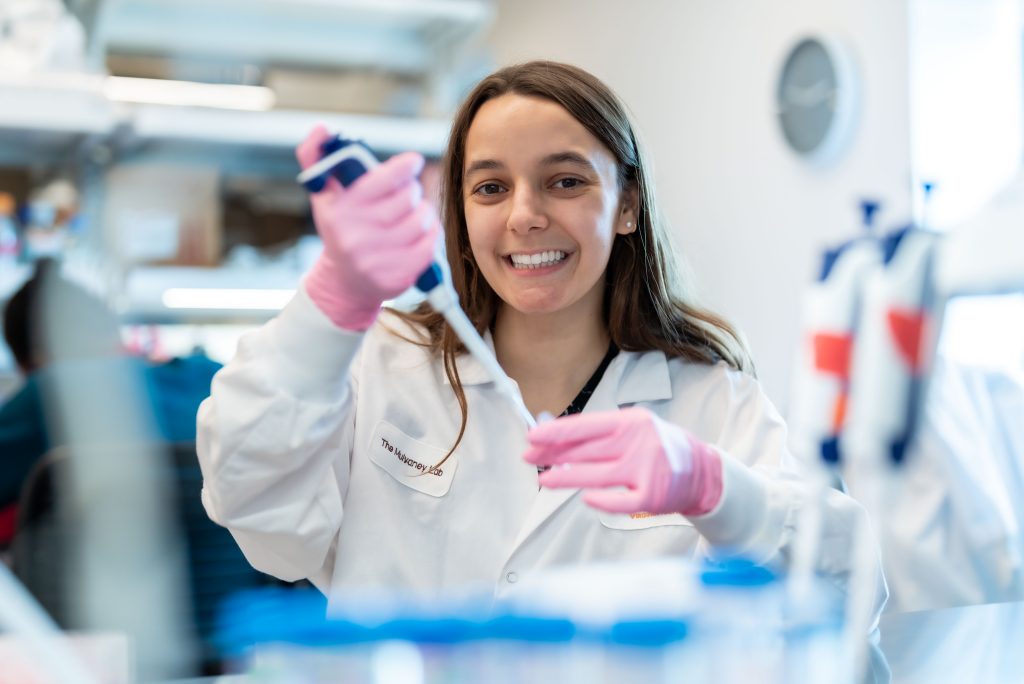
Blanka Bordas, a doctoral candidate in Virginia Tech’s Translational Biology, Medicine and Health Graduate Program, has received a National Institutes of Health fellowship to study a molecule involved in DNA repair and gene expression
The Ruth L. Kirschstein National Research Service Award for Individual Predoctoral Fellows is awarded by the National Cancer Institute (NCI) to support dissertation research related to its mission
The enzyme Bordas studies is called protein arginine methyltransferase 5, or PRMT5. It is essential to normal cell function. Past research has shown that embryos without PRMT5 do not survive
“We can assume that it must be doing something important if your cells will die without it,” Bordas said. “But as a whole, we don’t really know what this type of methylation does.”
The molecule is part of a class of enzymes that modify proteins by adding chemical tags known as methyl groups. This process, called methylation, is a core biological process. From the earliest stages of development, methylation helps guide cells into their specialized roles and repair damaged DNA
The grant will help Bordas track which proteins PRMT5 modifies in normal cells and the consequences of those modifications
“We’re trying to define what the modification actually does,” Bordas said. “If we understand the biology better, we can start asking more informed questions about disease and treatment.”
Bordas’ doctoral work is mentored by Kathleen Mulvaney, assistant professor at the Fralin Biomedical Research Institute whose lab at the institute’s Cancer Research Center in Washington, D.C., focuses on the role of PRMT5 in pancreatic and brain cancers
“Blanka has been an outstanding graduate student in the lab. Her work provides important insight into the function of PRMT5 in pancreatic cancer,” Mulvaney said. “We are very proud of her earning the NCI F31. I am excited to mentor her toward continued achievements in cancer research.” Mulvaney is also a faculty member in the Department of Biomedical Sciences and Pathobiology in the Virginia-Maryland College of Veterinary Medicine
A deletion affecting a gene region called CDKN2A-MTAP occurs in roughly 15 percent of all solid tumors. Mutant cells carrying the deletion become abnormally dependent on PRMT5 for survival
“We know that if you target it a little bit in cancers, it leads to a drastic effect versus in your normal cells,” Bordas said. Normal cells can tolerate reduced PRMT5 activity but cancer cells with the deletion cannot
That selectivity has made PRMT5 an attractive drug target, and several drugs designed to inhibit PRMT5 activity are now under clinical investigation as cancer treatments. But without a clearer picture of what the enzyme does under normal conditions, those therapeutic efforts may be operating in the dark
“There are emerging drugs that target this enzyme in this cancer setting, but we don’t fully understand what the enzyme does in a noncancerous cell or exactly how it modifies its substrate proteins,” Bordas said. “If we’re targeting this in people, it would be pretty important to know exactly what the consequence is.”
Contact:
540-526-2002
