

See all topics
A surprising trend has been showing up in Bank of America accounts over the past few months: The gap between America’s wealthy and poor appears to be narrowing
That’s counter to the narrative we’ve been hearing for years: that America’s rich are getting richer, leaving the less-well-off among us behind and the American Dream out of reach
That wealth gap, often called the “K-shaped economy,” has been blamed for many of the economy’s ills, and a chief other hand, it has also been credited for keeping the US economy humming, as wealthier Americans keep spending and businesses keep hiring
But what if that K-shaped narrative isn’t true anymore?
For the “K” theory to hold, income and spending growth for the rich needs to outpacethe growth in paychecks and expenses for the poor. In other words, the upward- and downward-pointing lines of the “K” diverge
Instead, by some measures, those lines seem to be getting closer together
The difference in spending growth between higher- and lower-income Americans is the narrowest it has been in three years, according to a June report from researchers at PNC. On Monday, PNC said there’s even early evidence that the savings gap between upper- and lower-income households is starting to narrow
Spending growth for lower-income Americans also outpaced high-income Americans’ in June And the gap in discretionary spending growth shrank to its narrowest point in June since July 2025 – a particularly encouraging sign for the economy if folks across all income levels are confident enough to buy things they want but don’t necessarily need
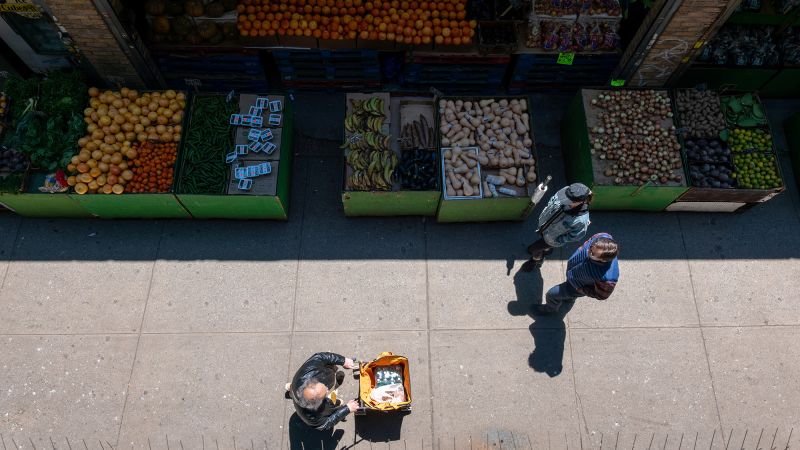
Shoppers outside a grocery store in Bergenfield, New Jersey, on October 24, 2025.
That convergence in the “K” lines is true for paychecks, too. There was basically no difference in earnings growth between rich and poor last month
Larger tax refunds from President Donald Trump’s One Big Beautiful Bill Act, consumer spending during the World Cup and a reasonably stable job market could all help explain why the K is narrowing in 2026. But these last few months of data also build on a trend we’ve seen for years
The “K” has narrowed considerably since 2019, as pay for lower-income workers increased to keep pace with surging inflation. A large influx of pandemic-era government stimulus and social safety nets also supported lower-income workers, noted Joe Brusuelas, chief economist at RSM US
Over the past seven years, the net worth of America’s poorest grew much faster than that of the upper middle class. And middle-class folks’ wealth grew at a higher rate than the top 1%
Over the past five decades, the percentage of Americans in the lower and middle classes shrank, while the contingent in the richest group and the upper middle class surged director of the Center on Opportunity and Social Mobility at the American Enterprise Institute, a center-right think tank
The middle class is hollowing out, but it’s mostly because more folks are getting wealthier, not poorer, Winship argued
The imperfect “K” analogy has recently led some economists and business leaders to try their hand at other letters
A person carries a shopping bag in Philadelphia, on December 10, 2025.
“We’re seeing more of a ‘C,’” argued Treasury Secretary Scott Bessent in an interview on CNBC August 4. Those on the lower end of the economy are making more, he said
“I got sick of hearing about this K-shaped economy,” Bessent said. “I can say here, definitively, the K-shaped economy is over.”
Hilton CEO Christopher Nassetta in June also suggested America’s economy is “C-shaped,” noting people across all price points and income levels are increasing their spending on travel and staying at his hotels
So is the “K” dead?
At this point in the year, “that K-shaped narrative probably doesn’t hold as much,” said Brian LeBlanc, senior economist at PNC
“We’re not seeing lower-income households get worse off,” he said. “There’s still a relative gap. But it’s not getting wider in absolute terms.”
Enter: a huge asterisk to the “dead-K” argument
Ask David Woodyard if poorer households are on more solid ground, and the answer will be brief: “No.”
Woodyard runs Catholic Charities Dallas, which served over 240,000 people in the last year. His organization provided around 9 million meals from summer 2024 to mid-2025. Since then, more than 15 million. About 60% of people who get food assistance come back at least once
“We’re busier than ever, in a total sense,” Woodyard said
Against this backdrop, the K has been widening as the cost of living soared and pandemic-era stimulus fizzled. It shows up clearly in the data if we shift our starting point to, say, 2023 instead of 2019, when many of the economy’s biggest challenges weighed heaviest on low-income families
2023 is around when spending on gas took on a K-shaped trajectory, signaling that wealthier Americans were willing to travel more than poorer folks. At the start of the Iran war, that gas-spending gulf widened significantly
Heather Black sees the bottom arm of the “K” getting even bigger, with more people struggling to cover the basics. Black is the vice president of the 211 System Strategy, a helpline supported by the United Way that connects people to food aid, mental health services, transportation and more
In 2025, the 211 network made 6 million referrals for housing assistance, plus another 3 million for utilities. The trends are on a similar track this year, Black said

A shopper pays for a purchase using a US ten dollar banknote during a farmers market at the Ferry Building in San Francisco, California, on Thursday, July 16, 2026.
Larger tax refunds this spring may have helped families catch up on bills for a month or two. But the one-time payment isn’t enough to bend the “K” itself
“Maybe we get caught up this one time on the overdue rent, but it’s not a solution,” Black said. “It’s a Band-Aid.”
Consider, too, how fragile the economy is underneath those Band-Aids. The job market unexpectedly shed jobs in July. If the slowing continues, it could lead to more stagnant wages, muted hiring or layoffs. Polls show folks are beyond fed up with Trump’s economic record, tariffs and inflation. The war in Iran has jolted gas and diesel markets with little end in sight
Often, poorer households just can’t absorb it all
Higher gas prices threw Javier Casillas’ lower-income customers for a loop. The owner of Live Well Mattress & Furnishing Centres in Alamogordo, New Mexico said his store was profitable at the start of the year. But sales slowed significantly starting in March, and he’s been in the red since
Casillas said he’s still selling premium mattresses to wealthier shoppers. But his discounted merchandise, evenat 80% off, sits idle. The clearance section now takes up half the store because he can’t unload the cheaper inventory
Naming the economy can help define what’s happening around us. Especially since the pandemic, the “K” captures the historic economic divides that increasingly define American life
But a single letter can’t capture everyone’s experience all of the time – let alone a $31 trillion economy that is the biggest and most diverse in the world
Despite all the negativity, Americans keep spending. Retail sales have risen for months. Consumer spending rose a healthy 3.2% in the second quarter. The economy’s in relatively solid shape – in large part, thanks to people spending as if they feel good about the economy
But the wealth gap is real, and it’s inherently unfair. Low-income Americans who can’t afford to buy into the housing market and who lack a significant presence in the stock market are starting on their back foot
All of that can be true at the same time. That’s why it is so important to try and understand every twist, bend and line of whatever letter gets tossed around next. A person’s story may show up on the upturned bottom of the “C,” another’s on the down-pointing leg of the “K.” The macro data may start to curve in a new direction before someone feels a shift in their daily life
Maybe the biggest problem with the “K-shaped” narrative, then, is that there’s just one narrative at all
See all topics
