

Health
The Lumbee Tribe of N.C. wants better healthcare, but plans to fund it are in limbo
July 30, 20265:00 AM ET
By
Andrew Jones
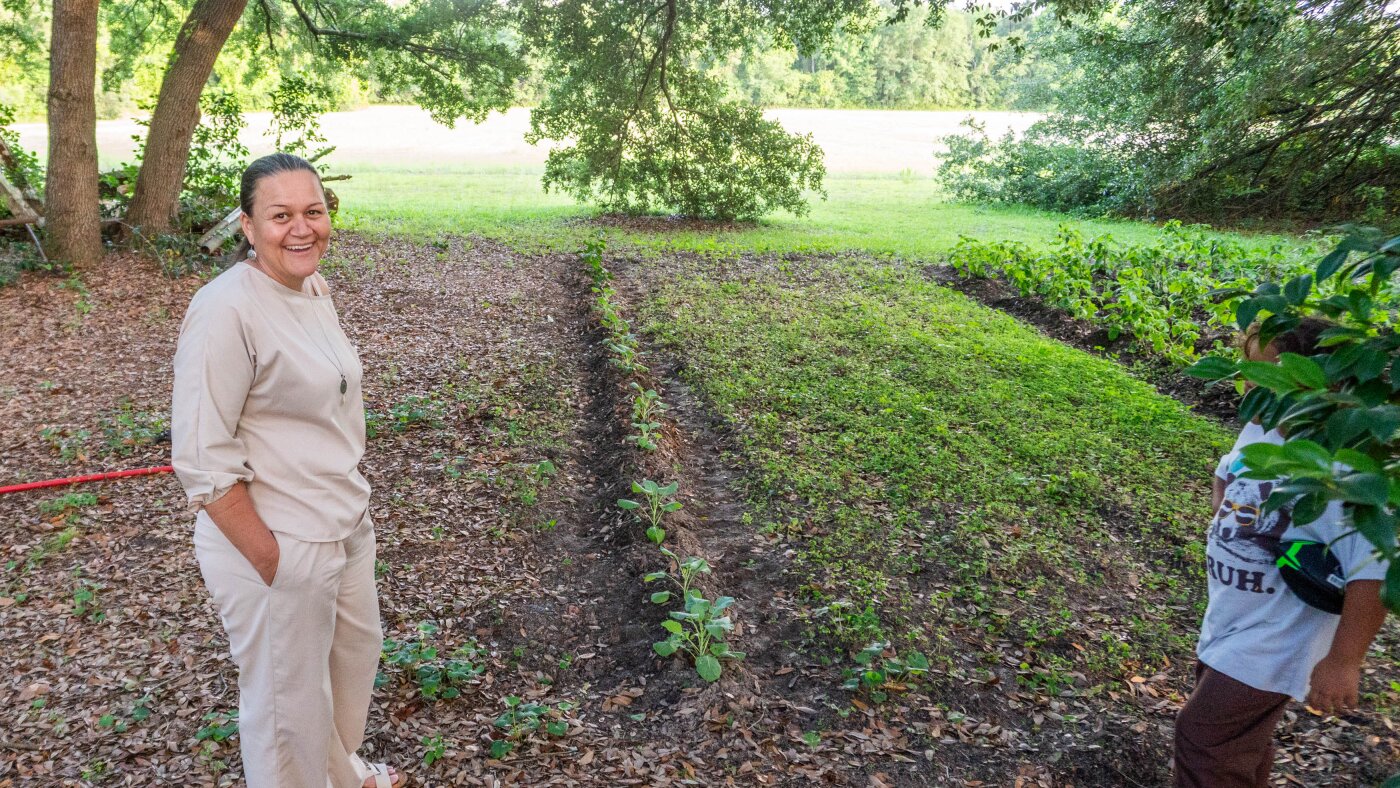
Angie Lowery grows squash, onions, potatoes, and other produce in her backyard garden in Robeson County, North Carolina. She’s tried to improve her health to be able to be there for her grandchildren.
Andrew Jones/KFF Health Newshide caption
toggle caption
Andrew Jones/KFF Health News
For stories of life in our changing world,subscribe hereto the global health newsletter
LUMBERTON, N.C. — Soybean fields surround Angie Lowery’s home on a plot of rural land in southeastern North Carolina’s Robeson County. Dozens of antique gas station signs, 20 feet tall, dominate her front yard. A framed re-creation of The Last Supper, Lone Ranger posters, and a 3-foot-wide tobacco harvesting basket adorn the walls of her home. A collector, Lowery over the years has amassed remnants of her region’s past
But behind the house, the 44-year-old’s backyard garden showcases her goals for the future, one that involves a long, healthy life with her kids: collard greens, bell peppers, onions, tomatoes, red and white potatoes, kale
Angie Lowery’s front yard in rural southeastern North Carolina hosts a small forest of antique gas station signs.
Andrew Jones/KFF Health Newshide caption
toggle caption
Andrew Jones/KFF Health News
Like Lowery, many in the small towns of Lumberton and nearby Pembroke are citizens of the Lumbee Tribe who have dealt with heart conditions. The mother of four struggled with obesity and had to take insulin pills and shots daily. But when her first grandchild was born, in 2024, Lowery imagined her own life ending the way her biological father’s did: Daily insulin shots for diabetes. Kidney dialysis treatments at home. Dead of a heart attack at 63. She wanted her grandkids to remember her
Here & Now Anytime
Native Americans say they’re being swept up by ICE
“If I don’t get this weight off me, if I don’t change my eating habits, it’s going to take me over,” she recalled thinking
So, she expanded her garden. She cut fatty foods and sugary drinks out of her diet, stopped eating fried and fast food, and started moving more. She lost 120 pounds in two years and weaned herself off the daily insulin pills
The Lumbee Tribe of North Carolina late last year became the 575th tribe to secure federal recognition as a sovereign nation, a milestone that leaders and citizens celebrated in tears. The designation provides federal funding for an array of services, including for healthcare.John Lowery, chairman of the tribe and a state representative,declared that “the biggest benefit” would be access to the Indian Health Service — its clinics and hospitals, as well as funding that it could provide for the tribe tocreate its own health system.
But Lumbee researchers and healthcare providers say that money won’t be enough. For decades, IHS has beenchronically underfunded, with the agency’s budget workgroup estimating thatit’s nearly $55 billion short of what it needs this year. And that was before the Trump administration’s cuts to other federal agencies further pinched IHS. Slashes to the Centers for Disease Control and Prevention last year initially included laying off nearly1,000 IHS employees, and President Donald Trump’s proposed 2027 budget cuts more than $150 million for aprogram to address diabetes in Native American tribes.
The nearest IHS facility is more than a two-hour drive to another state for most of the 55,000 Lumbee citizens in Robeson County. The county is one of thepoorest in the U.S. and has some of theworst health outcomes
The Congressional Budget Office in 2022 estimated that the tribe could increase IHS spending by$247 million over four years
The tribe will have to rely on other revenue, to reverse the health disparities their people have faced for decades, Lumbee researchers said
“None of us can depend on IHS alone, because we just don’t have the rearcher at the Johns Hopkins Center for Indigenous Health, and a member of the Oglala Lakota tribe. “But it’s a great starting point.”
The IHS did not respond to questions about plans for the tribe’s health system. Tribe chairman John Lowery did not respond to requests for an interview or a list of questions, but he said on a June podcast that he expected healthcare to be thelargest portion of the tribe’s budget
‘Not just statistics’
Eighteen years ago,Andrea Blackburn, a doctor in Lumberton and a citizen of the tribe, was working at a nearby medical center. There, she said, she was taught that patients with certain last names “are often referred directly to cardiac catheterization,” a procedure to diagnose or treat heart conditions
Blackburn said she realized that common Lumbee surnames carried an expectation of disease
“Nearly two decades later, I can tell you that reality has not changed,” she told assembled tribal leadership and citizens at a public hearing
Robeson County’s rates of heart disease, diabetes, and substance use disorder continue to rank among the highest in the state, Blackburn noted. In 2025,more than half of the county’s residents were Medicaid enrollees, the highest percentage of all counties in the state
“But these are not just statistics to me,” she said. “These are my patients. These are our families.”
For Angie Lowery, breaking free from those statistics meant taking her health into her own hands
She hopes a healthy diet is the answer to breaking her family’s cycle and living long enough to form relationships with her grandkids. And she brought the rest of the family with her. Her teenage daughter lost about 35 pounds. Two of her other children are now “health fanatics,” Lowery said
Her granddaughter will be 2 in November. One Sunday morning in March, Lowery served up macaroni, cauliflower, and chickpeas for her as they spent the day together
Lowery had supported building a casino, believing it would provide better education, infrastructure, and healthcare for her family
“That vote, I’m thinking of my children’s future,” she said
Casino dreams in limbo
Tribal citizens are deeply divided over how to reverse decades of economic decline that have led to poor living conditions, unaffordable health services, and chronic disease
Four months after Trump signed the Lumbee Fairness Act —declaring “I love the Lumbee Tribe” — tribal leaders gathered at a business meeting to take the first steps toward building a casino and establishing gaming as a new revenueave used gaming as acording to the latest report from the National Indian Gaming Commission
The Lumbee Tribe government offices and citizen housing in Pembroke, North Carolina, stand amid long stretches of agricultural countryside.
Andrew Jones/KFF Health Newshide caption
toggle caption
Andrew Jones/KFF Health News
The approach has been popular among tribal nations looking for more dollars to build up healthcare. The Choctaw Nation of Oklahoma in 1999became the first tribe to build its own hospital, using roughly $25 million in gaming money, and the Eastern Band of Cherokee Indians in western North Carolina funded its own hospital in 2015 mostly with$82 million in gaming funds
But the Lumbee Tribe’s effort to establish a casino collapsed in June
More than 60% of voters rejected a Lumbee constitutional amendment that would have allowed tribal leaders to create infrastructure needed for a gaming business. Tribal chairman Lowery saidon Facebook that he doesn’t plan on bringing back the initiative now that it was rejected “by the majority of Lumbee voters.” His term as chairman ends in two years
Other funding stations or hotels, he said in a call with citizens before the vote
Lumbee and other Native health researchers said they believe a twofold system — using IHS money and additional revenue — is necessary. Funds from gaming could compensate for what IHS can’t support
Casinos’ impact on tribal health has been debated in research for decades.Studies show that the money from gaming helps tribes build more facilities, hire more doctors, and improve social services, but unhealthy substance use and smoking increase
“There’s going to be negative impacts,”Brittany Locklear, a social work professor at the University of North Carolina and citizen of the Lumbee Tribe, said at a June panel discussion on gaming
Ronny Bell, 62, a Lumbee citizen and a researcher studying Native health at UNC, said the community has felt ripple effects from systemic racism, having not been acknowledged as a tribal nation for so long, and the economic downturn following the loss of Robeson County’s manufacturing and tobacco jobs
That history plays a part in the health statistics in Robeson today, Bell said. But with federal recognition, he said, the Lumbee people have achieved a victory they’ve fought for since 1888
“I think about the resilience of the Lumbee people and how they’ve gone through this 100-plus-year fight for federal recognition,” Bell said. “I sort of see that as a continuation of this resilience, and how now we have this opportunity with federal recognition to bring in re
Resolution and uncertainty
Jada Brooks, a Lumbee citizen and UNC researcher who studies Indigenous health and lives in Robeson County, is conducting a study about heart health among Lumbee women. The initiative includes classes in which Lumbee women ages 18 to 50 signed up to discuss their health. That’s where she met Angie Lowery, who talked about her lifestyle changes with the group
Shots – Health News
In Lodge Grass, Montana, a Crow community works to rebuild from meth’s destruction
“I was just floored by, like, just the extent to which she went,” Brooks said
She and other Lumbee researchers said federal recognition allows Lumbee citizens to be set apart in census data, paving a way to get clear information on heart health, cancer rates, diabetes diagnoses, and mental health risks
“There’s challenges in even understanding the nuances of these complex health disparities, because a lot of data isn’t out there,” said Ryan Dial, a public health researcher at UNC and a member of the Lumbee Tribe
But access and confidence may be the biggest barriers Lumbee people will have to overcome, Brooks said
“I think what really matters is people feeling like they can trust the healthcare system.”
Brooks said she worried that a casino would encourage bad health habits, such as smoking and drinking
“Let’s not create more problems for ourselves than we already have,” she said. She voted against the casino
Like others in the tribe, Angie Lowery believes in her people’s power to help themselves, regardless of whether government steps in to help
“Just because we’re federally recognized don’t mean that the doors are going to open up and money’s going to fall through the door like dirt,” she said
KFF Health Newsis a national newsroom that produces in-depth journalism about health issues and is one of the core operating programs atKFF— the independent
- indian health service
- trump
- Native Americans
