

Superhuman Artificial Intelligence Will Make Mistakes in Forecasting Reality
Avi Loeb
5 min readJust now
Press enter or click to view image in full size
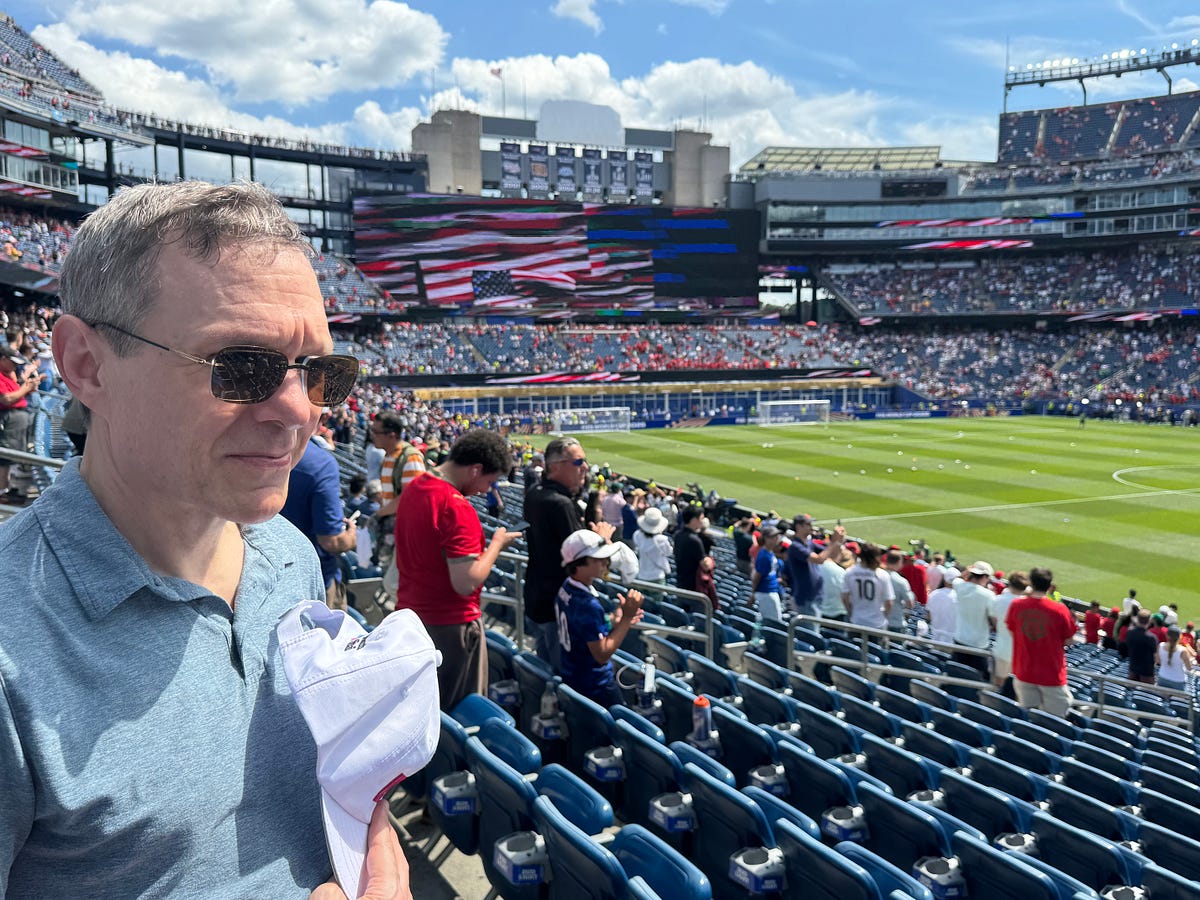
As we approached Gillette Stadium near Boston, Massachusetts, I informed my wife and two daughters that the most advanced models of Artificial Intelligence (AI) are forecasting a score of 2:1 in the quarterfinal game between France and Morocco. After France scored their second goal, I started rooting for Morocco in anticipation of the AI-forecasted goal. Every time Morocco’s offense arrived close to France’s goalkeeper, I chanted: “AI!, AI!”. The Moroccan fans sitting next to me had difficulties interpreting why I am rooting for their team with a slogan linked to superhuman AI.
At the end of the game, France won 2:0, not 2:1 as predicted by our most advanced AI models. This is not surprising. The score of a soccer match is dictated by a huge number of uncontrolled parameters, making accurate forecasts impossible. Even if we were to measure all the initial conditions on the field to exquisite precision, chaos could lead to exponential growth in the uncertainties on a much shorter timescale than the 90-minute duration of the game. This is partly why human behavior is unpredictable and many philosophers subscribe to the notion of “free will” despite the fact that the laws of physics leave no freedom to the behavior of the atoms that make our brain and body.
Press enter or click to view image in full size
Last week, I visited the Temple of the Oracle in Delphi, Greece, where Pythia served as the high priestess of the Temple of Apollo from the 8th century BCE to the late 4th century CE. For over a millennium, kings, generals, and ordinary citizens traveled across the Mediterranean to seek divine guidance from the Oracle on everything from personal marriages to major declarations of war. Today, our most advanced AI systems serve the same purpose. However, we should not repeat the mistakes of history and believe that the new Pythia, AI made of Silicon chips, can forecast the future of human endeavors. Even superhuman AI will undoubtedly make mistakes in forecasting the multi-parameter facets of reality, unless of course it uses the ancient trick of astrology in offering sufficiently vague forecasts that always hold true.
However, in smaller setups of reality, where the number of degrees of freedom is tractable, AI will do just as well or even better than human scientists
A few days ago, I shared an essay here in which I had mentioned a paper written by Professor John Birks from the University of Colorado, which interprets sightings of orbs as Unidentified Anomalous Phenomena (UAP) in the U.S. government released files (such as reported here) in terms of meteoritic dust cloud model. Subsequently, I invited Professor Birks to a zoom meeting with the UAP Science Advisory Council under my leadership (https://uapsac.com/), where council members had the opportunity to ask him questions. The questions raised at the meeting shed doubt on his model. In particular, it is unclear how dust clouds could condense out of the debris from meteors or space trash, since the debris tail gets diluted and smeared by the Earth’s atmosphere across a much larger scale than the observed orb sizes.
However, AI’s criticism of the dust cloud model turned out to be far more substantive than all the dismissive comments directed against the model by humans on social media. A council member, Professor Robin Hanson, compiled the criticism from Claude here. In response, Professor Birks wrote: “Yes, after reading the Claude response, I concur that it would still be a big problem to accumulate enough mass in a long column. I concede that I hadn’t given enough thought to the initial formation of the dust cloud.” Subsequently Prof. Birks used Claude to respond to this criticism. What I find remarkable is that he was unable to address Claude’s criticism by himself so he asked for help from Claude to respond to Claude. John has 50 years of experience in practicing atmospheric science, yet he needs the help of AI to respond to AI. Are we beyond the AI singularity in science since AI appears to be smarter than our best scientists? My personal assessment (and I decline to rely on Claude) is that Claude’s response to Claude is not satisfactory from a theoretical physics perspective and that the dust cloud model is not viable as it stands for explaining UAP.
Whereas superhuman AI will surely be of great help to scientists in the future by testing theoretical models or conducting analysis of vast data sets, it will likely continue to fail in forecasting the much more complicated events that shape societal realities. Our modern silicon-based Oracle will not be better than the Oracle of Delphi in forecasting the outcomes of personal marriages, major wars, or even the final score in the France-Morocco quarterfinal World Cup game
ABOUT THE AUTHOR
Press enter or click to view image in full size
Avi Loeb is chair of the UAP Science Advisory Council to the White House, Pentagon, FBI and intelligence agencies, director of the Galileo Project, founding director of Harvard University’s — Black Hole Initiative, former director of the Institute for Theory and Computation at the Harvard-Smithsonian Center for Astrophysics, and the former chair of the astronomy department at Harvard University (2011–2020). He is a former member of the President’s Council of Advisors on Science and Technology and a former chair of the Board on Physics and Astronomy of the National Academies. He is the bestselling author of “Extraterrestrial:The First Sign of Intelligent Life Beyond Earth” and a co-author of the textbook “Life in the Cosmos”, both published in 2021. The paperback edition of his new book, titled “Interstellar”, was published in August 2024.
Professional website:
https://lweb.cfa.harvard.edu/~loeb/
Social media:
https://avi-loeb.medium.com/https://www.youtube.com/@ProfessorAviLoeb
https://open.spotify.com/show/1zhndXkvSY2b8FdjspFpCdhttps://x.com/ProfAviLoeb
