

ByHannah Fry
July 16, 2026Updated 6:21 PM PT
- Click here to listen to this article
- Share via
0:000:00
This is read by an automated voice. Please report any issues or inconsistencies here
See more from the L.A. Times in Google Search. Set us as preferred
The trunk line that ruptured early Thursday, sending thousands of gallons of water rushing down Sunset Strip and surrounding communities, was installed 110 years ago and has emerged as the latest example of L.A.’s struggles to overhaul its aging water system
The break was on a riveted steel pipe from 1916 that forms the major arteries for water delivery from reservoirs and tanks to smaller distribution mainlines across Los Angeles. The section of the Sunset Trunk Line was slated to be replaced in 2031, according to the utility
There are about 547 miles of trunk line underground across the city. In 2019, the Los Angeles Department of Water and Power said roughly 29% of the city’s pipes were over 80 years old, approaching their typical lifespan of 100 years
- Share via
Utilities have been struggling to keep the system going, given funds are limited for any kind of major overhaul of the aging pipes
“Over time rust, corrosion and those sorts of things sets in,” said David Feldman, professor emeritus of urban planning and public policy at UC Irvine. “They have a tremendous grid of pipes and obviously they’re not going to be able to replace every single one,” he said. “They couldn’t afford to and the disruption would be enormous.”
If there’s a weak spot in the pipe because of corrosion, the sudden surge of pressure can result in a leak, Feldman said
A 2019 report from the city’s Office of Public Accountability said that the utility has struggled to move forward with its planned trunk line replacement projects due to contracting delays
But infrastructure that’s reaching the end of its useful life has dogged Los Angeles officials for years. In 2009, a series of major breaks — including one in which a sinkhole partly swallowed a fire truck — generated outrage
A ruptured trunk line in 2014 on Sunset Boulevard in Westwood sent millions of gallons of wateronto the UCLA campus, flooding several buildings and causing several million dollars in damage
There were no damage estimates for the Sunset rupture, which created a sink hole that closed Sunset Boulevard
A Times data analysis after the 2014 flooding found nearly half of L.A.’s water pipes were given a grade by officials of “C” or less for their condition
The reporting highlighted the Hollywood Hills — the site of Thursday’s rupture — as particularly problematic because of the age of the pipes. One expert said at the time pipes in the hills operate at higher than normal pressure, making leaks more common
The Times analysis found a number of linesin the Hollywood Hills near the Sunset incident that were more than 80 years old and had recorded previous leaks
“This is one of the challenges when our infrastructure is so old,” L.A. Mayor Karen Bass said, pointing to the sinkhole behind her during a morning news conference
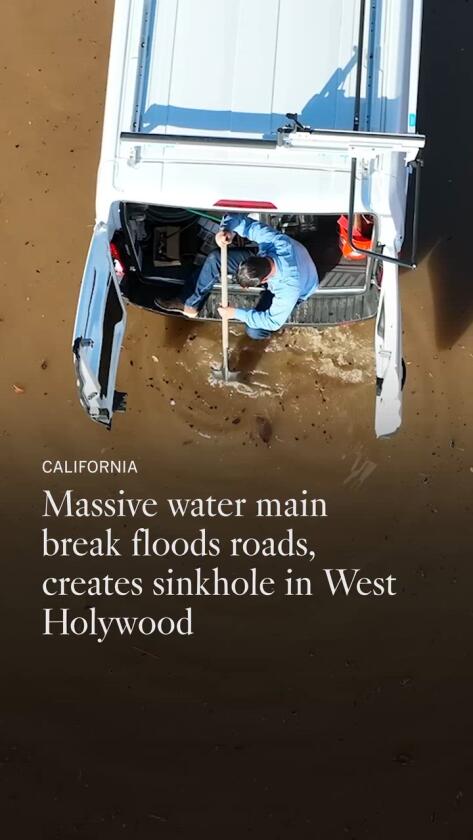
Just before 4 a.m. the LADWP was notified that the 110-year-old trunk line ruptured in West Hollywood. Water poured down Holloway Drive, inundating businesses and flooding underground parking garages of neighborhood apartments. The leak was shut down after a few hours, leaving a giant sinkhole in the middle of Sunset Boulevard
Crews from the utility, Los Angeles County sheriff’s deputies and firefighters swarmed the area as residents woke to find their streets transformed into rushing rivers
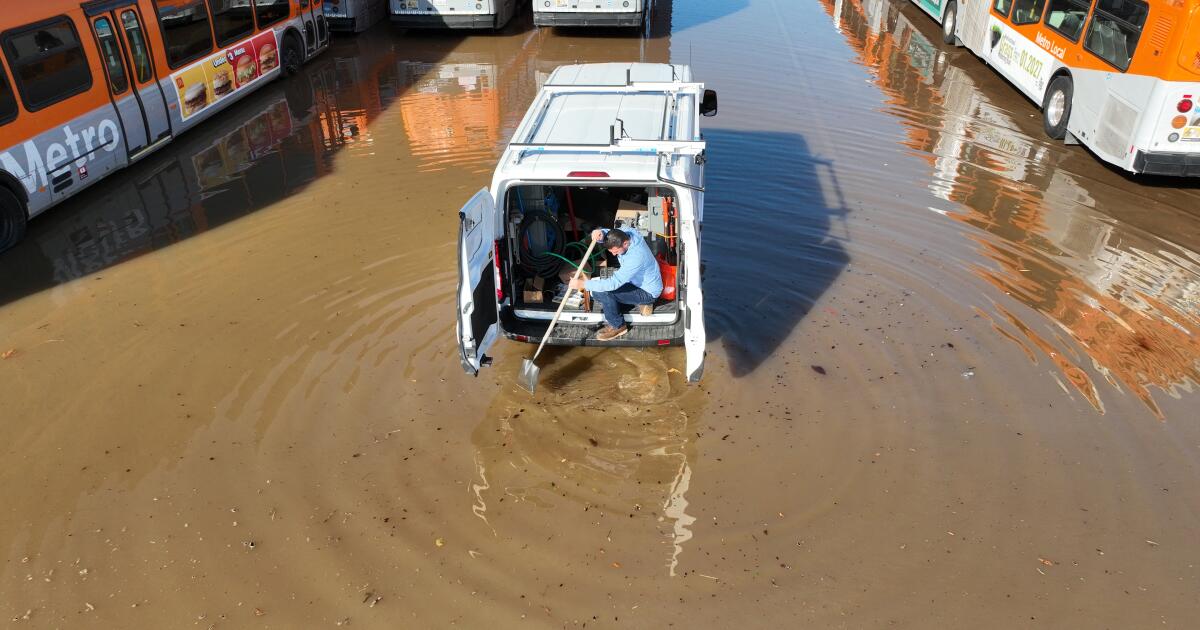
A bus depot at Santa Monica and San Vicente boulevards had become a shallow lake. Video footage from the scene showed a person being swept down a street by the roaring water before finding their footing and getting up
(Jonathan Alcorn / For The Times)
In the 2024-25 fiscal year, the city installed 5,266 feet of trunk line pipe with the goal of replacing just over 6,000 feet the following fiscal year, according to DWP’s water infrastructure plan. The utility says it prioritizes trunk lines for replacement based on leak history, soil conditions and pipe age
In May, Bass announced a Capital Infrastructure Program for the city, a first for L.A. The program helps guide longtime decisions about critical infrastructure, such as sidewalk repairs, curb ramps and roads. The lack of a plan has led to underfunded projects and maintenance of city facilities, her office said
At the same time, voters in November will be able to decide whether to approve an amendment to the city’s charter, the governing document, that would allow the city to establish a five-year capital infrastructure program
It is not clear how long it will take DWP to make repairs to the trunk line in West Hollywood
“Once everything is shut down … we’ll pump the water out of the hole that we have,” said Anselmo Collins, DWP’s chief operating officer and senior assistant general manager. “We’ll make an assessment. That will determine then how long it will take us to make the repairs.”
Firefighters emerge from a flooded underground parking structure after a water main break flooded streets in West Hollywood.
(Allen J. Schaben / Los Angeles Times)
Collins acknowledged during a news conference that the city’s pipes are aging, but said the utility has a water infrastructure program that installs and replaces about 45 miles of pipe every year
Los Angeles has roughly 7,400 miles of pipes, including distribution pipes and trunk lines, he said
Crews assess a sinkhole at Holloway Drive and Palm Avenue after a water main break.
(Jonathan Alcorn / For The Times)
“We have crews dedicated to only replacing trunk lines, as well as over 30 crews that are throughout the city replacing our distribution pipes on a yearly basis. So we have a very aggressive program,” Collins said. “Unfortunately, sometimes there may be parts of the pipeline where you end up with a weak spot, and it reveals itself when you have these type of leaks.”
Collins emphasized that all water provided to DWP customers is safe to drink despite the water main break
L.A. Metro said commuters should expect significant delays on Lines 2, 4, 10/48, 14/37, 16, 20, 28, 30, 35, 134, 217, 602, and 617 because of the water main break and resulting flooding
An aerial view of the flooded Metro bus barn after a major water main broke.
(Allen J. Schaben / Los Angeles Times)
Several major street closures were expected to impact commuters throughout the day. Eastbound Sunset Boulevard is closed between Larrabee Street and Sherbourne Drive, eastbound Holloway Drive is closed between Sunset Boulevard and Westmount Drive and eastbound Santa Monica Boulevard is closed between San Vicente Boulevard and Hancock Drive
Larrabee Street, Palm Avenue and Hancock Avenue are also all closed northbound and southbound between Sunset Boulevard and Santa Monica Boulevard
The break prevented several businesses along the busy corridor from opening on Thursday, with owners rushing over to assess the damage
Tadeh Ghazalian, one of the owners of Dialog Cafe on Holloway Drive, started getting phone calls around 5 a.m. about a broken water line on Sunset Boulevard. Water gushed all the way down the street and flooded his restaurant. It also destroyed several cars parked in the area
“It was like a waterfall,” he said
Ghazalian, who has owned a stake in the restaurant with his family for 18 years, said he doesn’t know how long it will take to fix the eatery or when he’ll be able to reopen
“We’re just waiting, you know, the biggest thing is that we do it safely,” he added. “There’s a couple of areas that pulled all that sand underneath the sidewalk, so there are sinkholes that they’re trying to avoid.”
Times staff writer Melissa Gomez and editor Joseph Serna contributed to this report
