

By
- Drew Taylor for AL.com
As Beth Scherer-Smokey puts it, you can’t have more than two Jewish people in a room without an argument breaking out
That turn of phrase is on full display this particular Sunday afternoon at Knesseth Israel Congregation, the oldest Orthodox Jewish synagogue in Birmingham and in Alabama, as she and Martin Stein discuss some of their favorite kosher foods. Growing up on Long Island, New York, Scherer-Smokey fondly recalls something her mother made every year for Passover
“Chicken livers,” Scherer-Smokey says without hesitation. “It was the best chopped liver that I ever had.”
Stein remains unconvinced
“My grandmother’s was better, probably,” he said
“No way. No way,” Scherer-Smokey fires back
Scherer-Smokey still remembers how her mother would cook the chicken livers with eggs, mustard and sauteed onions, and how she would cook potato kugel with a soft center and a crispy crust, almost like a pie
“The chicken livers at Publix are terrible,” she said
Stein, who grew up just outside of Chicago, fondly remembers his grandmother’s toffee squares, which remain a large part of family lore to this day
“It was really just a cookie bar, but everybody loved it and people tried to copy it in the family, and no one could ever make it as great as her,” he said
In Birmingham, where Jews make less than 1% of the population, finding good kosher food can be difficult. As defined by the kashrut laws set out in the Torah, kosher food must be prepared in certain ways — from never cooking meat and dairy together to avoiding shellfish
Kosher food has its own history in the city, especially with Knesseth Israel, which started in 1889. In “A Century of Jewish Life in Dixie,” author Mark Elovitz wrote about how the synagogue’s first rabbi, M.B. Herman, worked as a butcher at Bloomston Brothers in town to make sure their meats were kosher. By 1937, the arrival of S. Rabinowitz made local news as the city’s first shochet in over 20 years. As a shochet, Rabinowitz humanely slaughtered animals according to Jewish law so the meat would be considered kosher. By 1962, Knesseth Israel and Temple Beth El began jointly operating a kosher market in the city.
To Scherer-Smokey, being able to have some of these kosher foods makes the whole experience that much more special
“I think that’s what people like when you taste a good pastrami sandwich or a good corned beef sandwich, it’s precious because you can’t find it anywhere, so when you finally get one that tastes really yummy, it brings back those memories,” she said
For Stein, food has always been an important part of Judaism, an act of coming together and celebrating one another
“A lot of our community revolves around food,” Stein said. “It’s the thing that ties everything together.”
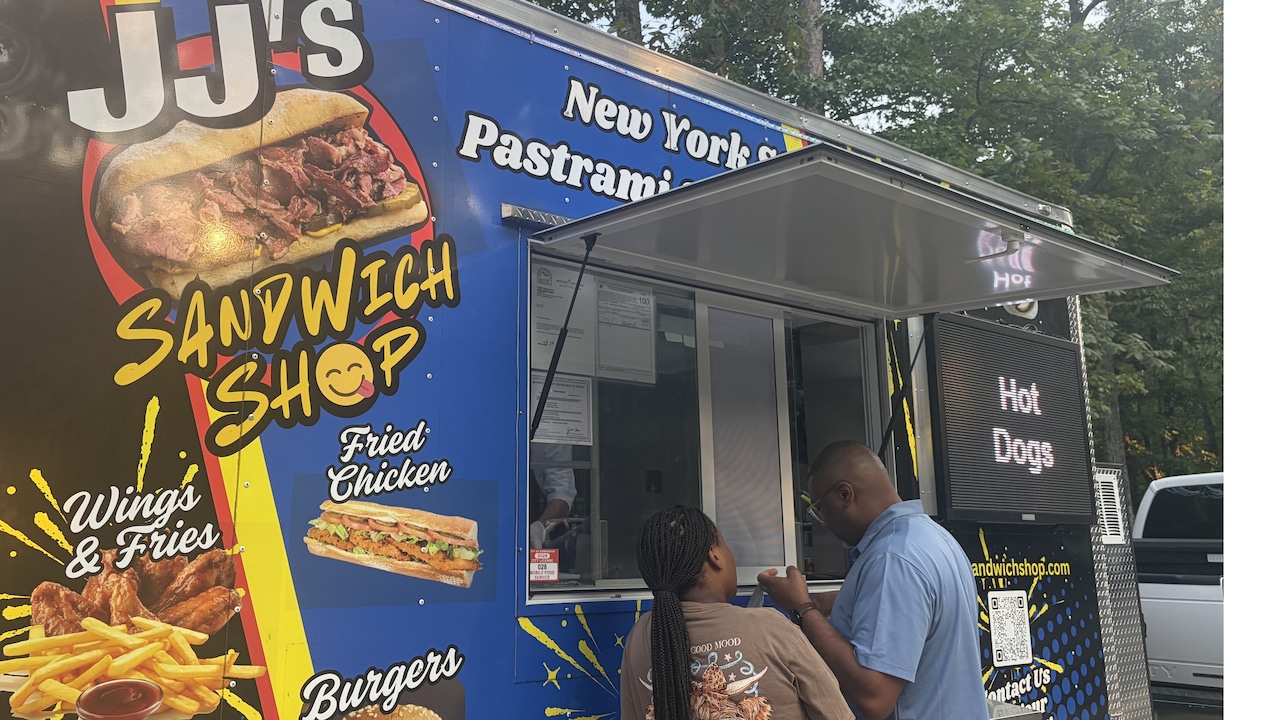
It’s a philosophy that guides JJ’s Sandwich Shop, a kosher food truck, run by the 137-year-old synagogue, that serves deli favorites from New York-style pastrami sandwiches to schnitzel, burgers and hot dogs
From Brooklyn to Birmingham
The man behind JJ’s Sandwich Shop is Nathan Lichtenstein, who can be seen driving the food truck a couple of times a week to different places around Birmingham. At 65, the native New Yorker does a little bit of everything, from seasoning the fries to laying a pile of corned beef on a spread of lettuce, sauerkraut, pickles and tomatoes on a bun, all with a kippah pinned slightly askew atop his head
“That truck is my baby,” Lichtenstein said
Growing up in the Hasidic community of Brooklyn, New York, Lichtenstein had spent years working in different kitchens and restaurants across the city. Before the war between Russia and Ukraine, Lichtenstein would travel to Uman every year to feed thousands of Jews who had come to the city to pay their respects to the grave of Rabbi Nachman of Breslov, the founder of the Breslov Hasidic movement
In 2007, Lichtenstein was about to lose his restaurant in Monsey, New York, when he decided it was time for a change
“I woke up all morning, and I told my wife, ‘Guess what? I had a dream and I’m not opening another store. I’m buying a food truck,” Lichtenstein said as he was seasoning fries at JJ’s most recent stop at the Brook Highland Racquet Club off Hwy. 280. “She said ‘You’re crazy.’ I said, ‘Baby, I did.’ So, I went up and got a food truck.”
That dream turned into Sub on Wheels, which sold everything from hamburgers and hot dogs, as well as Jewish kosher foods like knishes and kugel in Brooklyn. Despite the popularity of the food truck, which Lichtenstein said always had a good crowd, some in the borough’s ultra-Orthodox community took issue with the food truck, arguing that it was a celebration of “fress,” a Yiddish term for gluttony or overeating, considered a sin in Judaism. Some protesters even caused a scene at the food truck, with police sometimes getting involved.
While taking a drag on a cigarette on his smoke break, Lichtenstein says he views the whole controversy differently from others
“There was some competition because some restaurants on the block, they were pissed,” he said. “So, they said ‘You can’t let them open up the truck on the street.’”
Years later, Lichtenstein would find his way down south to Birmingham through his family
“My brother kept begging me to come here,” he said. “I came down for a weekend during Thanksgiving. “Two weeks after that, a friend of mine told me about Knesseth Israel and them wanting to start a food truck.”
Food as a reminder
The food truck, named after a teenager who is part of the nearly 20 families who make up Knesseth Israel, has been running for the last three years, coming at a time when the congregation was facing several big changes all at once. In 2022, the congregation sold its building on Overton Road in Mountain Brook, and Rabbi Moshe Rube later left for New Zealand to lead the Auckland Hebrew Congregation
Since then, members of Knesseth Israel have met each week out of a house just down the street from its former location, where Mountain Brook’s Fire Station 2 now sits. The congregation still has no rabbi, but members like Scherer-Smokey and Stein have taken leadership roles within the shul and taken turns leading services. Still, they feel obligated to go out into the community, especially with a food truck. That way, every sandwich they sell is a reminder that Knesseth Israel is still standing.
“When we moved here, some people thought we didn’t think we existed anymore,” Scherer-Smokey said. “With the food truck, we’ve been out introducing ourselves in the community, and letting them know we still exist.”
Stein said there is now greater awareness of Knesseth Israel than there has been in a long time, and it’s about more than just the quality of the food
“In so many places, Orthodox congregations have gone away,” he said. “It’s really important for us.”
Continuing to reach out
Originally, Lichtenstein and Knesseth Israel’s first food truck was a crepe truck called Holy Crepes. Because fewer people knew what crepes were, the venture was not as successful as they had hoped
“It didn’t go over well,” Scherer-Smokey said. “It was very challenging because they didn’t know what was done here.”
After that, the group decided to switch the operation to a deli-style menu, something that had a broader appeal in Birmingham. However, all the food is prepared kosher, which Lichtenstein gets from a vendor in Atlanta and prepares at the Levite Jewish Community Center. Scherer-Smokey handles the logistics of the truck while Stein keeps the books for their business. So far, the work has produced positive results in the community
“The people have been very happy with the food,” Stein said
Lichtenstein feels he is in a place where he can offer something that many Jews can’t find anywhere else
“In New York, it’s one kosher place after another,” he said. “There’s John on the block and Moshe on the back.”
Lichtenstein, who also prepares lunch for the synagogue every Friday and Saturday, says he feels that the best way he can be productive and give back to his faith is to feed people
“For me, to be able to feed people, that’s my drug,” he said
For more information on JJ’s and when it runs, click here
