

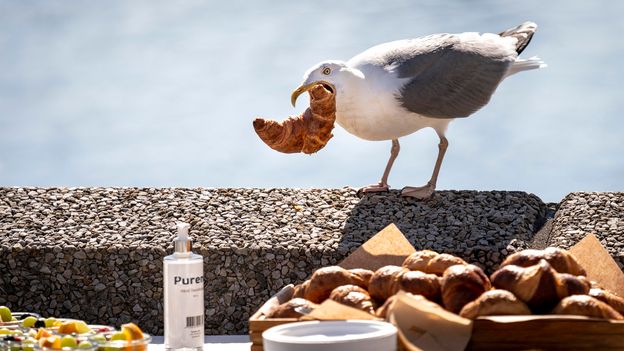
Seagulls are the thieves of the skies. Here’s how to stop them stealing your food
3 hours ago
Getty Images
When you’re visiting the seaside, a simple trick could stop seagulls from robbing you of your lunch
Sitting in the sunshine, enjoying the sea air – you have no idea a thief has its beady eyes on you
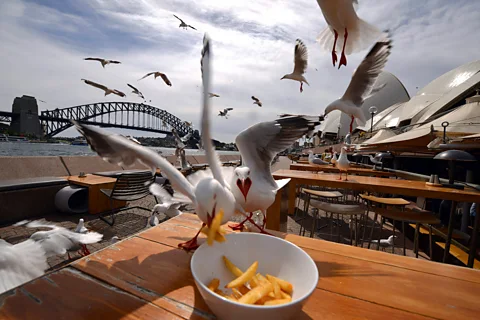
Suddenly, a feathered assailant appears from the sky, blotting out the Sun with its giant wings. In a flurry of flapping and an explosion of fish and chips, the monstrous herring gull steals your dinner right out of your hands.
Herring gulls, the typical “seagull” of coastal towns across the Northern Hemisphere, are enormous. Weighing in at almost 3.31lb (1.5kg) and with a wingspan of up to 4.9ft (150cm), to have one dive straight at you can be pretty terrifying. But this has become a fairly common seaside occurrence in recent years.
So, how can you stop seagulls from stealing your food?
This was the question Laura Kelley, an animal behaviour researcher at the University of Exeter, UK, set out to answer. She discovered one simple trick that can keep thieving seagulls at bay.
In 2019, Kelley set up an experiment to investigate whether herring gulls are more cautious around food when someone is looking directly at them, and found they were slower to approach. Many animals, including gulls, have this tendency for “gaze aversion”, she says, as the stare of a predator often indicates imminent attack
Getty Images
Consequently, some animals have evolved markings – known as eyespots – that resemble eyes, to scare predators away. The more realistic the eyespots, the more effective. Some even have “sparkle markings” to mimic the reflection of the Sun
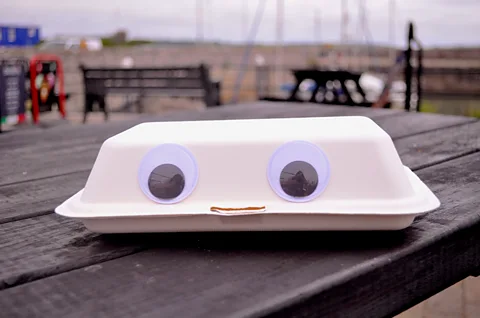
Kelley thought her fish and chips might also benefit from the protective power of eyespots – and found sticking a pair of googly eyes on food packaging was enough to deter herring gulls from pinching it.
Kelley and her team tested the idea in seaside towns across Cornwall, Devon and Dorset in the South West of England, where gulls are known to steal food from people. They gave the birds a choice of two food boxes placed 6.6ft (2m) apart on the ground – one with eyes stuck on, and one plain box
They’re the ones causing 95% of the mischief… The bad boys of seagulls – Laura Kelley
“We found that gulls were happy to go up to the boxes without eyes,” says Kelley. “But with the boxes with eyes, we found the gulls split into two groups. The first group was slightly reticent to approach at the start but became much quicker over subsequent presentations – so they learned that the eyes weren’t scary. The other group of gulls just never approached.”
This indicates a certain level of personality, says Kelley. Some, she says, are the “problem gulls” that are bold and curious, and more likely to “dive-bomb people for their food”
“They’re the ones causing 95% of the mischief,” says Kelley. “It’s just a small subsection that is giving everyone else a bad name – the bad boys of seagulls.”
Katherine Latham
Herring gulls are at once scavengers, predators and kleptoparasites, meaning they steal food from others. They often find food by watching other animals’ behaviour and muscling in when they spot a feast on the go. This includes humans, a skill that makes the birds particularly well suited to urban living
And, while they may appear to us to be abundant, herring gulls numbers across the worldare plummeting. In 2021, both the European and American herring gulls were added to the IUCN red list of endangered species
This decline may not be immediately apparent to us, though, as herring gulls are increasingly moving into urban areas, where they substitute marine prey for human food
• How we got the dodo so absurdly wrong
• The birds that ride hurricanes
• How an English castle became a stork magnet
“Numbers in their natural areas are collapsing,” says Kelley, “due to loss of habitat and lack of natural food available [caused by] overfishing – but also urban environments just offer a lot of food. Gulls are very adaptable. They’re curious and tenacious, which helps them to exploit these new environments that they find themselves in.”
Even so, gulls do still show a strong preference for a natural diet. Adults who have nestlings to feed, for instance, will go out to sea to forage, rather than foraging in human areas. “This suggests they’re only eating human food when there’s not really much other choice,” says Kelley. “Sometimes, you’ve just got to eat – so a bag of chips is a good solution.”
I‘ll have what you‘re having
Gulls observe and learn from humans, not just stealing our food but copying the food choices we make too. Rare interspecies learning like this reveals a high level of intelligence
“In the past, people thought seagulls were stupid,” says Franziska Hacker, a behavioural ecologist and researcher at the Australian National University. “But you just watch them, and you realise they’re really smart.”
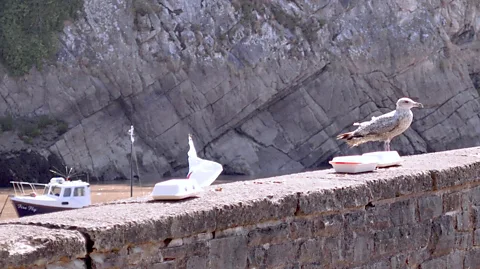
Katherine Latham
Hacker lived in the lively seaside city of Brighton in 2021, while studying for her masters degree at the University of Sussex, UK. She set up an experiment – in which she ate copious salt and vinegar crisps – to see if her food choices influenced the choices made by seagulls. The results were “crazy” she says
They use behavioural cues, even ones given by humans – Franziska Hacker
At the same time as she ate her own crisps from a blue packet, she offered a single nearby gull the choice between a blue and green packet placed on the floor in front of her. “The gull gave one call,” she says, “and suddenly there were 20 more”
Hacker, who “absolutely hates” salt and vinegar crisps, managed to keep a straight face as she ate so as not to give any extra visual cues through facial expressions – and the amassed gulls, more often than not, went for the packet that colour-matched Hacker’s
“They use behavioural cues, even ones given by humans,” says Hacker. Some domestic animals, like dogs and horses, can understand when a person points or gestures to communicate – but this is a skill rarely seen in wild animals, says Hacker
Seagulls use many types of cues: sight, smell, sound, the call of another bird. And because “so much of their daily food intake is obtained through stealing”, says Hacker, the ability to observe other gulls or other species is really important if they are to be successful – “because to steal someone’s food, you need to observe them, you need to time it right”
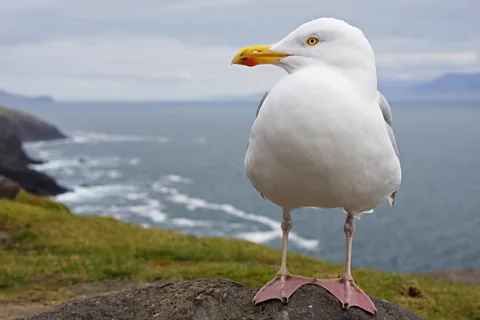
Getty Images
Two years of research – and lots of packets of crisps – later the results showed gulls preferred the same colour packet 95% of the time. “Which is such a crazy result, right?” says Hacker. “They can understand that I’m eating from something, recognise that the item on the floor is the same as the one I’m holding, and make a food choice based on that.
“In my opinion, that is really smart. That requires a lot of processing – object recognition, object comparison, the assumption that what I’m eating is good for the gull to eat as well.”
A harmonious coexistence
Understanding gull’s intelligence and behaviour, adds Kelley, could reveal the secrets we need to prevent them from stealing our food.
Kelley offers some key tips for preserving your food at the beach. Sit with your back to a wall, she says. Often, gulls will approach from behind so you can’t see them coming. Keep your food covered up, and don’t wave it around. Keep an eye on them. If you’re looking at them, they’re less likely to approach. And if all else fails, shout at them
Simply changing our own behaviour, says Kelley, could be the answer to living peacefully alongside these birds that are so much part of our “everyday nature”
“They’re just trying to make the best of the situation they’re in. We need to figure out a way to coexist with them as best we can,” says Kelley. “It’s all about trying to find strategies for a more harmonious coexistence.”
And if that harmonious coexistence involves googly eyes, what’s not to love?
—
For more science, technology, environment and health stories from the BBC, follow us onFacebookandInstagram
For essential climate news and hopeful developments to your inbox, sign up to thewhileThe Essential Listdelivers a handpicked selection of features and insights twice a week
Earth
Animal
Bird
Environment
Beaches
Science
Features
