

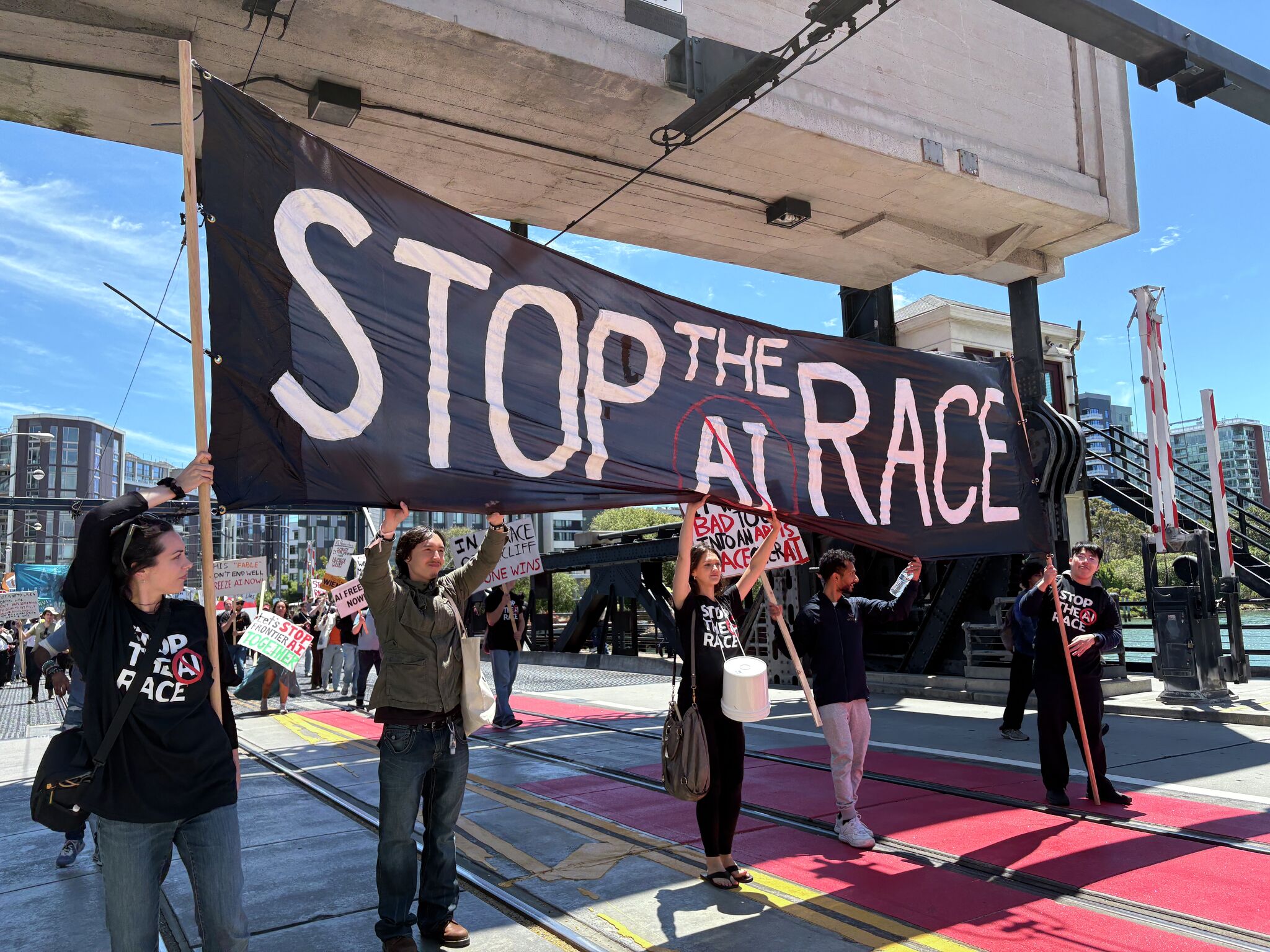
A crowd of protesters fiercely condemning artificial intelligence and the San Francisco companies that power the technology marched through the city — the epicenter of AI development — on Saturday to demand that the companies “stop the AI race.”
About 200 people carrying signs with messages like “stop slop,” “it’s not too late to regulate” and “in a race off a cliff no one wins,” marched from offices of OpenAI to Anthropic and Google DeepMind to ask to their CEOs to collectively pause all new training of AI models.
Protesters decried what they described as AI’s role in rising rents, job losses and environmental damage, as well as existential threats to future generations.
Article continues below this ad
The rally was organized by Stop the AI Race, led by activist and former AI researcher Michaël Trazzi, who last year started a hunger strike outside Google DeepMind in London to draw attention to the demand to freeze AI development. (A parallel hunger strike took place outside Anthropic’s office on Howard Street.)
Protesters, who included students, people who work in AI and longtime San Franciscans, said they hoped their collective action would help increase public awareness and, in turn, ratchet up the pressure on AI companies to act. As they marched through downtown San Francisco, people in restaurants, on apartment balconies above the street or walking on the sidewalks stopped to take photos or videos
Make us a Preferred Source to get more of our news when you search.
Add Preferred Source
“Protests can only do so much,” said Aleesa Carbo, a Johns Hopkins University student and AI researcher. “But if we can make the public more aware, that can mobilize them to speak to their senators, speak to the government, to make their wishes known to the AI companies.”
Carbo is currently enrolled in MATS (Machine Learning Alignment & Theory Scholars), a prominent AI research fellowship whose graduates go on to found AI safety companies or work at companies such as Anthropic.
Article continues below this ad
She said she has pivoted her focus to AI safety.
“I’m not against AI in principle, but I do think the way that companies are racing towards it is not in a very responsible manner,” she said. “At the end of the day, these are dark boxes. Even us, the people who train these models, play with them, we don’t fully understand them.”
Trazzi, who at one point led the crowd in chanting expletives against OpenAI CEO Sam Altman and Anthropic CEO Dario Amodei, said the stakes are high. “We are in an emergency,” he told the crowd. “The problem is they can’t stop the race, unless other people stop.”
His organization is advocating for a global agreement to pause AI development, including from China. This would, in practice, mean current models remain available, but with “no new training runs of larger or more general frontier models,” the Stop the AI Race website reads. “The teams currently working on improving the capabilities of these models would move to narrow AI applications or alignment research instead.”
Article continues below this ad
The companies have not responded directly to Stop the AI Race’s demand — though the group often points to a January interview in which a Bloomberg journalist asked DeepMind CEO Demis Hassabis if he would advocate for a collective pause on development, and he said, “I think so.”
He said he had long envisioned an AI version of CERN, the European Organization for Nuclear Research, “where all the best minds in the world would collaborate together and do the final steps in a very rigorous, scientific way.”
“Unfortunately,” he said, “you need international collaboration, though, because even if one company … or even the West decided to do that, it has no use unless the whole world agrees.”
Duncan Haldane, the CEO of a San Francisco startup that uses AI to design circuit boards, said he came to the protest — with his two children, ages 1 and 5, in a stroller — to pressure the heads of prominent AI labs to acknowledge the technology’s risk and commit to the pause. Haldane’s company has benefited from AI, but he said he sees the technology as an “existential threat to humanity.”
“What they can do now is actually phenomenally dangerous and is going to affect society tremendously,” he said
Article continues below this ad
Dean Preston, a former San Francisco supervisor, criticized the “devastating” effects AI companies have had on the city, including soaring rents and housing prices, job loss, environmental “havoc” and political influence. “These tech CEOs view San Francisco as a trophy,” he said, “as something to be exploited.”
He pointed to examples of people pushing back against AI throughout California, from Pittsburg residents protesting in June the construction of a 300,000-square-foot data center from AI developer Avaio Digital (which moved forward despite the public backlash) while voters in Monterey Park in Southern California agreed to permanently ban data centers, becoming the first U.S. city to do so.
Some protesters said that, short of a global development pause, they hoped to see more local and state regulation of the artificial intelligence industry. “I would like to see the mayor and our Board of Supervisors start to regulate AI in the city,” said Kathe Burick, a resident of San Francisco for 50 years. “Shut them down if they need to, or demand a pause or they can’t operate in town.”
She said the race toward AI without sufficient regulatory guardrails reminds her of the famous scene in the film “2001: A Space Odyssey,” when astronaut Dave Bowman asks the HAL 9000 computer to open the pod bay doors after HAL discovers the crew’s plan to disconnect him, and HAL responds, “I’m afraid I can’t do that.”
Article continues below this ad
In March, Burick went to a Stop the AI Race demonstration at OpenAI that she said drew only about 30 people. She was heartened by the larger turnout Saturday, especially seeing throngs of young people
“To see this gives me hope,” she said
