

Okinawa project provides CSUMB students food for thought
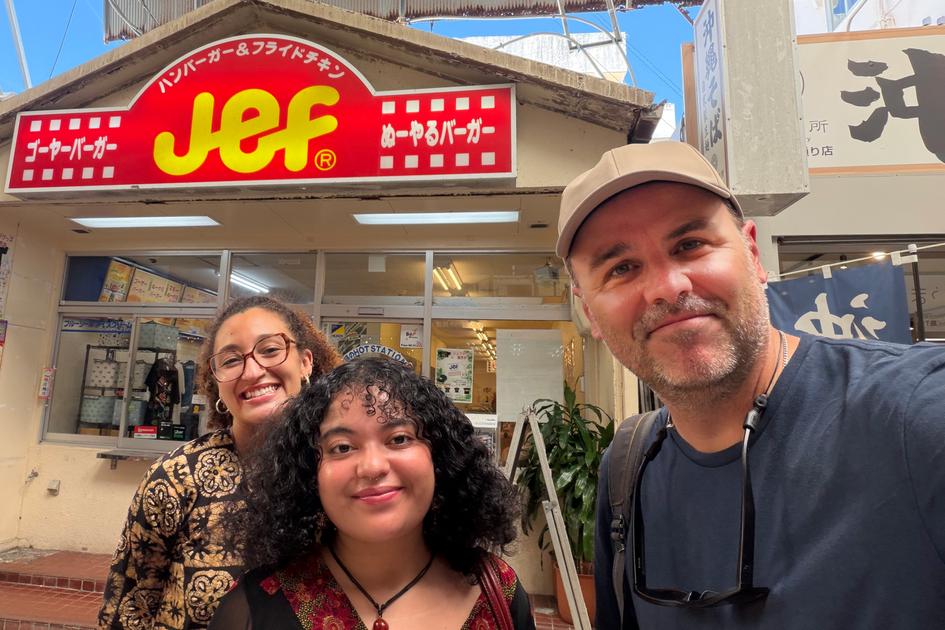
Taking part in the Okinawa Memories Initiative is an annual summer event for Dustin Wright, chair of CSUMB’s World Languages and Culture department, and a few students
Azriel Winchester was transported by her experience of preparing a meal in a traditional Okinawan home.
“It was kind of magical,” the Cal State Monterey Bay senior said of her visit to the Okinawa Traditional Experience. “To go into a garden and pick the leaves that had such wonderful smells. We got to cook different foods together. It was a great bonding moment. It was a very beautiful human interaction.”
It was just one day of a monthlong research trip to the Japanese Island, but it made an impression on Winchester. A Bay Area native who moved to Dallas a couple of years before coming to CSUMB, she hopes to teach African American art or work in the GLAM (galleries, libraries, archives and museums) industry. She said spending the day in the Okinawan home brought into focus many of the issues she and fellow student, Jenifer Segovia – both are global studies majors – were studying while on the island.
The two were taking part in the Okinawa Memories Initiative, which for more than a decade has been documenting changes on the island and capturing the oral histories of its elderly residents, particularly those who survived World War II. OMI is an evolution of the Gail Project, which got its start many years ago when people began showing the post-war photographs taken by U.S. Army Capt. Charles Eugene Gail, a student of Ansel Adams
Dustin Wright, chair of the World Languages and Culture department, became involved with OMI while a graduate student at UC Santa Cruz. He traveled to Okinawa to take part in the effort to preserve the local history.
“We would go to community centers and show (Gail’s) photos,” he said. “The locals would walk through and say, ‘I remember when it looked like this.’ You’d get these wonderful stories. We would make note of those observations and record them, if we had permission.”
The program grew into an active oral history project, which also began looking at various cultural changes.
Although the COVID-19 pandemic limited travel for several years, since 2019, Wright has helped make it possible for a few students to go to Okinawa over the summer to participate. This year, Winchester and Segochanged
“Their food ways have changed,” Winchester said. “The smaller villages are more traditional, but they push a lot of Western ingredients on the tourists.”
This sort of homogenization with the rest of the world in the more populous regions impacts the culture
“There’s a consistent erasure that has happened,” SegoIt’s like an educational theme park, but there wasn’t really any Okinawan history. It was kind of tweaked for tourists.”
That included such food offerings as pizza and buffet-style restaurants.
“It’s important to see that,” Segonous Okinawans who are still fighting for their culture and land, and to preserve it.”
While such conflicts are not uncommon in other places, the island offers a good case study, she added
“Okinawa’s very special because you see these processes of globalization and hybridization happening in a heightened way,” she said. “It’s made me more aware of the smaller examples (of that process) around me.”
The experience has also inspired her to consider a different career path.
“After this trip and seeing that research can be different than what I thought, I’d like to go into a graduate or doctoral program and pursue research,” Sego
Wright said such impacts are an important reason for the project. But funding has been a challenge at times.
“Every year it’s different,” he said, noting that past support has come from UCSC and a Hispanic Serving Institutions grant. “This year we got support from our College of Arts, Humanities and Social Sciences.”
He called the program “incredibly important.”
“There aren’t a lot of opportunities for in-depth funded research abroad that aren’t STEM-related,” he said. “If we can do this with students while they’re undergraduates, it’s a really powerful thing.”
News Information
Published
August 6, 2026
Department/College
College of Arts Humanities and Social Sciences, University News, World Languages and Cultures
News Type
- News
News Topics
- Global Studies
- Japanese Language and Culture
- Research
