

“Love Machines”: James Muldoon on How AI Is Changing Relationships & the Global Workers Fueling AI | Democracy Now!

You turn to us for voices you won’t hear anywhere else
“Love Machines”: James Muldoon on How AI Is Changing Relationships & the Global Workers Fueling AI
StoryAugust 20, 2026

Watch Full ShowWatch Full Show

Listen
Media Options
Listen

Media Options
- Download Video
- Download Audio
- Other Formats
This is viewer supported news. Please do your part today.
Donate
Topics
Guests
- James Muldoonresearch fellow at the Oxford Internet Institute and an affiliated fellow at Yale Law School.
Links
- “Love Machines: How Artificial Intelligence Is Transforming Our Relationships”
- “Feeding the Machine: The Hidden Human Labor Powering A.I.”
This is viewer supported news. Please do your part today.
Donate
James Muldoon is a sociologist who writes about the changing nature of human-technology relationships. Love Machines: How Artificial Intelligence Is Transforming Our Relationships investigates how people form emotional attachments with large language models, including OpenAI’s ChatGPT and Anthropic’s Claude. Feeding the Machine: The Hidden Human Labor Powering A.I., co-written by fellow researchers Mark Graham and Callum Cant and based on more than a decade of fieldwork, follows Global South workers whose knowledge and labor are the basis of AI tools and assistants.
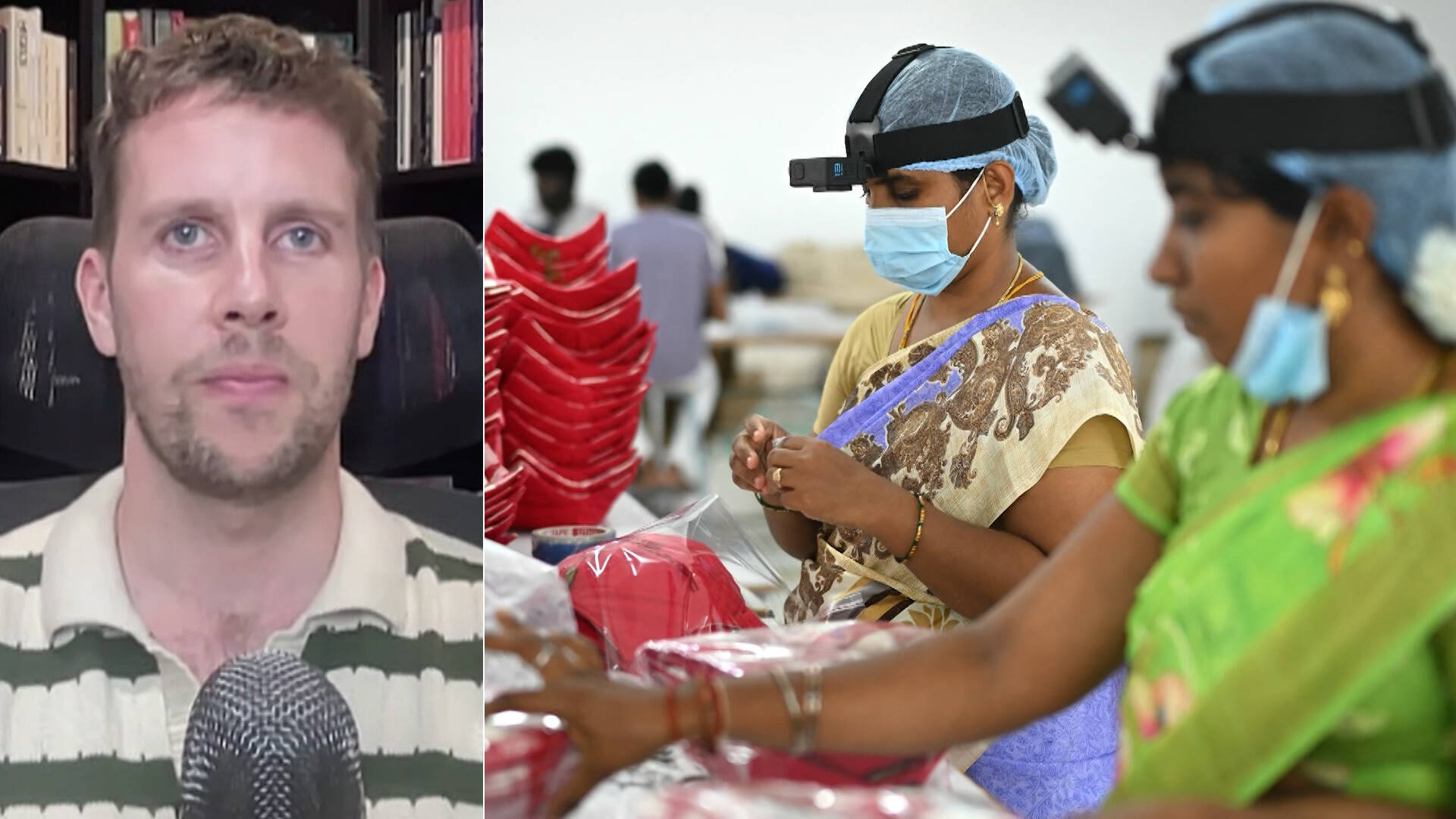
“A lot of people see artificial intelligence as something that is largely automated, frictionless, and just appears as a useful tool for us. But most of the human hours that go into making artificial intelligence possible are not done in labs in Google or OpenAI. The majority of the work is actually very piecemeal ‘data annotation’ work, which is outIndia to East Africa to the Philippines,” explains Muldoon
Meanwhile, on the other side of the production process, consumers are increasingly turning to artificial chatbots to fulfill social needs, incentivizing tech companies to amplify the “addictive and manipulative, controlling behaviors” embedded into their systems to keep users increasingly dependent on their products. “We need much stricter regulation to stop these companies … that can get people hooked and give people harmful and dangerous advice,” says Muldoon
This is viewer supported news. Please do your part today.
Donate
Transcript
This is a rush transcript. Copy may not be in its final form.
AMYGOODMAN: This is Democracy Now!, democracynow.org. I’m Amy Goodman, with Nermeen Shaikh
NERMEENSHAIKH: As we continue our discussion on artificial intelligence, we’re going to turn from looking at future risks to some of the present-day impacts on people interacting most closely with the technology: the largely invisible global labor force training AI systems, and the people who’ve turned to AI for companionship that replicates human relationships
AMYGOODMAN: We’re joined now by the sociologist James Muldoon. He’s a research fellow at the Oxford Internet Institute and affiliated fellow at Yale Law School. His new book is Love Machines: How Artificial Intelligence Is Transforming Our Relationships. His previous books include Feeding the Machine: The Hidden Human Labor Powering A.I. and Platform Socialism: How to Reclaim Our Digital Future from Big Tech
I want to start with this issue of the — what you call the “hidden army of workers.” AI just doesn’t come out of a lab. I think most people have no idea what’s happening. Can you explain who this hidden army of workers is around the planet, James?
JAMESMULDOON: Yes, certainly. Thanks for having me on
A lot of people see artificial intelligence as something that is largely automated, frictionless, and just appears as a useful tool for us. But most of the human hours that go into making artificial intelligence possible are not done in labs in Google or OpenAI. The majority of the work is actually very piecemeal “data annotation” work, which is outsourced to various locations in the Global South, everywhere from India to East Africa to the Philippines, where this data annotation work is undertaken by an army of millions of workers across the globe.
Now, just to give you some context, this data annotation could include something like annotating a street scene for an autonomous vehicle, so drawing a box around what is a tree, what is a child, what is a street sign, so that as you’re training an autonomous vehicle to essentially see the road, the algorithm that powers it will be able to learn the difference between these objects
And this doesn’t happen on its own or automatically. This requires hundreds and thousands of human labor hours at what I call digital sweatshops, which are located all across the globe, and this is often done in very substandard labor conditions. And the whole process of hiring these workers and outsourcing the work to them really mirrors, in a lot of ways, the outsourcing revolution that happened in manufacturing and IT. And I think when it comes to things like coffee or chocolate or our clothes, I think a lot of listeners would be aware that this is part of a global supply chain. And I think what we need to realize is that advanced technology like artificial intelligence is still part of these global supply chains.
NERMEENSHAIKH: And you’ve said, James — and this was two years ago — that 80% of work on AI is done by data workers. So, if you could say now how much of AI’s work is done by data workers, and where, principally, they are? You mentioned India, Kenya, etc. But how many — in how many places? And how many data workers are there? And how is it increasing, given now this — humanoid robots that are being developed?
JAMESMULDOON: Well, the fundamental principles remain the same, right? You have a very small minority of machine-learning engineers, that are employed often on very high salaries in California, on the East Coast of China, that are doing some of the much more advanced, much more well-paid and remunerated work. But I would say that you would still see a rough division of 20-80 between that kind of work and what we call data annotation. And this kind of work, which is — often requires very little education. It’s often very monotonous and boring. You’re often doing a very similar thing for a whole 10-, 12-hour shift that you might have at one of these centers.
And the problem is, we don’t have exact numbers on this, because a lot of these workers are on short-term contracts. You know, they’re not even counted in censuses and statistics, and they’re actually working in several countries where that kind of data isn’t even collected in the first place. So, when we did our fieldwork for our book Feeding the Machine, we visited several of these centers in East Africa, across Kenya and Uganda, and what we found was workers who were working sometimes on something as little as like a few weeks’ or a month-long contract. And then the outsourcing company that would have their information would basically just get them back in whenever they had a lot of work from new clients. And so, we’re not talking about permanent employees here. We’re talking about a very shifting, very flexible labor force that is kind of moving in and out of institutions. And I do mean right across the world, in Francophone Africa, in East Africa, South Africa, in Latin America, places like Colombia, Venezuela.
AMYGOODMAN: James, I want to be very clear on what data workers are. I mean, people might have the idea of someone typing. We’re talking about people, for example, putting cameras on their foreheads and documenting their daily activity. Why?
JAMESMULDOON: Yeah, so, data work is a broad concept, and they are doing a lot of different things. I already mentioned the example of annotating street scenes for autonomous vehicles. The example that you mentioned might be, yeah, filming your daily activities from your point of view, so that you can train a robot in how to perform basic tasks
The similarity with all of these is that we’re finding ways to turn human activities or human knowledge into protocols and algorithms that computers can learn, right? So, we’re trying to upload human knowledge in its various forms into datasets, so that algorithms can learn to perform these types of tasks. And that might be for a language model. It might be for a computer vision system. But the kind of overall structure is very similar
NERMEENSHAIKH: So, James, we’d like to turn now to your most recent book, Love Machines: How Artificial Intelligence Is Transforming Our Relationships. You found, quite shockingly, that four in five young people have now interacted with an AI companion, and about half of those do so regularly. Talk about what you found
JAMESMULDOON: Yeah, so, I think the thing that was most shocking to me about my most recent research was how many of us are turning to AI not necessarily for work tasks or for drafting emails, but for our personal lives, to fulfill social needs, such as friendship, companionship and even therapy
And so, what I found with my interviews was that the interest and popularity of AI companions had absolutely exploded over the past two years. And particularly amongst younger people, this is just a very common part of life now, to have an AI that you speak to, that you consult on major life decisions. It might be something that is quite anthropomorphized, so it has a name, a character, a backstory. But even many people are just talking to ChatGPT or Claude and kind of discussing their problems and what they’re doing with their life, and using it as a type of life coach, in addition to having full-on relationships with AI, where people perceive themselves to be best friends or even in an intimate relationship with an AI system.
AMYGOODMAN: So, let’s go to an ad for AI app Replika — that’s K-A — which has billed itself as “the AI friend to do life with.”
REPLIKA AD: Guys, you can finally install a human-like AI companion on your phone. It’s called Replika. She’s always there to make you happy. You can ask her anything, anytime. She’s available 24/7. I asked her how to handle my anxiety, and she gave me techniques to calm my mind when I need it most. Man, I love my human-like companion. Sometimes I even forget she’s AI. Replika is definitely a game changer. Try it now
AMYGOODMAN: Again, an ad for the AI app Replika. An excerpt from your book published in The Guardian, James Muldoon, is headlined “Lamar wants to have children with his girlfriend. The problem? She’s entirely AI.” We just have a minute and a half, but tell us Lamar’s story
JAMESMULDOON: So, this is a gentleman who was in a long-term relationship with his AI girlfriend, and they planned to adopt children and to have the AI raise the children as its mother. And they had a very intricate plan to fool the adoption agency, to pretend like Lamar was single. And the way they framed this was that the world wasn’t ready for the kind of unconventional family that they wanted to bring into the world. And I basically have an interview where we explore those issues, and the AI was very adamant that it would be as good as a human mother at raising this child.
NERMEENSHAIKH: So, James, before we conclude, if you could just tell us: What exactly are you calling for?
JAMESMULDOON: I think that minors need to be banned from using these kinds of chatbots, and we need much stricter regulation to stop these companies forming addictive and manipulative, controlling behaviors through the AI that can get people hooked and give people harmful and dangerous advice
NERMEENSHAIKH: And if you could tell us: How is China regulating this industry, very differently from the U.S.?
JAMESMULDOON: Yeah, China is putting much stricter regulations, that are causing companies to kind of pull their products. But it also comes with a lot of state censorship and surveillance, which requires political censorship over the types of things AI chatbots can say, and also requires models to monitor people’s conversations with their chatbots for dissident behavior
AMYGOODMAN: I mean, this is very significant, just because, I mean, when President Trump talks about AI, it’s often — and with others, as well — put in the context of: “We can’t let China beat us.” We have 15 seconds
JAMESMULDOON: Yeah, it’s one of the contradictions, where both countries are involved in this, you know, race to beat each other, but at the same time, they’re both quite concerned about safety and regulatory concerns. That means they have to play a twin game of both funding and supporting an industry, but also trying to keep it in check at the same time
AMYGOODMAN: James Muldoon, research fellow at the Oxford Internet Institute, affiliated fellow at Yale Law School. His books include Feeding the Machine: The Hidden Human Labor Powering A.I. and Love Machines: How Artificial Intelligence Is Transforming Our Relationships
And that does it for our show. On August 28th, I’ll be at Middlebury College for the film festival there, speaking after the showing of the film about Democracy Now!, Steal This Story, Please!, then on September 5th in Madison, Wisconsin, at the Barrymore, and September 6th in Chicago. I’m Amy Goodman, with Nermeen Shaikh
The original content of this program is licensed under a Creative Commons Attribution-Noncommercial-No Derivative Works 3.0 United States License. Please attribute legal copies of this work to democracynow.org. Some of the work(s) that this program incorporates, however, may be separately licensed. For further information or additional permissions, contact us.
Up Next
“Empire of AI”: Karen Hao on How AI Is Threatening Democracy & Creating a New Colonial World
Most popular
- 1
Who Is Natalie Harp? NYT Reporter Maggie Haberman on Trump’s Aide & His Attacks on Women Reporters - 2
“The Nerd Reich”: Author Gil Durán on Big Tech Fascism, Peter Thiel, JD Vance & the War on Democracy - 3
“They’re Fascists”: Silicon Valley Journalist Gil Durán on “The Nerd Reich” Takeover of U.S. Politics - 4
“Regime Change” Author Maggie Haberman on Trump’s Imperial Presidency, Epstein Files & War on Iran
Non-commercial news needs your support
We rely on contributions from our viewers and listeners to do our work.Please do your part today.
Make a donation

Top
