

• Hourslong strikes: The US launched a third night of strikes across a broad swath of Iran, US Central Command said. Iranian media reported explosions in the port city of Bandar Abbas and the islands of Kish, Qeshm and Abu Musa
• Ceasefire in tatters:Trump notified Congress that “limited” military action has resumed in Iran. Tehran launched strikes at US regional allies and said it struck and disabled two “rogue supertankers.” The UAE said Iranian missiles hit two of its tankers in Omani territorial waters in the Strait of Hormuz, killing one crew member
• US blockade:US Central Command said it will resume its naval blockade of ships going to and from Iranian ports at 4 p.m. ET on Tuesday. Global oil prices surged more than 9% on the news
• Regional tensions:Saudi Arabia and Yemen’s Iran-backed Houthi rebels have exchanged fresh strikes, appearing to end a de facto truce
10 Posts
Strong Chinese exports have helped buoy the world’s second-largest economy, which is capitalizing on a global tech boom amid economic strain from ongoing conflict in the Middle East
June exports rose 27% compared to a year earlier, according to customs data released Tuesday, the largest percentage gain in four months
The increase, which exceeded analyst expectations, was largely driven by demand for semiconductors, as a rush to develop advanced artificial intelligence has sparked massive investment around the world
Meanwhile, imports increased 36% year-over-year, hitting a five-year high even as crude imports fell to near decade lows. Chinese data showed June imports of crude oil declined 41.3% year-on-year, as the country’s refiners curbed activity and relied on domestic inventories over new purchases
In China, growing exports and energy self-sufficiency have helped offset the economic impact from the war in Iran, which has hit Middle Eastern crude production and interrupted deliveries to major buyers
Brent crude, the global benchmark, traded up 1.4% to a one-month high of $84.49 a barrel Tuesday, one day after its biggest one-day gain in six years
US Central Command (CENTCOM) on Monday gave details of the US military’s first-ever use of one-way sea drones in a strike on an Iranian port a day earlier
An accompanying video showed the vessels hitting what CENTCOM said was a submarine – which did not appear to be operational – at a ship maintenance facility
In a separate social media post, Texas-based Saronic Technologies confirmed the drones were its Corsair model, a 24-foot-long vessel with a top speed of 40 mph and a range of more than 1,000 miles
Used in rescue:While this is the first American use of naval drones in an attack strike, in June a Corsair USV was used to rescue US Army aone over the Persian Gulf, Saronic confirmed in a social media post
Bahrain strike: Early Tuesday, Iran’s revolutionary guards claimed to have “destroyed” the control center for US unmanned boats in an attack on Bahrain, the semi-official Fars News said
Key for Ukraine: Elsewhere, USVs have become a potent part of Ukraine’s arsenal in its war with Russia, and Kyiv is viewed as a leader in the field, with around two dozen types in its inventory
A February report from the Carnegie Mellon Policy and Law Review said Ukrainian USVs have sunk or damaged 19 Russian ships in the past three years
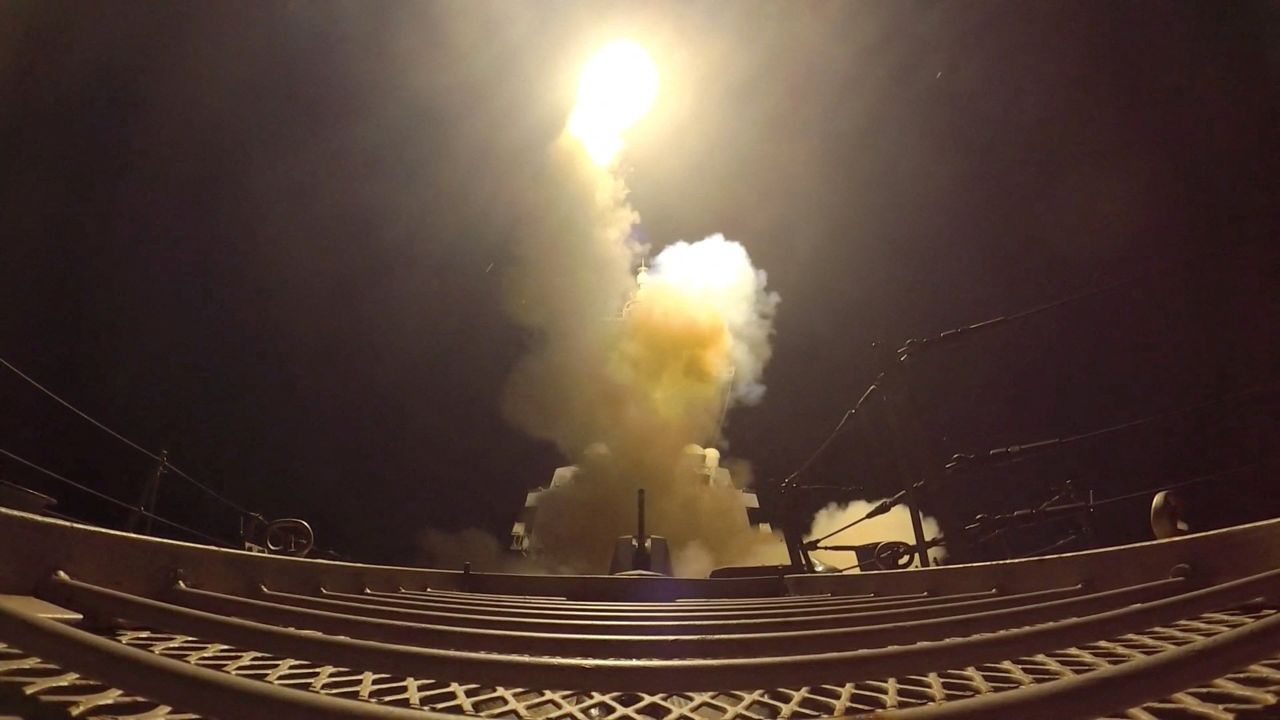
A projectile is fired during what the U.S. Central Command (CENTCOM) said were strikes on Iran, in this screen grab taken from a handout video released on Sunday.
It’s been a volatile three days in the Middle East as a fragile ceasefire between the US and Iran lies in tatters, the US says it will reimpose a naval blockade on Iranian ports and Washington’s regional allies are fending off Iranian drone and missile attacks
What’s happened since the latest strikes began:
As mediators race to revive diplomacy, Oman drafts a tentative proposal to manage traffic in the Strait of Hormuz through two separately controlled routes, according to a source
Hours later, Iran’s Islamic Revolutionary Guard Corps (IRGC) say they fired a warning shot at a vessel trying to cross the Strait of Hormuz
The US military launches its third round of strikes in a week, saying the IRGC “blatantly attacked” a container ship transiting the strait. US Central Command (CENTCOM) says it hit 140 Iranian military targets
The IRGC says it launched strikes on US military targets across the Gulf, and authorities in Gulf nations report defending against attacks
Indian authorities say one of its nationals is missing after an attack on a commercial vessel on the Strait of Hormuz
The US and Iran are at odds over the status of the waterway. US President Donald Trump and CENTCOM insist the waterway is open, while Iran’s strait authority says the passage of vessels is “not possible.”
The US military launches another round of strikes and says it hit dozens of Iranian military targets. Iran reports multiple explosions in the south of the country, including at a water pumping station where one person was killed
Iran says it conducted a new wave of missile and drone attacks toward US bases in the region, including those in Kuwait and Bahrain
The US launches a third night of strikes across a broad swath of Iran after Trump warned “we’re going to hit them very hard.” Iranian media reports explosions in the port city of Bandar Abbas and the islandsof Kish, Qeshm and Abu Musa
The US military says the US naval blockade of vessels going to and from Iranian ports will resume at 4 p.m. ET on Tuesday. Trump also declares a levy of 20% on cargo
Iranian missiles hit two UAE tankers in the Strait of Hormuz, killing one crew member, the UAE Defense Ministry said. Iran launches multiple waves of strikes toward Bahrain
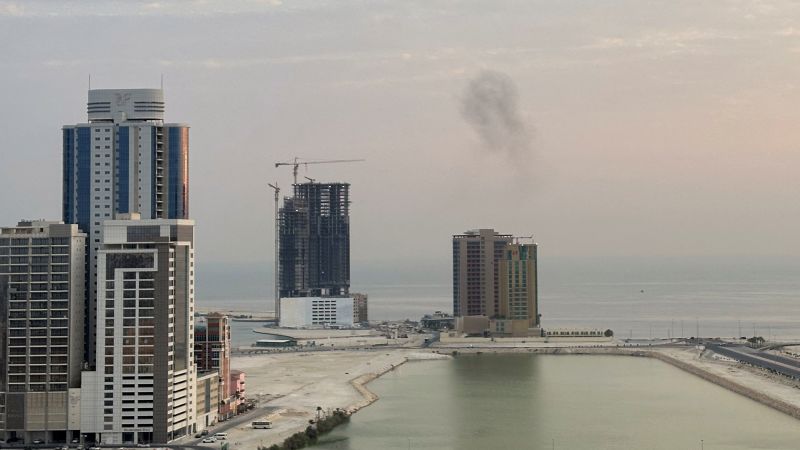
Reuters footage showed a plume of smoke rising from behind a building in Bahrain’s capital Manama on Tuesday morning local time, after Iran said it launched multiple waves of strikes toward the Gulf nation
Bahrain’s interior ministrysaid sirens had been activated multiple times and urged residents to remain calm and head to safety
Iran’s Islamic Revolutionary Guard Corps claimed to have destroyed several weapons-support warehouses, a satellite communications center, and a US forces building at Bahrain’s Juffair base in a missile and drone attack
Iran has regularly claimed to have destroyed facilities on US bases throughout the war but often those claims are not backed by evidence
Video geolocated by CNN shows flames and smoke billowing near a port facility in Iran’s Kish Island on 14 July 2026.
Video shows the aftermath of a strike at a port on Kish Island, off Iran’s southern coast in the Persian Gulf, early Tuesday morning local time
The video, geolocated by CNN, shows flames and smoke rising near the port facility
The strikes mark the third consecutive night the US has attacked Iran. The US military said it struck targets across a huge swath of the country, including Bushehr, Chabahar, Jask, Konarak, Abu Musa, and Bandar Abbas. Bushehr and Chabahar are around 620 miles (1,000 kilometers) apart
Separate video from a resident in southeast Iran shows the aftermath of US strikes on what he said was a gas station
The video was geolocated by CNN to Saravan County, in Sistan and Baluchestan province, near the border with Pakistan
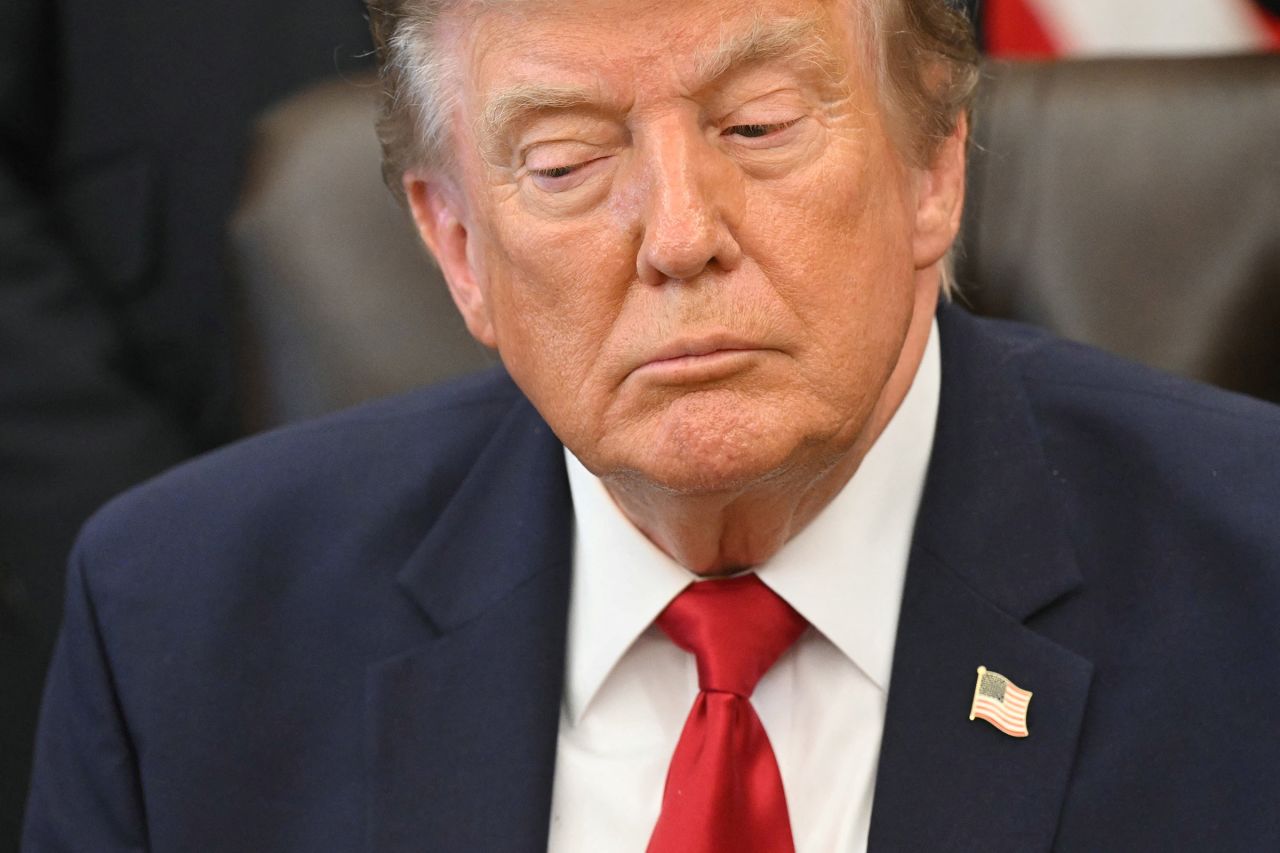
President Donald Trump in the Oval Office of the White House on July 13, 2026.
Iran seems to be playing Donald Trump at his own game
The president complained Monday that the Islamic Republic can’t be trusted to honor an agreement, rebuking its rulers for one of his own signature moves
“It was a done deal, and then they broke it. They always break it,” he told Fox News of the memorandum of understanding that briefly paused the war
Trump did not seem to appreciate the irony of his critique, given his habit of walking out on multiple international agreements, including the Paris Climate Accord (twice). Some critics would trace America’s current predicament to Trump’s first-term decision to scrap the Obama-era deal capping Iran’s nuclear program
Later in the day, a frustrated Trump vowed to impose his own toll on ships transiting the Strait of Hormuz. Iran — in an offer laced with sarcasm — jumped in with a better price than the author of “Art of the Deal.”
Trump is finding out that Iran drives a hard bargain and has its own interpretation of what was in the memo. And he’s yet to clearly explain to Americans why he reignited a war that he repeatedly said he’d already won
Read Stephen Collinson’s full analysis on whyTrump can’t change the reality of the war
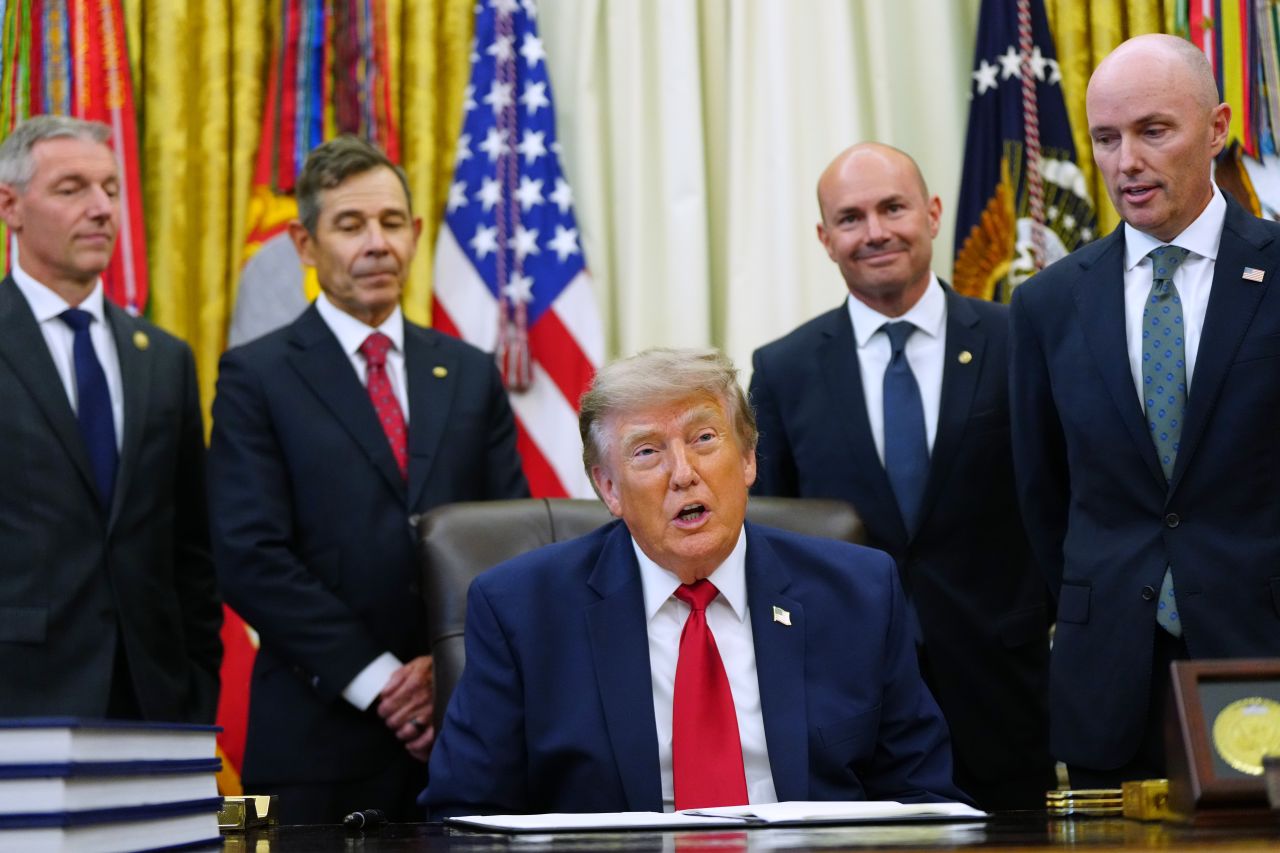
President Donald Trump speaks at the Oval Office of the White House, on Monday.
US President Donald Trump said Monday that American forces were knocking out Iran’s offensive capability with hundreds of strikes launched on the country in recent days
But Iran continues to strike at US and allied facilities around the Persian Gulf, and it’s still hitting tankers around the Strait of Hormuz –– again bringing traffic through the critical waterway to a crawl
So just how much offensive firepower still remains in Iran’s arsenal? It could be thousands of drones and missiles, according to previous CNN reporting
And Trump said on Monday that 92% of Iran’s drone manufacturing capability and 89% of its missile manufacturing capability had been “knocked out.”
But there have been no exact numbers of how many missiles and drones Iran had when the war began or how many were used or destroyed
In early April – just before the ceasefire began – Tehran still had thousands of drones and roughly half of its missile launchers intact, CNN reported, citing
By late May, Iran had restarted drone production and was repairing missile sites and replacing launchers destroyed earlier in the war, sources told CNN.
Analysts note that Iran doesn’t need a huge inventory of drones and missiles to destabilize the region and keep the Strait of Hormuz effectively shut down, cutting off around 20% of the world’s pre-war oil supplies
That risk was highlighted Monday when two United Arab Emirates tankers were hit by Iranian missiles in the southern part of the Strait of Hormuz, according to the UAE Defense Ministry
Fighting between the United States and Iran is heating up again as both sides launch attacks, plunging the region back into active hostilities and sending global oil prices surging
Despite the ceasefire effectively collapsing, US President Trump denied that the latest attacks represent a new, prolonged stage in the war — but declined to say how long it would last. Here’s the latest:
- US attacks:The US carried out a third consecutive night of strikes against Iran, hitting locations across the country. Much of the recent campaign has targeted Iran’s coastal military infrastructure and vessels, aiming to limit Tehran’s ability to attack ships in the Strait of Hormuz.
- Blockade is back:The US said it will resume its naval blockade of ships going to and from Iranian ports at 4 p.m. ET on Tuesday. Trump suggested that the US would offer protection in the strait for a fee of 20% of the cargo shipped. Brent crude, the global oil benchmark, soared 9.59% after his announcement.
- It’s official:Trump formally notified Congress that “limited” military action has resumed in Iran, describing attacks as “defensive strikes” against military infrastructure. Ground forces were not involved, he said.
- Ships struck:Tehran said it struck and disabled two “rogue supertankers,” claiming the vessles had ignored warnings from Iranian authorities in the Strait of Hormuz. This comes after the United Arab Emirates said Iranian missiles hit two of its tankers, killing one crew member.
- Iran strikes region: Tehran launched multiple waves of strikes toward US regional allies, claiming to have “destroyed” targets at a base in Bahrain. It also claimed it targeted US military facilities in Kuwait with drones, and fired cruise missiles at a US naval vessel on Monday. Jordan said its air defenses intercepted and shot down four Iranian missiles on Tuesday morning local time, state media reported. Iran has regularly claimed to have destroyed facilities on US bases throughout the war, but those claims are often not backed by evidence.
- What Trump has said:In an interview with conservative radio host Hugh Hewitt on Monday, Trump said Iran hadn’t honored the memorandum of understanding that Washington and Tehran signed. He also told reporters that the US would ultimately control the Strait of Hormuz and insisted the war is moving “very fast.” But he offered few details on how he planned to ultimately end the war, and acknowledged that there was little expectation a deal would materialize soon.
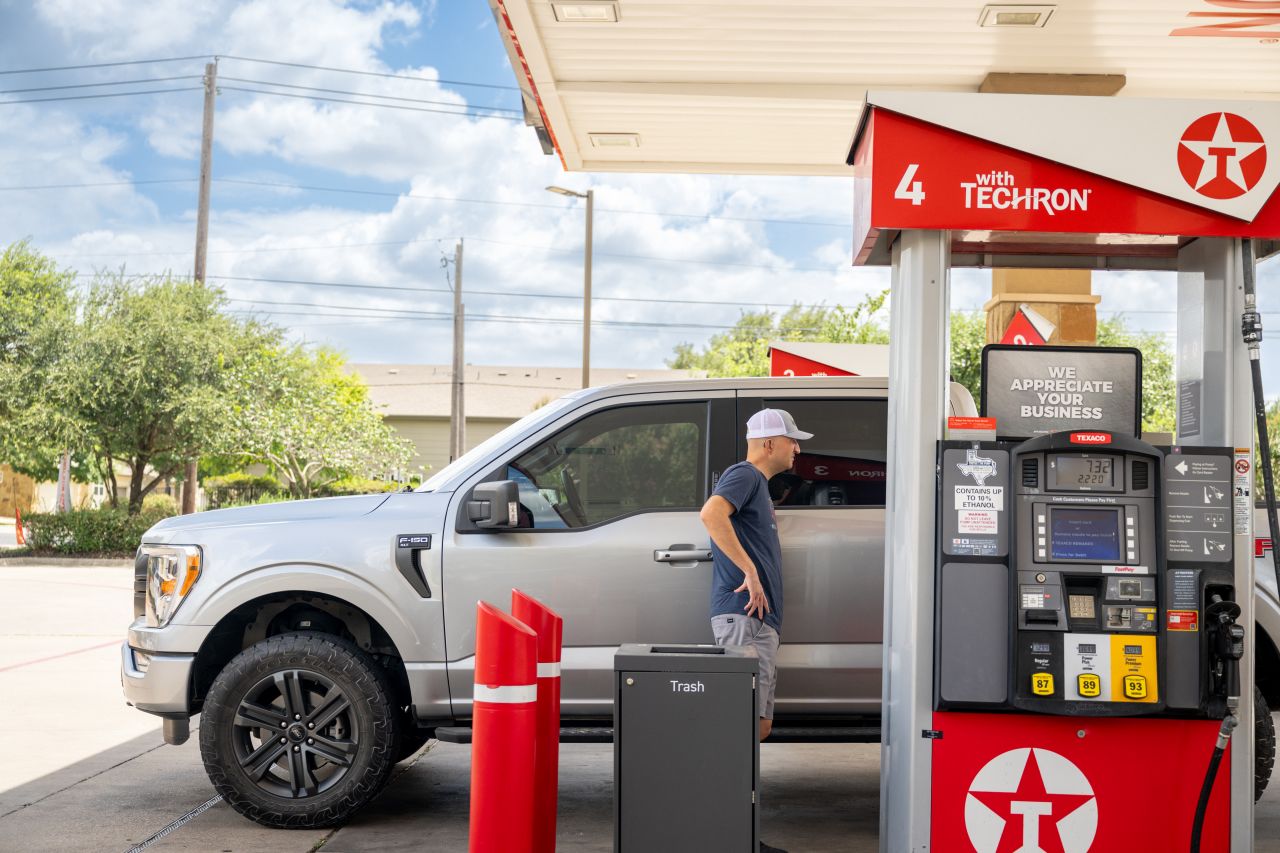
A person pumps gas at a Texaco gas station in Austin, Texas on July 10.
Global oil prices rose to a one-month high on Tuesday, as the US launched repeated strikes against Iran and as traffic through the the Strait of Hormuz ground to a near halt
Brent crude, the global benchmark, gained 1.5% to $84.56 a barrel as of 12:15 p.m. local Hong Kong time, trading at its highest level since June 12. US oil futures rose 1.9% to $79.51 a barrel, adding to a 9% jump on Monday
Just five commercial vessels, none transporting crude, could be tracked transiting the strait of Hormuz on Monday local time, according to data from Kpler, which tracks shipping movements. That’s appears to be that lowest level of activity since May 30 –– before the US signed the agreement with Iran to work towards an end to the war. The early data, however, does not yet reflect vessels that may have transited while their transponders were switched off
One-fifth of the world’s oil supply transits through the Strait of Hormuz, and its effective closure during the war in the Middle East has sent prices soaring on expectations of an unprecedented global shortage
However, buyers are finding workarounds to the supply squeeze, limiting further surges in price for now. Major crude consumers have leaned on emergency stockpiles while buying more energy from the US, the world’s largest producer of oil and natural gas
China is exporting record levels of clean energy technology as countries look to reduce reliance on fossil fuels following the conflict in Iran. China’s crude oil imports for June were down 41.3% from a year earlier, according to customs data released on Tuesday
Gulf nations are looking at rapidly building out pipelines to avoid the Strait of Hormuz, which Goldman Sachs analysts predict could displace about half of the Gulf’s pre-war exports by the end of 2027
CNN’s Sandi Sidhu contributed reporting
US President Donald Trump provided some insight Monday night into the latest US military strikes against Iran
Here are the key things you need to know:
- In interview with conservative radio host Hugh Hewitt, Trump said, “We’re going to hit them very hard tonight, and we’re going to hit them hard tomorrow.”
- When talking about the memorandum of understanding that Washington and Tehran signed, he said Iran “didn’t honor the test.” While Trump on Monday said the MoU “didn’t mean much,” he has previously described it as “an agreement with Iran that achieves everything we set out to accomplish … ending the current conflict, reopening the Strait of Hormuz, and preventing Iran from obtaining a nuclear weapon.”
- He told reporters that the US would ultimately control the Strait of Hormuz and insisted the war with Iran is moving “very fast” – even as it has blown past prior deadlines he predicted for its end. Characterizing it a “military skirmish,” he denied that the latest US bombing campaign marked a new, prolonged stage in the fight even as he declined to say how long it would last.
- The US should be reimbursed by “the countries that we’re helping” in the conflict with Iran, Trump said, naming several allies in the region, including Israel, Saudi Arabia, Qatar and the United Arab Emirates.
