Markets live: Domino’s Pizza loses federal court case, ASX rises as oil prices hit five-week high
By business reporters David Chau and Gareth Hutchens
Topic:Financial Markets
Posted Wed 22 Jul 2026 at 7:54am
Wed 22 Jul 2026 at 7:54am
, updated Wed 22 Jul 2026 at 4:08pm
Wed 22 Jul 2026 at 4:08pm
Domino’s Pizza shares fell after it lost a wage underpayment case in the federal court. Energy retailer Origin says there may have been unauthorised access to customers’ personal data
See how the trading day unfolds on our blog
Disclaimer: This blog is not intended as investment advice
Pinned
Wed 22 Jul 2026 at 4:48pm
Wed 22 Jul 2026 at 4:48pm
Market snapshot
By Gareth Hutchens
- ASX 200: +0.34% at 8,823 points (close)
- Australian dollar: -0.04% at 69.94 US cents
- Wall Street: Dow Jones (+0.7%), S&P 500 (+0.9%), Nasdaq Composite (+1.3%)
- Europe: FTSE (+0.6%), Stoxx 600 (+0.6%)
- Spot gold: +1.27% to $US4,128/ounce
- Oil (Brent futures): +2.02% to $US92.87/barrel
- Oil (WTI futures): +1.99% to $US86.02/barrel
- Iron ore: -0.43% at $US98.1/tonne
- Bitcoin: -0.78% at $US65,867
Prices current at around 4:48pm AEST
Live updates on the major ASX indices:
Collapse all posts
New: Filters
Choose what information you see below by using filters
Filter Posts
All
40
Key Events
23
Energy
4
Shares
2
Market snapshot
2
Company news
1
Key Event
Wed 22 Jul 2026 at 5:10pm
Wed 22 Jul 2026 at 5:10pm
Most Australians don’t understand how interest rates affect inflation, RBA survey finds
By Gareth Hutchens
The ABC’s business correspondent David Taylor and business reporter Stephanie Chalmers have written about the RBA’s recent survey of Australians’ understanding of monetary policy and inflation
Despite the concern about inflation, respondents largely did not understand how the RBA was trying to bring it down
“Only 25 per cent of respondents assessed correctly that higher interest rates would ultimately lead to lower inflation, while more than half indicated that higher interest rates would lead to higher inflation,” the report said
“This finding shows that most respondents expect interest rates to have the opposite effect on inflation to central bank economists.”
The RBA report notes that the public’s misunderstanding on that point has an adverse impact on public trust in the central bank
Wed 22 Jul 2026 at 4:58pm
Wed 22 Jul 2026 at 4:58pm
Best and worst performers
By Gareth Hutchens
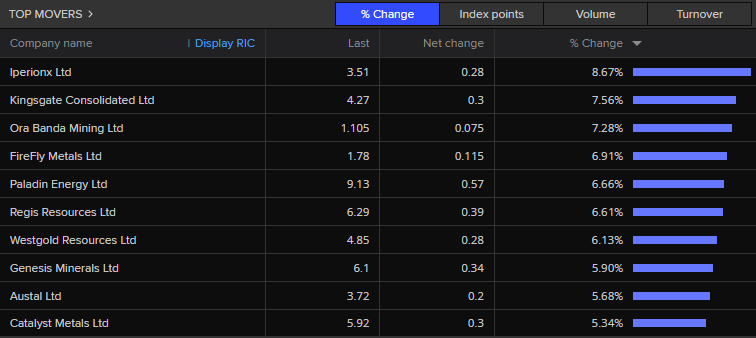
Among the top performers on the ASX200 today were Iperionx (+8.67%), Kingsgate Consolidated(+7.56%), and Ora Banda Mining(+7.28%)
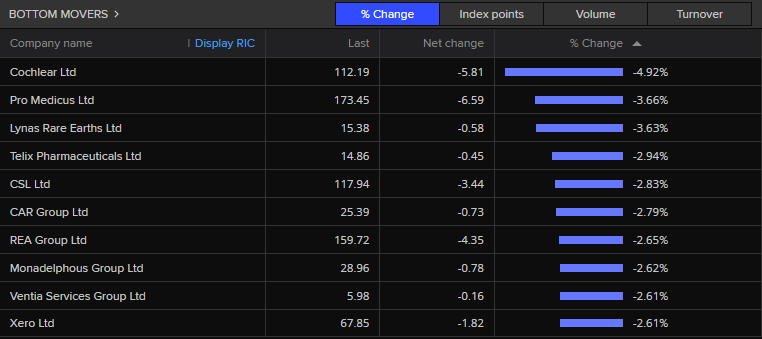
Among the worst performers were Cochlear(-4.92%), Pro Medicus(-3.66%), and Lynas Rare Earths (-3.63%)
Wed 22 Jul 2026 at 4:34pm
Wed 22 Jul 2026 at 4:34pm
Origin Energy investigating ‘potential’ customer data breach
By Gareth Hutchens
The story that Origin Energy is investigating a security breach that “may have” affected customer data is still developing
Origin has not yet publicly confirmed whether or not a data leak has taken place and, if it has, whether it was due to a hack of its systems, how many customers might be affected, or exactly what data might have been stolen
The ABC’s Tess Flemming and Emilia Terzon are adding to the story at is unfolds here:
Wed 22 Jul 2026 at 4:21pm
Wed 22 Jul 2026 at 4:21pm
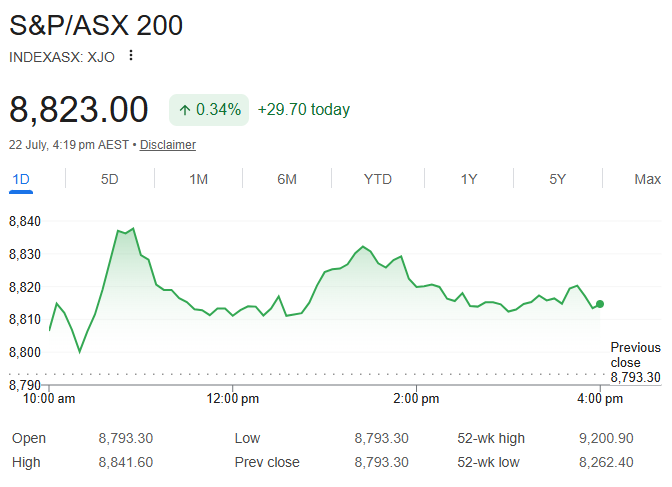
ASX closes 0.34 pc higher
By Gareth Hutchens
Trading on the stock market has closed for the day and the ASX200 index has gained 29.7 points (+0.34%) to finish on 8,823 points
Wed 22 Jul 2026 at 3:51pm
Wed 22 Jul 2026 at 3:51pm
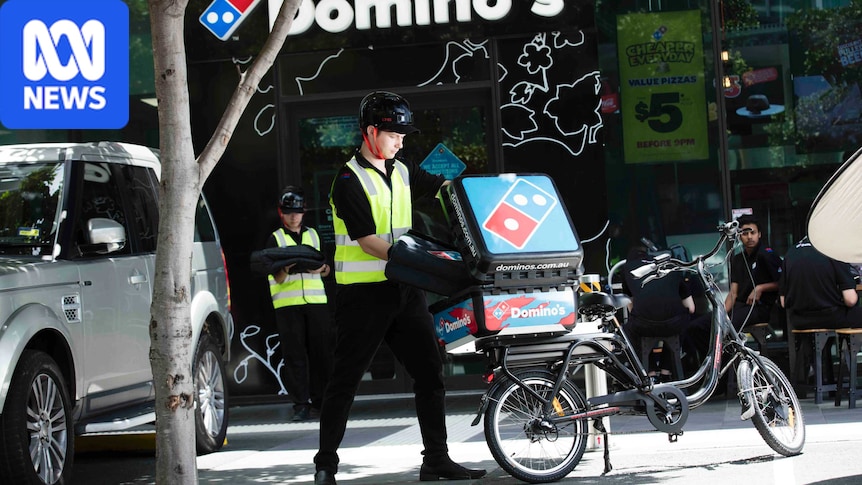
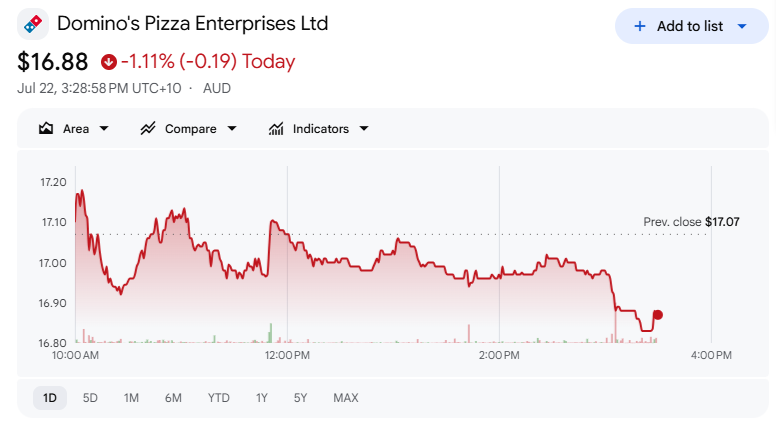
Domino’s Pizza down more than 1pc
By Gareth Hutchens
Domino’s Pizza is down more than 1.1 per cent today (down 19 cents) to $16.87
Wed 22 Jul 2026 at 3:37pm
Wed 22 Jul 2026 at 3:37pm
Cybersecurity experts weigh in on ‘potential’ Origin breach
By Emilia Terzon
I’ve just been calling around cybersecurity experts that previously helped us cover data breaches on major companies like Optus, Qantas and Medibank
Today, the scrutiny is on Origin, as the gas and electricity retailer investigates a “potential” cybersecurity incident
Professor of Cyber Security at UNSW, Richard Buckland, says a breach on a power company would be especially worrying because they manage critical infrastructure
In fact, there is a specific law about how 11 “critical” industries, including energy, respond to cybersecurity incidents
“How important is Origin taking security?” Professor Buckland asks, adding that a successful cybersecurity attack on a energy company could be a “canary in the coalmine”
“If an energy company is hacked they could cut off people’s power in winter or black things out,” he warns
UNSW’s resident cybersecurity expert Professor Sanjay Jha notes there is very little information currently on what might have happened with Origin
It has came to light after The Australian newspaper reported a hacker sent it 50 Origin customer records. We haven’t verified these claims
Professor Jha adds:
“There is no way to verify if the data put to the media is authentic,” he says
“Organised groups who do this kind of thing do resort to this tactic like extortion first and then release [data] on dark web
“They’re putting on more pressure by either going to media or public release. These days you have social media as well.”
So far Origin has put out a short six-sentence statement to the ASX confirming that they are investigating the claims “as a matter of urgency” and have notified the relevant government authorities
The company has not yet publicly confirmed whether or not a data leak has taken place and, if it has, whether it was due to a hack of its systems, how many customers might be affected, or exactly what data might have been stolen
Are you an Origin customer? Do you work in their cyber security teams? Confidentially email me
Key Event
Wed 22 Jul 2026 at 3:22pm
Wed 22 Jul 2026 at 3:22pm
Landmark victory for low-paid Domino’s workers in underpayment class action
By Gareth Hutchens
The Federal Court’s Justice Murphy has delivered an important judgement today, regarding Domino’s Pizza
Phi Finney McDonald (a litigation law firm) has issued this press release in response, summarising what’s happened:
Thousands of low-paid Domino’s franchisee workers could be entitled to significant compensation following a landmark victory against Domino’s Pizza Enterprises
The Federal Court has found that Domino’s pizza misled franchisees by directing them to underpay thousands of drivers and in-store staff under outdated employment agreements over five years that excluded key entitlements
In 2019, Phi Finney McDonald launched the class action against Domino’s on behalf of lead applicant Riley Gall, a former Domino’s delivery driver, for underpayment of wages under the Australian Consumer Law for loss caused by misleading and deceptive conduct
The class action covers delivery drivers and in-store workers employed by Domino’s Australian franchisees between 2013 and 2018
The Court found that Domino’s instructed its Australian franchisees to pay delivery drivers and in-store workers under enterprise bargaining agreements when some employees were covered under the Fast Food Industry Award that has better terms and conditions
These workers should have received benefits under the award, including a 25% loading for casual workers, additional penalty rates for working after hours, on weekends and public holidays and minimum three-hour shifts
A forensic investigation conducted by the Retail and Fast Food Workers’ Union’s (RAFFWU) uncovered the underpayments.
His Honour Justice Bernard Murphy found the “Award rather than the Agreements applied to the employment of the applicant and a substantial cohort of Delivery Drivers and In-Store Workers employed by franchise operators during the relevant period”
Consequently, the conduct of Domino’s in making the representations was “objectively wrong”, and “was therefore misleading or deceptive conduct or conduct which was likely to mislead or deceive, in contravention of s 18 of the ACL,” he said.
He did not accept Domino’s contention that claims for award entitlements could only be brought through the Fair Work Act. “It is likely that similarly situated group members employed in award stores also suffered causally connected loss, but the scope of the initial trial only allows determination of the applicant’s loss,” he said
A further hearing will be held to decide group member claims
Key Event
Wed 22 Jul 2026 at 2:48pm
Wed 22 Jul 2026 at 2:48pm
Clean Energy Regulator cracking down on problematic solar installation businesses
By Daniel Mercer
Australia’s green energy watchdog suspended almost two dozen companies from the federal government’ssolar subsidy scheme over claims they were unfit to hold a licence
In an update released this morning, the Clean Energy Regulator said it had struck21 firms from the small-scale renewable energy scheme in the quarter between April and June this year
The suspensions came after the regulator found the installers had failed “to meet fit and proper person requirements”
Under the requirements, companies must show they have complied with the law “and that they have the integrity, capability and competence to effectively fulfil their role as a provider” of the solar scheme
One company singled out by the CER wasAsun Solar Pty Ltd, which “was suspended for failing to meet these obligations”
According to the watchdog, another firm was hit forfalsely claiming that systems it had installed were complete and capable of generating electricity “when they in fact weren’t”
Carl Binning, the acting chair of the CER, said false statements and incomplete work were unacceptable
Mr Binning said the regulator was now using artificial intelligence tools to help its oversight of the industry
“False statements and incomplete work will not be tolerated,” Mr Binning said
“We’re warning installers that we will fail their applications and send them back to site if things aren’t done properly the first time.”
Under the scheme, installers must be accredited by the regulator to be eligible for the taxpayer incentives that help slash the upfront cost of the technology for consumers
More than 4 millionAustralian homes and small businesses have solar installations on their roofs
Key Event
Wed 22 Jul 2026 at 2:26pm
Wed 22 Jul 2026 at 2:26pm
Podcast: What Australians get wrong about interest rates
By Gareth Hutchens
Today’s episode of ABC Business Daily is live
The latest results of an RBA survey are out today, capturing how Australians experience and understand the economy
While public awareness for the RBA is high, survey results seem to suggest that people don’t have a great handle on how inflation is affected by interest rates. So, what problem does this present for the RBA, whose one blunt tool is to move rates?
And a new set of draft recommendations from the ASX’s Advisory Group on Corporate Governance raises the question: can diversity targets influence a company’s economic outcome?
Daniel Zifferand ABC Business Reporter Steph Chalmers break it all down:
Wed 22 Jul 2026 at 2:22pm
Wed 22 Jul 2026 at 2:22pm
Market snapshot
By Gareth Hutchens
- ASX 200: +0.25% at 8,815 points
- Australian dollar: +0.01% at 69.98 US cents
- Wall Street: Dow Jones (+0.7%), S&P 500 (+0.9%), Nasdaq Composite (+1.3%)
- Europe: FTSE (+0.6%), Stoxx 600 (+0.6%)
- Spot gold: +1.27% to $US4,128/ounce
- Oil (Brent futures): +1.24% to $US92.14/barrel
- Oil (WTI futures): +1.13% to $US85.29/barrel
- Iron ore: -0.48% at $US98.05/tonne
- Bitcoin: -0.07% at $US66,336
Prices current at around 2:20pm AEST
Live updates on the major ASX indices:
Wed 22 Jul 2026 at 2:18pm
Wed 22 Jul 2026 at 2:18pm
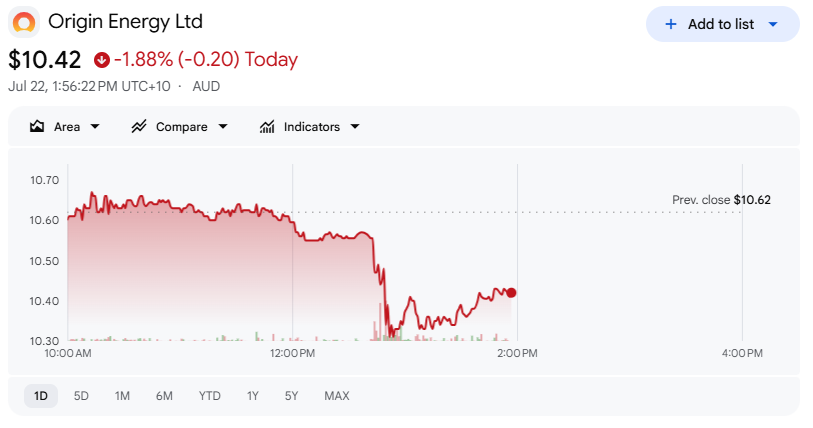
Origin shares down 1.88pc
By Gareth Hutchens
Origin Energy shares are staging a very slow recovery after that initial drop, but they’re still down 1.88% at this point
Wed 22 Jul 2026 at 2:09pm
Wed 22 Jul 2026 at 2:09pm
A reasonable misunderstanding
By Gareth Hutchens
I think the results of that RBA survey show the difference between where the RBA work, and where everyday people work. The RBA see their acts as having an impact on this calculated inflation number, that includes and excludes all sorts of things, but back in the real world, it has a direct and immediate impact on people’s day to day expenses: their cost of living is rising as a result of the RBA’s decisions, that’s inflation to them. They need to do more to show how their rate rises have changed their measure of inflation. If they can’t do that, they can’t link up the direct chain between reduced economic demand and lower prices, people will never see their acts as those of reducing inflation, because in reality, it’s not.
– m
Thanks for your comment, M
Re: this statement of yours, “[The RBA] has a direct and immediate impact on people’s day-to-day expenses: their cost of living is rising as a result of the RBA’s decisions, that’s inflation to them.”
I tend to agree with that. If your household has a mortgage and the RBA lifts interest rates, your interest rate payments will go up pretty much immediately. That will have an immediate impact on your household’s ability to pay for things
How many people are making a distinction between “consumer price inflation” and “everything our household has to pay for this month”?
The RBA wants people to know that it will reduce inflation in the medium term by lifting interest rates, but in the short term, households may feel that their major household expenses are just increasing from the higher interest rates
So, the RBA is essentially asking people to “look through” their rising household expenses in the short term so that they can appreciate lower and more stable prices in the medium term
It’s a big conceptual leap
Wed 22 Jul 2026 at 1:42pm
Wed 22 Jul 2026 at 1:42pm
KPMG ‘raking it in’ on multi-million-dollar contracts, Greens say
By Gareth Hutchens
The Australian Greens are drawing people’s attention to new biannual government data that records consulting contracts published on AusTender worth more than $2 million, which shows the multi-million-dollar value of government contracts held by KPMG
As of July 1, 2026, KPMGheld eight active large contractsworth $51.4 million between January 1, 2026, to June 30, 2026
It has contracts with Defence, Finance, Home Affairs, Services Australia, and other departments
On June 24, the Department of Finance announced an independent review of KPMG Australia in light of reports of the misuse of clients’ confidential information
The review will be completed by September 30, 2026 and will inform the Commonwealth as to whether KPMG Australia has breached the Supplier Code of Conduct
Greens finance and public service spokesperson senator Barbara Pocock says:
“The Department of Finance alone has three multi-million-dollar contracts worth over $25 million combined — the same department that is investigating KPMG for its unethical behaviour
“As scandal engulfs KPMG and it appoints long-term insiders to fill the shoes of the disgraced leadership, Australians want to know why KPMG is keeping multi-million-dollar government contracts and has not been removed from bidding panels
“Labor needs to stop feeding the beast and get on with the job of reforming a sector gone rogue
“The Big 4 have lost their social licence. Australians have had enough of the repeated scandals. It’s time to end the gravy train and properly regulate the Big 4.”
Wed 22 Jul 2026 at 1:21pm
Wed 22 Jul 2026 at 1:21pm
Are you an Origin Energy customer?
By Stephanie Chalmers
Are you an Origin Energy customer? Are you concerned about a potential data breach or have you noticed anything?
Let us know in the comments or email business correspondent David Taylor(taylor.david@abc.net.au)
Key Event
Wed 22 Jul 2026 at 1:16pm
Wed 22 Jul 2026 at 1:16pm
Reports hacker accessed Origin customer details
By Stephanie Chalmers
Originconfirmed to the ASX shortly before 1pm AEST that it is investigating a potential security incident, which may have affected customer data
It followsreports in The Australian that an alleged hacker had accessed customer details, after the publication received a sample of customer records
Origin Energy shares are down 2.5%
Key Event
Wed 22 Jul 2026 at 1:09pm
Wed 22 Jul 2026 at 1:09pm
Origin Energy shares fall on data breach probe
By Stephanie Chalmers
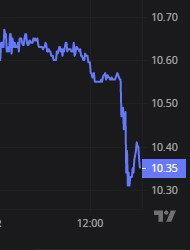
Shares in Origin Energy are down 2.5% after the company said it was investigating a potential breach of customer data
Looking at the share price chart, you can see the announcement to the ASX had an impact:
Key Event
Wed 22 Jul 2026 at 12:59pm
Wed 22 Jul 2026 at 12:59pm
Origin Energy investigating potential cyber incident
By Stephanie Chalmers
Energy retailer Origin Energy is investigating “a potential security incident”, which it says may involve unauthorised access to some customer data
In a statement to the ASX, Origin said it does not believe customers’ credit card or bank details were among the accessed information
More to come
Wed 22 Jul 2026 at 12:53pm
Wed 22 Jul 2026 at 12:53pm
Australians aware of RBA’s inflation target, less aware of full employment responsibility
By Gareth Hutchens
RBA survey continued
The RBA survey also found that an awareness of the RBA and its price stability mandate was high, but awareness of its other responsibilities weren’t as high
Most respondents showed an understanding of the RBA’s core monetary policy role, including that it sets the cash rate and aims to maintain price stability
More than half also correctly identified that the inflation target range is between 2–3 per cent using a multiple choice question
However, by contrast, awareness of the RBA’s full employment objective is much lower, with only about one-quarter of respondents identifying this responsibility
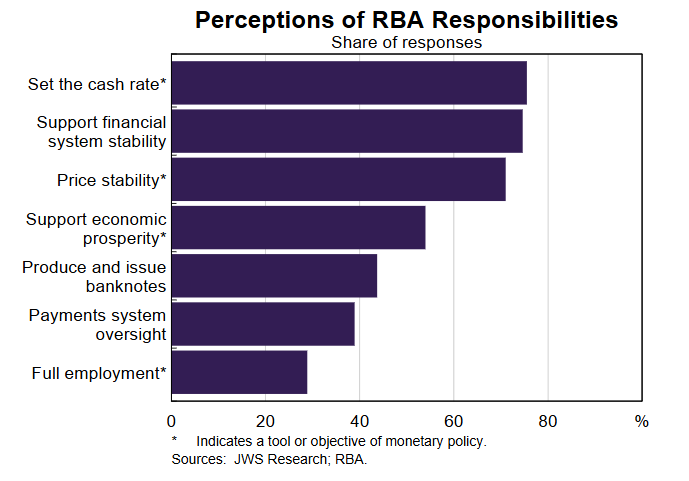
Is that result surprising?
Ask an Australian what the RBA’s inflation target is, and they’d have a reasonably good chance of saying something like 2.5%, or 3%, or somewhere between 2-3% (as the survey found)
But what does “full employment” mean, in this day and age?
The RBA would say it refers to the rate of unemployment at which inflation is sitting sustainably around 2.5%
How many Australians would be able to provide that answer off the top of their head?
“Full employment” has no hard target, like the inflation target. You can’t put a number on it. The media is always talking about the RBA missing its inflation target but it rarely (if ever) talks about the RBA missing or achieving its full employment target in those terms
So given its abstract nature, is it any wonder that Australians are less aware that full employment is one of the RBA’s responsibilities?
Wed 22 Jul 2026 at 12:20pm
Wed 22 Jul 2026 at 12:20pm
RBA survey finds majority of respondents think higher interest rates lead to higher inflation
By Gareth Hutchens
RBA survey continued
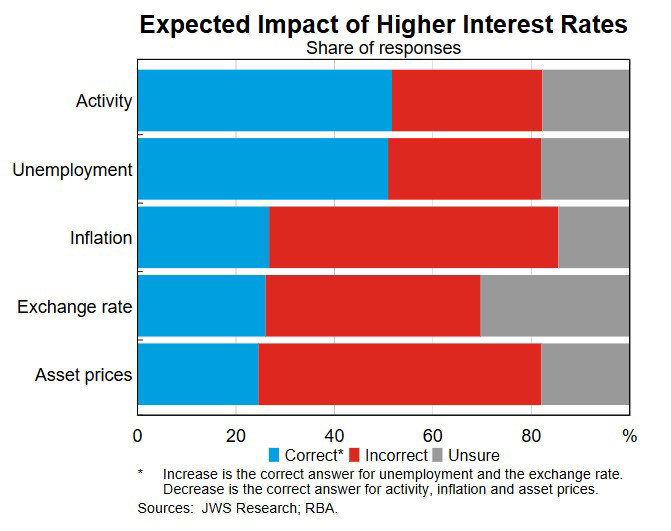
The RBA’s survey of Australians also found that the public generally understands how interest rates affect economic activity, but the effect on inflationis less well understood
Part of the survey’s economic literacy component assessed respondents’ knowledge of the RBA and how monetary policy works. Respondents were asked how they thought higher interest rates influenced key economic variables
About 50 per centof respondents correctly assessedthat higher interest rates wouldbe expected tosloweconomic activity and employment, compared with about 30 per cent of respondents who incorrectly judged that higher interest rates wouldincreaseeconomic activity and employment (the remainder were unsure)
These findings are in line with recent international experimental evidence that has also identified relatively high levels of public understanding of how interest rates affect economic activity and employment
When it comes to how interest rates affect inflation, the survey found a large amount of confusion
The survey identified a large gap in the Australian community’s understanding of how interest rates affect inflation
“Only 25 per cent of respondents assessed correctly that higher interest rates would ultimately lead to lower inflation, while more than halfindicated that higher interest rateswould lead to higher inflation
“This finding shows that most respondents expect interest rates to have the opposite effect on inflation to central bank economists
“This is not unexpected given that, in practice, interest rates affect inflation through multiple channels.”
The RBA says the finding that households expect higher interest rates to increase, rather than reduce, future inflation has important implications for how monetary policy decisions are understood by the Australian community
It says it could contribute to community frustration with monetary policy decisions if the decisions are interpreted as adding to inflation and, in turn, this could weaken confidence and trust in the RBA
It could also make it more difficult for households to interpret economic developments and make informed financial decisions